Хочете будувати кар’єру в Data Science та AI? Vodafone Big Data Lab відкриває новий набір —>
Ігор Вишневський Startup
16 January 2025, 09:00
2025-01-16
“One account reposted Russia Today content 86 times per second.” How LetsData, a startup that makes a business on fighting propaganda and fake news, works
On January 15, Ukrainian startup LetsData, which uses AI tools to detect potential information attacks, announced that it had raised a funding round of about $1.6 million from a number of institutional venture funds and angel investors. According to co-founder Andriy Kusy, the funds will be directed both to technology development and to sales and marketing, in order to try to maintain the current growth rate of 300% and into 2025.
On January 15, Ukrainian startup LetsData, which uses AI tools to detect potential information attacks, announced that it had raised a funding round of about $1.6 million from a number of institutional venture funds and angel investors. According to co-founder Andriy Kusy, the funds will be directed both to technology development and to sales and marketing, in order to try to maintain the current growth rate of 300% and into 2025.
The startup was founded in June 2022 by two co-founders, Andriy Kusy and Ksenia Ilyuk. It offers its technical solution to both government agencies and various institutions, as well as consulting companies and business clients. In the latest Forbes Ukraine ranking, LetsData was among the top 25 most promising Ukrainian startups that may receive unicorn status by 2030.
The day before, Andriy Kusyy spoke with dev.ua about the product, market scaling, and cases of information threats that the startup’s clients have had to face.
From whom the funds were raised
According to Andriy Kusy, the funds were raised simultaneously from a number of different types of investors, both institutional and angel. In particular, this is the institutional venture fund SMOK Ventures, which is actively working in Ukraine and Poland and focuses primarily on companies entering the American market. «Sasha Yatsenko and Boris Musielak are very cool partners in this fund,» says the startuper.
«Russian interference in TikTok forced a Romanian court to annul the recent presidential election. Hybrid warfare, social media manipulation, and information operations are the new reality. That’s why we invested in LetsData, a Ukrainian team based in New York that uncovers information operations on social media that can harm corporations, governments, and democracy itself,» he noted.
Returning to other investors, LetsData raised another portion of its funds from Waira, which is essentially the investment department of Telefonica, a large telecom corporation operating in Europe and Latin America.
«They have their own investment department. Why are they interested in joining and investing in companies like ours? Because they also offer their clients a wide range of cybersecurity services and related solutions, so they are very interested in our technology in the cyber market,» Andriy Kusy explained.
Another investor is 1991 Ventures, which is based in London but has Ukrainian founders Denys and Viktor Gursky and focuses on Eastern Europe and Ukraine.
«LetsData is a tool that helps companies and governments detect information threats at an early stage: from information manipulation to attacks by cybercriminals, hostile states or competitors. Their technology is already trusted by FCDO (UK Foreign Office — ed.), British embassies, the armed forces of NATO member countries and corporations in the US, UK and Europe that require reliable information operations management,» the 1991 Accelerator page on LinkedIn states .
Also among the company’s investors are Google for Startups Ukraine Support Fund and Startup Wise Guys.
«And the last institutional investor is Tilia Impact Ventures: an impact fund funded mainly by the European Union that invests in startups that have social impact. It is based in the Czech Republic. That is, a kind of international group of venture funds,» Andriy Kusyy concluded in a conversation with dev.ua.
Also, according to the startup’s co-founder, a group of angel investors, mainly from North America, joined the round. «We have advisors, we met them through friends as part of social activities. They were very interested in the topic of our startup, and also spread this opportunity to a certain group of their acquaintances and partners. Thus, we have a group of six angel investors. There is also one investor from Poland. All of them are either entrepreneurs or at least well-versed in the cybersecurity market,» Andriy Kusy explained.
According to him, the key goal of this round of investment is to accelerate the pace of growth.
«For the last year and a half or two, we have been growing due to revenue and the profit we make. But now we have an understanding of the market and a sufficient level of product readiness to make rapid investments in technology, and later also in sales, marketing and other functions. We want to speed up the processes and at least get the same 300% growth that we had this year. But the bigger you get, the harder it is for you to keep these high numbers,» concluded the LetsData co-founder.
Currently, judging by the company’s official website, LetsData is looking for an ML Engineer, a PR person, and a Talent Community specialist to join the team.
For whom LetsData was launched
Andriy Kusy explains that the specifics of the startup’s work are such that clients do not seek to advertise themselves and make public what information attacks they have encountered and what it cost them.
«This information is not usually disclosed. And the clients themselves do not want it, and in general it is not considered good practice in the industry,» the startuper notes.
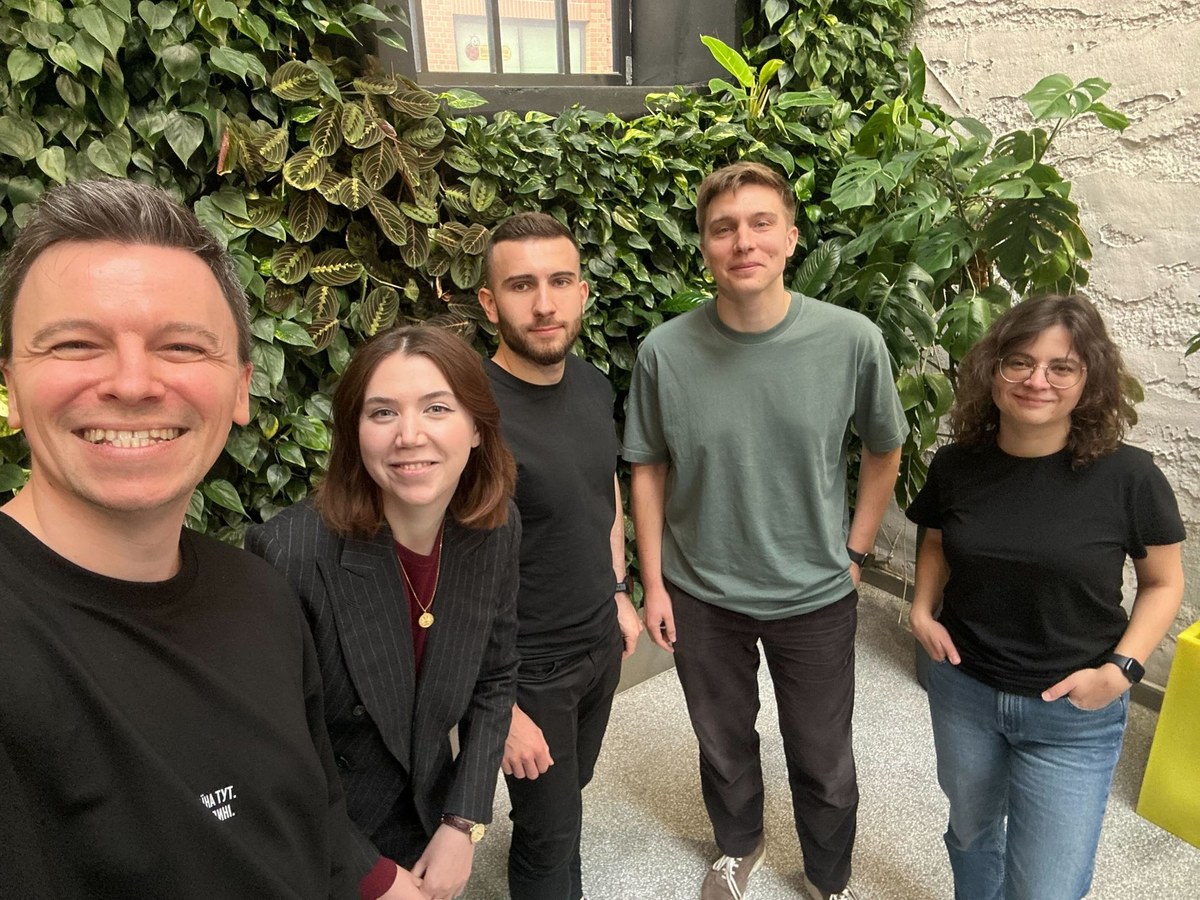
Startup co-founders Andriy Kusy and Ksenia Ilyuk
According to Kusii, among government clients there have been many cases when information attacks posed a risk of disrupting high-level events, but the tool helped to detect them in advance and develop an appropriate countermeasure plan. «Such cases include very large summits with the participation of dozens of presidents of countries and foreign ministers,» explained the IT specialist, who, according to his LinkedIn data, had worked as an Engineering Manager at the first unicorn with Ukrainian roots, Grammarly, for several years before that.
Andriy Kusiy also provided information about a public case of LetsData’s successful work, thanks to which it was possible to expose a complex network of profiles and groups on Facebook. The network massively distributed content from the Russian state-run TV channel Russia Today, which is under international sanctions. «This network worked to artificially increase RT’s reach, bypassing restrictions and manipulating online narratives. The scale of the operation is impressive — one account on the network reposted RT content 86 times per second,» LetsData noted. The startup’s founders estimated that such hostile information activity could produce 7.4 million posts per day, filling Facebook with hostile propaganda and massively distorting public opinion.
Currently, the startup has a limited number of clients — a little over 10. But among them, as Andriy says, are the defense ministry of one of the NATO countries and the Ministry of Foreign Affairs of one of the NATO countries.
How it works and when the «red alert» is triggered
«We provide what is called threat intelligence in English,» explains Andriy Kusy. This refers to coordinated behavior in social networks and the media aimed at spreading certain narratives both by real people and through technical means.
«Relatively speaking, if our system found that someone was posting a very toxic hate speech video that accused your company of some environmental disaster, and some set of bots were constantly reposting and commenting on it at a rate of 60 reposts per second, then this insight would be validated by our analysts and sent to relevant people in your company,» Kusii explains.
Startup co-founders Andriy Kusy and Ksenia Ilyuk
According to him, the LetsData tool is similar in its operating model to cybersecurity systems that sell threat intelligence solutions and warn about potential threats, because it is almost impossible for monitoring teams or simple software to track such risks 24/7.
LetsData analyzes information from major social networks — Telegram, the company’s Meta platform, X, YouTube, TikTok, etc., as well as news websites from dozens of countries around the world. «We aggregate information from all these platforms, both text and video, and work on the basis of this data,» the co-founder explains.
According to Andriy, the solution differentiates the level and scale of threats, indicated by color indicators in the style of a traffic light — green, yellow, and red.
«It all depends on the „speed of dispersal“ and the dynamics of the threat. For example, a fake post on Telegram can gain a hundred thousand views in two minutes, or maybe 500 views in 7 hours. That is, it matters how it spreads across the network, how quickly this post grows in the context of engagement metrics. Depending on how this threat changes, it will be classified as relatively stable or one that is developing, but not too quickly — that is, a yellow threat level. It needs to be monitored in detail, but it is not necessary to get up at 5 am and run to do something. And red, when the time of day no longer matters for the reaction — you need to get up and do something quickly,» explains Andriy Kusy.
AI at the service of good and evil
In our conversation with Kusy, we also touched on the topic of the «arms race» that information protection teams and startups are engaged in with those who generate these information attacks. After all, attackers can also use an equally sophisticated arsenal of technological solutions. Accordingly, the «attack» and «defense» teams are theoretically on equal terms and are constantly improving.
According to the co-founder of LetsData, the democratization of access to gen AI and large language models means that the number of artificial comments during information attacks is not just increasing — they are becoming much better quality.
Startup co-founders Andriy Kusy and Ksenia Ilyuk
«Previously, these comments were copied and pasted from some Excel spreadsheet and were all the same, you could filter them and immediately see a coordinated system. Now this stops working, because identities appear that can behave like a given person — for example, a hypothetical 25-year-old resident of Ivano-Frankivsk with the appropriate education. The translation is also becoming much better, many completely synthetic accounts have appeared on social networks,» says Kusy.
So, while organizers of disinformation campaigns previously had to make some kind of deepfake, write texts, and hire people who would post and distribute them, that is, create some kind of coordinated infrastructure for distribution, now, as the IT expert says, these processes are automated.
On the other hand, on the «defense side,» in the words of Andriy Kusy, there are also significant improvements, thanks to which solving global tasks has become much easier.
Andriy Kusy, co-founder of LetsData
«Previously, in order to track an information operation, you had to collect a large dataset on this topic and train a machine learning model that would learn to detect this particular information operation on this particular platform. Then you need to extend this formula to all other platforms. That is, it is a huge amount of work — weeks, if not months — to adapt the system to a new narrative and a new information operation. Now, if we translate our systems into large language models, we can very easily identify potential targets — companies, key people, key products, partners, anything that can be attacked. And for this, we only need a few examples to adapt the system. After all, language models already have a huge level of context and they generalize it an order of magnitude faster. That is, the current access to technologies on the defense side has blurred these boundaries of languages and platforms that significantly hindered monitoring.»
Would LetsData have warned of a full-scale Russian invasion?
dev.ua also asked Andriy Kusy to model a potential situation, whether LetsData could predict with a significant degree of accuracy a full-scale Russian invasion on February 24 based on the analyzed data.
The startuper says that it is difficult to theorize on this topic, because the LetsData startup started working after full-scale. «We worked on various social projects for a long time, but it was not a product. Now, looking back, it is quite easy to find some signals. For example, an increase in certain activity, the appearance of the infrastructure of Telegram channels in the territories that were planned to be occupied. This infrastructure was prepared in order to drive the audience into them. But here it is very difficult to find a balance between some kind of provocation and a real signal, because such channels were created in Ukraine in 1914, 1915, and 1916, only on a smaller scale. This time there was a different scale and a completely different geography,» Kusiy explains.
According to him, after analyzing the merged offensive plans and the network of the aforementioned media channels, a very clear parallel emerges and an understanding that this was happening in a certain coordination.
«I would like to believe that we would have had much more signals and much more time to prepare — both in terms of information and in terms of military training,» says the co-founder of LetsData. But we will not be able to verify this.
Оновлення Adobe. Як власник Photoshop намагається заробляти на боротьбі з діпфейками
Штучний інтелект популярних інструментів для редагування фото та відео Adobe допомагає створювати максимально переконливі фейки. Гендиректор компанії Шантану Нарайєн прагне не лише покласти цьому край, але і заробляти на проблемі. Розповідаємо головне з матеріалу Forbes.