
Open space distracts? Silentbox brings focus back
The most popular phrase in open spaces is «I’m going to leave because it’s noisy here.» It’s said almost automatically, not as a complaint, but as part of a normal workday.


The most popular phrase in open spaces is «I’m going to leave because it’s noisy here.» It’s said almost automatically, not as a complaint, but as part of a normal workday.
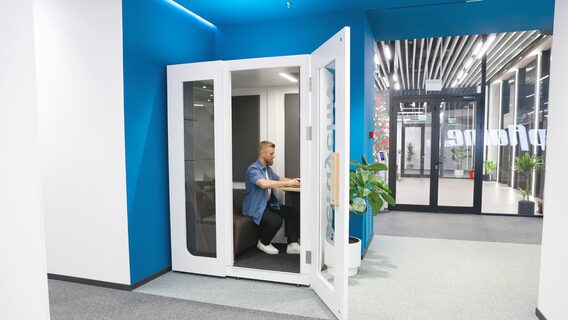
The most popular phrase in open spaces is «I’m going to leave because it’s noisy here.» It’s said almost automatically, not as a complaint, but as part of a normal workday.
That is why more and more companies are implementing Silentbox® office cubicles - a solution for open spaces that allows you to create a quiet zone for calls and focused work without renovating or reorganizing the office.
At a certain point, office noise stops being annoying. It just becomes a background that people get used to. Until it starts affecting concentration, decision-making quality, and overall team fatigue.
Now, let’s be honest: how many minutes per hour can you work in such a space without constant distractions?
Open space has long seemed like a universal solution. It saved space, seemed modern, and created a sense of teamwork. But at the same time, it gradually took away one critical thing from offices: the ability to focus when you really need it.
There is always something going on in an open space: calls, conversations, online rallies, background noise. This noise is not aggressive, which is why it is so easy to ignore. Until it starts breaking up the workday into dozens of small switches.
Today, tasks that require constant interaction and tasks for which deep concentration is critically important coexist in the same office.
Open space is unable to qualitatively support both of these scenarios simultaneously.
Over time, the consequences become very specific:
At a certain point, it stops being a matter of comfort.
It becomes a question of how the team actually works every day.
Most companies try to deal with this in a piecemeal manner.
It usually looks like this:
At a distance, this does not solve the problem, but only postpones it. Negotiators live according to a schedule, while the need for silence arises spontaneously. Headphones become not a tool for focus, but a way of survival in a noisy environment.
It gradually becomes clear: it’s not about the discipline of people. It’s about the space itself, which no longer corresponds to real work scenarios.
In the last few years, companies have started to address this problem differently.
Instead of reorganizing offices and making complex renovations, they add autonomous quiet zones to open spaces.
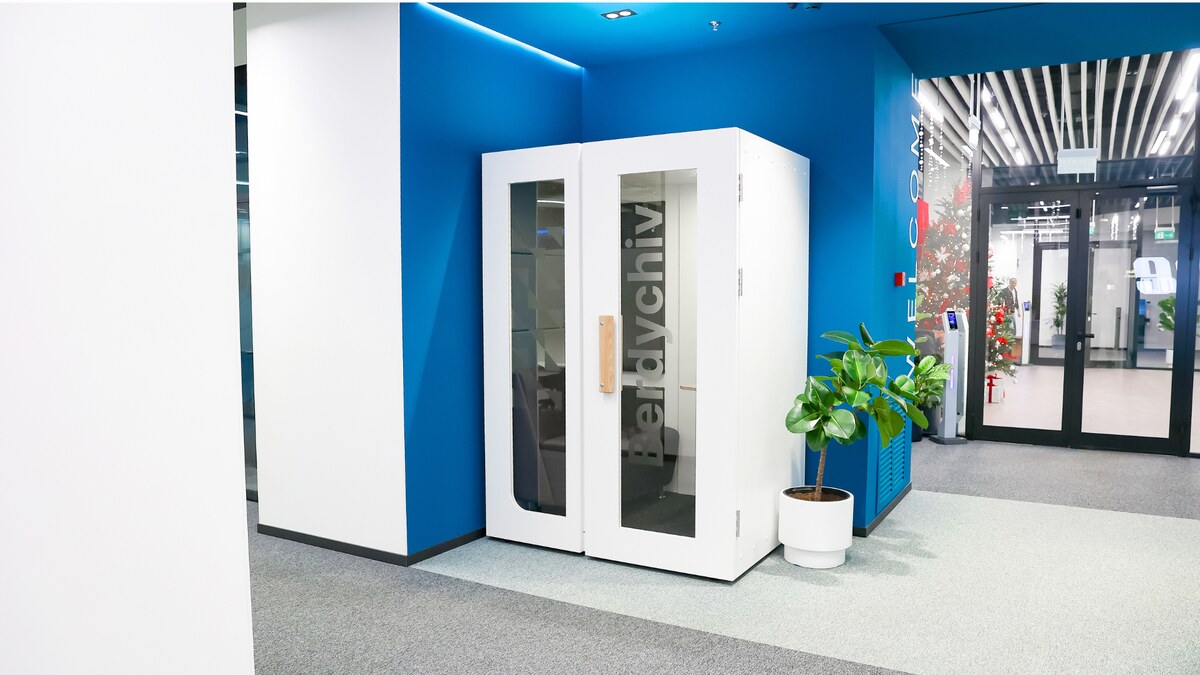
These are separate, isolated spaces for one person, used for calls, confidential conversations, and work that requires concentration.
The key idea here is not to make the office quiet, but to give people the opportunity to choose whether to stay in the common space or isolate themselves from it for a while.
In 2024–2025, companies increasingly began to count not only square meters, but also the quality of working time. And in this logic, short periods of noise-free work turned out to be more effective than hours of constant interruptions, because they directly affect the quality of thinking and decisions.
One example of this approach is the Silentbox WorkPod — a personal office in a plug&play format that integrates into an open space without renovation or complex planning changes.
Such solutions do not replace open offices and do not contradict their logic.
They simply close a scenario that open space cannot handle on its own.
Open space will not disappear. But without such spaces, it becomes increasingly less suitable for work that requires concentration.
And if it seems like the team is constantly busy, but it’s harder to get results than before, maybe it’s not about motivation. Maybe there’s just no place to focus properly.








