Марія БровінськаMoney
19 March 2025, 10:00
2025-03-19
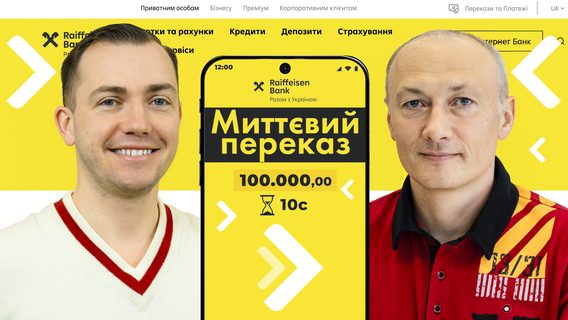
“We don’t set any limits for IT professionals in choosing technologies.” Raif is changing the rules of the game in payments: you can now transfer funds instantly — in 10 seconds instead of 15 or more minutes
Imagine: you just paid for a service, and the funds are instantly credited to your account. No waiting, no worries — you get a receipt in a couple of seconds and move on. And next to you, another client who used the bank’s services without instant payments has been nervously updating the application for 15 minutes, waiting for his money. This is not a fantasy, but the new reality of payments in Ukraine.
Thanks to the Instant Payments service from Raif, which works on the basis of the NBU SEP 4.1 service, clients can transfer funds much faster. This is a revolution in the financial services market, which seemed unattainable a year ago. So far, the service has been connected in 20 banks in Ukraine. And Raif is one of the first.
dev.ua talked with Artem Artemov, Director of the IT Development Department for Payment Services, and Vitaliy Borozenko, Director of the IT Development Department for Automated Banking Systems, and learned how the Instant payments service works, which allows you to transfer funds from client to client in literally up to 10 seconds, who implemented it in Raiffeisen, and why so far only a very limited number of banks can provide such a service.
Imagine: you just paid for a service, and the funds are instantly credited to your account. No waiting, no worries — you get a receipt in a couple of seconds and move on. And next to you, another client who used the bank’s services without instant payments has been nervously updating the application for 15 minutes, waiting for his money. This is not a fantasy, but the new reality of payments in Ukraine.
Thanks to the Instant Payments service from Raif, which works on the basis of the NBU SEP 4.1 service, clients can transfer funds much faster. This is a revolution in the financial services market, which seemed unattainable a year ago. So far, the service has been connected in 20 banks in Ukraine. And Raif is one of the first.
dev.ua talked with Artem Artemov, Director of the IT Development Department for Payment Services, and Vitaliy Borozenko, Director of the IT Development Department for Automated Banking Systems, and learned how the Instant payments service works, which allows you to transfer funds from client to client in literally up to 10 seconds, who implemented it in Raiffeisen, and why so far only a very limited number of banks can provide such a service.
What are instant payments?
Instant payments are a new type of service that, in accordance with the requirements of the Law of Ukraine «On Payment Services», must be introduced by all banking institutions in Ukraine by August. For users, the new service means that the transfer should be made in no more than 10 seconds — regardless of the day of the week and time of day. Customers can make payments quickly, without unnecessary delays and stress.
Raiffeisen Bank was one of the first in Ukraine to implement this technology.
«Until recently, transfers between banks were carried out in batches, at best once every hour or two. Banks exchanged files through automated systems in asynchronous mode, and this meant that payments could „hang“ for an indefinite period of time. But in 2020, everything changed — the NBU set a clear goal: to make payments instant,» says Vitaliy Borozenko.
Currently, according to him, a truly new exchange technology, SEP 4.1, has been implemented, which allows for organizing payments at a speed of up to 10 seconds — in accordance with the requirements of Ukrainian legislation, which is harmonized with similar legislation in the European Union.
The financial institution has switched to a new generation of online SEP technology, which provides banks and businesses with new opportunities and increases the speed of payments, increasing competition in the payment market.
How does instant transfer work?
There are usually three parties involved in the transfer process:
Sending bank
NBU electronic payment system
Beneficiary bank
Thanks to the new infrastructure, this chain works almost in real time. In seconds, the funds are already in the recipient’s account, and the sender also receives confirmation.
Artem Artemov explains: «Until now, this was impossible, but now we can build different services almost in real time at different rates, with different speeds. On the surface, the National Bank is building a fairly competitive service that can become an analogue of Visa and Mastercard.»
How Raif achieved this speed
«Our Odesa team successfully completed all NBU beta tests during the implementation of SEP-4.1,» says Vitaliy Borozenko, «we were one step ahead of most competitors and received congratulations from the National Bank twice.»
100% of the infrastructure was built without involving external contractors. Modern technologies were used: Java and Apache Flink, cloud services AWS, Kubernetes, Pengmut.
Strike while the iron is hot — why not all banks have implemented instant payments
Developing such solutions requires significant resources and deep technical expertise. Many banks are dependent on external vendors and cannot adapt systems quickly. Raif, on the other hand, relied on in-house development, which allowed not only to quickly implement instant payments, but also to create a powerful technological foundation for further exploration and competition in the digital financial services market.
Work on the instant payment service at Raiffeisen Bank started back in November 2023. «We started from the foundation — at the core banking level, we built an end-to-end process of interaction with the Electronic Payment System (EPS). This means that the data exchange mechanism with the EPS itself was integrated directly into the core of the banking system,» says Vitaliy Borozenko.
To achieve the optimal solution, the team went through three development iterations. In total, more than 12 teams participated in the process. «We invested not only in the customer experience, but also in the technological payment platform — a lot of effort over the year was focused on building the payment core, the optimal anti-fraud process, horizontal scaling, speed, security, and reliability,» Artem Artemov notes.
The bank does not disclose the amount of investment in the development of instant payments, but emphasizes: in parallel with the introduction of new products, cloud technologies, network solutions, multi-platform development, and data visualization are actively developing.
«Our teams have access to all modern technologies available in the world. We do not set any restrictions for IT specialists in choosing technologies, if justified,» adds Vitaliy Borozenko.
The introduction of the instant payment service was not only a breakthrough in customer convenience, but also a large-scale update of the banking infrastructure.
During load testing with the National Bank of Ukraine, Raifu’s automated banking system C-ISAOD processed 645 thousand instant payments in 10 hours, demonstrating high load resistance. Today, the service is already actively used by hundreds of clients, and from August, when instant payments will become a mandatory standard, the bank is fully ready to scale the load without any operational risks.
What’s next?
While most competitors are only looking for ways to implement instant payments for individuals, Raif is scaling the technology and preparing to launch services for legal entities.
The bank is already analyzing how customers' payment habits will change in the future. «I am sure that we are on the verge of a quantum leap. The transformation of payment habits will be the next stage, and we are already investing in it today to gain a competitive advantage in the market in the near future,» Artem Artemov notes.
Three tips for those who are just planning to implement instant payments
Develop technological competencies within the bank. Success depends on strong expertise. It is important to have specialists who can not only implement technological solutions, but also shape a strategic vision for digital transformation focused on customer needs.
Build a team that takes responsibility.Ownership is key. Gather people who share the vision, are passionate about the idea, and are ready to quickly implement it.
Invest in in-house development.Internal technology resources provide flexibility and vendor independence, which is critical for rapid implementation and adaptation of new solutions.
200 IT professionals from Raif created a mobile superapp for a million users. What’s in the app, how does it make life easier, and who are they looking for in the MyRaif developer cohort?
The bank moved to the cloud: what’s next? Cloud solutions architect Raif on challenges and solutions that will simplify cloud infrastructure management after migration
Raif is migrating to a single MFI. How to transfer millions of accounts without errors and not lose customers, says an IT specialist who has been working at the bank for 23 years