Хочете будувати кар’єру в Data Science та AI? Vodafone Big Data Lab відкриває новий набір —>
Ігор Вишневський Work
21 July 2026, 09:00
2026-07-21
How to pass a polygraph despite pain, a hangover, parents in Crimea and a grandmother from Russia. Cases of three specialists who were tested on a "lie detector" during the employment process
Currently, the vast majority of companies operating in the deftech and miltech sectors use polygraphs to screen candidates during the hiring process, making it a common practice in the industry. In addition, polygraphs have long been a common occurrence in employment in law enforcement and the security sector, the financial and banking sectors, for representatives of security companies and those specialists whose work is related to the topic of cybersecurity.
In this article, we do not undertake to evaluate this practice in terms of evidence or effectiveness — let the experts argue about that. Instead, we try to convey the personal experience of those people who have successfully or unsuccessfully passed the polygraph and are ready to share their cases.
Currently, the vast majority of companies operating in the deftech and miltech sectors use polygraphs to screen candidates during the hiring process, making it a common practice in the industry. In addition, polygraphs have long been a common occurrence in employment in law enforcement and the security sector, the financial and banking sectors, for representatives of security companies and those specialists whose work is related to the topic of cybersecurity.
In this article, we do not undertake to evaluate this practice in terms of evidence or effectiveness — let the experts argue about that. Instead, we try to convey the personal experience of those people who have successfully or unsuccessfully passed the polygraph and are ready to share their cases.
dev.ua spoke with three people — all of whom have taken a polygraph test twice in their lives. Each of the heroes of this article is currently related to either miltech or IT and telecom in their professional careers, but we won’t name their names. Here’s what Maksym, Yulia, and Serhiy told us.
The «Big Red Flag» with relatives in Crimea and the struggle with pain: Maxim’s case
For the first time, Maksym, who now works in telecom, passed a polygraph at the beginning of his working life, around 2009, when he was employed at a bank. The second time was quite recently, when he was trying to try his hand at the miltech sector. Both times, after passing the «lie detector», he did not receive an offer. In the second case, he is sure that the rejection from the potential employer was due to his parents and brother, who live in the occupied Crimea, which is often a «red line» for the miltech sector. Despite the fact that Maksym’s relatives maintained a sober pro-Ukrainian position during the occupation.
«When I took a polygraph test at a bank a long time ago, they asked questions mainly about whether I had stolen something, as well as about drugs and alcohol. And this time, there were mainly questions about Crimea — whether there were any connections with Crimea, how you feel about the annexation of Crimea, how you assess the current situation. That is, everything related to the war. They also asked who was interested in me working here — Ukrainian special services or Russian special services, or some other third parties were interested in this,» Maksym said.
According to the specialist, he himself indicated the presence of relatives in Crimea before the polygraph procedure, and, in addition, the polygraph examiners could have learned about this from the questionnaire he filled out. During the procedure, he says, a video camera was also working.
«A video camera was also recording me — probably to later analyze how I respond. Maybe there are mega-specialists working there who then look at the facial expressions and analyze everything. They probably wouldn’t have recorded me just like that,» he concludes.
According to Maksym, the preparatory procedure before taking the polygraph lasted half an hour, which included a questionnaire and standard questions to «calibrate» the device. In total, taking the polygraph took about two hours.
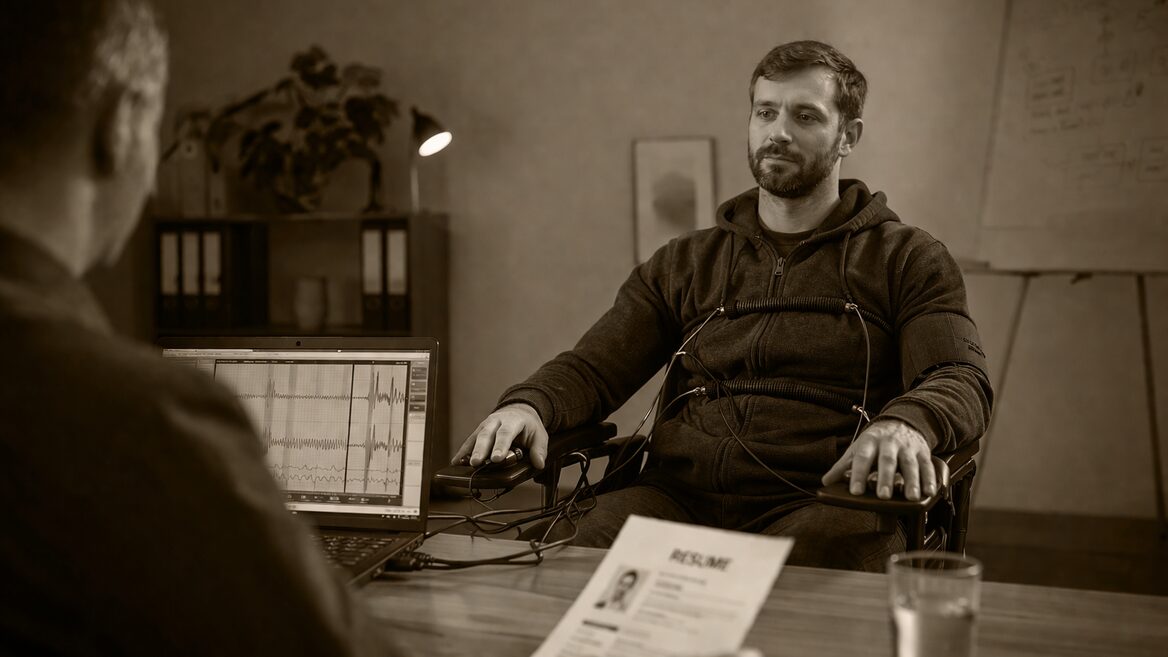
«Then they sat him in a chair, hung sensors around him, and started asking questions. The sensors were on several fingers, I don’t remember which ones, and on his chest,» the specialist says.
Most of all, as Maksym claims, he was «charged» by the question of whether he uses social networks and when he stopped using the Russian network «VKontakte», because he himself does not remember very well when exactly it was. «They somehow asked the question incorrectly about social networks, and I simply remained silent. There was a condition to answer „yes“, „no“ or simply remain silent. Well, I began to remember when I stopped using „VKontakte“. It was probably in 2014, but I do not remember whether immediately after the annexation of Crimea began, or a week later, or a month later. That is why I remained silent, because it was unclear to me how exactly I was supposed to answer,» the specialist shared.
But what particularly surprised the polygraph examiners was when Maksym did not answer the question of whether he wanted to work for their company.
«I don’t remember what I was thinking during the polygraph, but after the procedure they asked me why I kept quiet when they asked if I wanted to work for them. I answered because you have to tell the truth, and I don’t really know if I want to work here. Moreover, the company itself was under NDA, which means I essentially didn’t know anything about it. Nevertheless, they were very surprised,» Maksym said.
In addition, an important factor that caused Maksym significant discomfort during the procedure was his pain, which he feels after an operation performed many years ago. He has a disability, and pain, in particular, occurs when Maksym is deprived of the opportunity to move and is forced to be in one uncomfortable position, and also feels tension and stress. Before the procedure, he warned the polygraph examiners about these peculiarities of his.
«The pain got worse for some reason, maybe because I was a little worried, and it added to the pain in my legs. Because when I’m worried, my legs start to hurt. And I already understood that this affected the polygraph results. I saw how the polygraph examiner himself reacted to my results, and he asked, «Do you have pain now?» I said, «Yes, it hurts,» Maksym shared.
The latter later discussed this case with a neurologist, who said, «that in a state of pain, the brain is really excited,» and this greatly affects the polygraph. «The neurologist also said that if someone really wanted to employ you there, they would quickly teach you how to pass this polygraph, and you would pass it regardless of what tricky questions they would ask you,» added Maksym.
After the polygraph, the specialist says, he clearly understood that he had failed the test. This was confirmed by the letter from the recruiter he received later.
«Thank you for taking the time to communicate with our team. We are interested in your experience, but at the same time, unfortunately, after a detailed review of the security service’s inspection results, we will not be able to move further on this position,» the specialist quoted part of this letter.
He is not sure if he will be able to move to miltech from the telecommunications sector, because the «very big red flag» of having close relatives in Crimea could also work in other defense companies. However, Maksym admits that he will go for more interviews at the defense company, and perhaps his situation will be understood somewhere.
Three hours of «interrogation» and a grandmother who left Russia in 1946: the case of Yulia
Yulia graduated from Miltech with a degree in project management a few years ago and works for one of the well-known companies on the market. She took a polygraph test twice — the first time when applying for her current position, and the second time — during a relatively recent interview at another defense company. The motivation to change from one manufacturer to another in this case was simple — she would not have to add a significant distance to her work every day, which takes at least 1 hour and 20 minutes, and walk to work. However, she did not succeed in passing the polygraph test at the second company.
As Yulia says, her two polygraph tests differed in both questions and duration. While the first time it took an hour and a half to answer everything, the second time the procedure was extremely long and took as much as 3 hours.
«The specialists I took the polygraph with are psychologists by training, and each has their own methodology, so it may differ slightly. One interview took an hour and a half, and the other took three. He constantly re-recorded some blocks because there was too much noise, I didn’t react in the right way, and there was a knock on the door,» Yulia compared her two cases of taking the polygraph.
Apart from the duration factor, the first time the procedure seemed easier and more comfortable to Yulia than the second, even a bit boring. «I tried not to fall asleep,» she recalls. The second time, Yulia was really tired, and she really wanted to smoke, but there was no question of a smoke break — they were ready to let her out of the polygraph only to go to the toilet, and only in case of extreme necessity.
In the second case, the polygraph procedure, according to the specialist, in terms of the general atmosphere, reminded her more of an interrogation than a conversation.
She was especially «amused» by the question about her grandmother, who left Russia in 1946 after the end of World War II.
«They ask a bunch of additional questions that make you think, ‘Oh my God, why do they need this information?’ If it concerns, conditionally, my grandmother, who left Perm in 1946 and then lived in Ukraine all her life,» Yulia is surprised.
According to her, the questions on her last polygraph test covered several thematic blocks, the main of which were cooperation with special services (Ukrainian, enemy, or other states), the presence or absence of relatives in Russia with whom the candidate maintains contact, patriotic questions like «whose Crimea is it?», as well as her characteristics as a person. «For example, do you have loans? This is a question that is asked for some. Have you ever stolen? Have you been fired from your job? Do you consider yourself a decent person?» she gave examples.
According to Yulia, the topic of potential ties with the aggressor country dominated the polygraph test. She answered all questions truthfully, and if necessary, the polygraph examiner clarified certain circumstances.
«I didn’t steal, but they kicked me out. And he’s like, 'What for?' Well, if you need a detailed account, one day on the director’s birthday he got drunk, and then tried to get close to me and cornered me. I refused, but the next day he felt ashamed and fired me,» Yulia shared.
As Yulia says, during the polygraph there were also questions about the presence of criminal proceedings against the candidate, although, in her opinion, the security service of each company can easily check this information itself and compare it with the candidate’s questionnaire, confirming the truth or falsehood about it. Therefore, she does not see much point in asking these questions during the polygraph.
Yulia says that, from conversations with colleagues and information from the media, one polygraph session costs approximately UAH 3,000. Accordingly, miltech companies spend quite significant funds on such a screening of candidates, which they could at least partially save or use more rationally.
Anyway, she failed the polygraph test at the second company.
«The next day, the recruiter writes to me, ‘You didn’t come for the polygraph.’ I’m like, ‘Wow, did they really not like my story about my grandmother and 1946?’ Actually, I don’t know what exactly caused this decision. I don’t even know what kind of company it was, because everything was under NDA,» Yulia shared with our publication.
According to rumors the specialist heard, this employer prefers men, but in that case she doesn’t understand why she was even invited for an interview.
Meanwhile, from what she heard from colleagues in the miltech market, having close relatives in Russia or in the occupied territories casts doubt on possible employment in defense companies. She gave the example of a friend of hers who works in a taxi and wanted to get a job in miltech for the sake of booking prospects. As he told Yulia, because of his mother living in Russia, he was refused by three companies.
At the same time, her own employer, as Yulia says, takes a calmer approach to such cases, which is confirmed by the stories of some of her colleagues.
In general, according to Yulia, the use of a polygraph in the process of screening candidates is «complete profanation.» «It seems to me that there is a lot of subjective attitude of the polygraph examiner himself in this. For example, I know of an example when a wife and husband tried to get a job at my company together and went to take a polygraph. They have common family circumstances and views, but she passed, and he did not. So he sat at home for half an hour, staring at the wall, and asking: „What was that?“,» she shared.
Also, in her opinion, successfully passing a polygraph test may be strongly related to a person’s temperament.
«A polygraph is a very slow interrogation using medical equipment that is supposed to read your breaths, exhales, and pulse. And the obtained sinusoid is interpreted by a psychologist-polygraph examiner into your characteristics. So, in my opinion, in essence, passing a polygraph is an interrogation of a suspect. You can’t put it any other way. Cholerics have almost zero chance with their expressions! And I wasn’t surprised that at work I was surrounded by mostly classic phlegmatics,» she expressed her opinion.
Yulia herself assures that during both the first polygraph and the second she was not nervous at all and took it «easy», since she was employed at the time of these interviews and a hungry future did not threaten her. However, the result «at the exit» was strikingly different — the first time there were no problems, and the second time she did not pass the polygraph.
Hangover polygraph and personal deception techniques: Sergey’s case
Like the two previous heroes of this text, Serhiy, an IT worker, passed a polygraph test twice in his life, applying for a job in law enforcement agencies, but both times he was successful. However, the first time he took the polygraph test the day after his birthday and with a hangover. However, even that did not stop him.
«The polygraph should last about two hours, but I had nightmares for almost four hours, precisely because I was really dizzy from a hangover. I was shaking like a jackhammer. Because it was June 19, and on the 18th I celebrated my birthday,» said Serhiy.
He mentioned that before taking the polygraph, the so-called adjustment took place, that is, the device was set up on some control questions.
«They ask, for example, if your name is Andriy, if you are Serhiy. They force you to say, 'Yes,' and watch how the machine reacts to your lie. Well, I’m using this figuratively, because I don’t remember the exact questions they asked for this,» the IT guy shared.
The range of questions asked to him on the polygraph included a fairly standard set regarding relatives in Russia or the DPR/LPR, as well as relatives abroad in general, questions regarding alcohol or drug use, cases of theft, etc.
«They asked me if I often drink alcohol, and I said no. But everyone has their own frequency, let them decide for themselves what is often for whom,» Serhiy joked.
According to him, passing the polygraph in the first and second cases had one significant difference for him: the first time the polygraph was after the final interview and had to be passed as a formality, and the second time — before the final interview, and much depended on its passage in further employment. At the final interview, clarifying questions were asked based on the reasons for passing the polygraph and explanations were required on some points.
According to Serhiy, you can learn to easily deceive the polygraph, which he realized, in particular, after talking with colleagues who actually conduct it.
«I became friends with these guys, did some favors for them, so now I know very well how a polygraph works and how to hire one,» he says.
To do this, as Serhiy claims, you should reframe the question in your own head that you hear from a specialist, and look at the situation with different eyes, perceiving your own lie as the truth.
«A banal example with alcohol, which I already gave. Let’s say they ask you how much you drink? And you have determined for yourself that a lot is 10 liters of beer a day, so you calmly say: „No“. Although for some people a liter a week is a lot. That is, you need to think a little differently,» advises the IT expert on how to deceive a polygraph.
Another mechanism for cheating on a polygraph, which, according to Serhiy, can be successful, is to put in your own head some completely different questions than you hear from the specialist, and to which you are sincerely ready to answer in the affirmative. «There is a second option — do not listen to what he says at all, but have a conversation in your head. For example, he asks: «Is your name Alexey?», and you think about something completely different, for example, about your girlfriend-colleague. And you ask yourself: «Is Masha pretty?» Then you answer: «Yes,» Serhiy expresses his opinion.
He himself does not believe too much in the effectiveness and efficiency of the polygraph for screening candidates for employment, calling it «status show-offs» and a way to earn money for specialists who work directly with it. He does not deny that the polygraph can be one of the screening methods for «ordinary citizens», but trained people will pass it one way or another.
«I think it could be a helpful thing if there is also a psychologist and if there is a conversation with a normal psychologist afterwards. If we conduct various psychological tests at the same time,» he said.
Finally, let us recall that in this material we only quote our interlocutors, and do not undertake to assert the effectiveness of either the polygraph itself or the methods of its deception. One way or another, the polygraph remains one of the rather ambiguous tools in modern security practice, and, despite technological progress, is not an «infallible oracle», because it does not determine truth and lies, but only human reactions.
Polygraph, office, OSINT check and up to 5 stages of interviews. How IT specialists are hired at BlueBird, General Chereshnya, Himera, Frontline Robotics and other defense companies: a mini-guide for those who want to work in DefenceTech
Polygraph to check for «kickbacks» and bribes: Instagram user talks about the unexpected stage of the interview for the position of a cleaner at the MEGOGO media service
«Did you order a polygraph with a visit to your home?» An iOS developer was offered to take a lie detector test at home during a hiring process. How the IT community reacts