Хочете будувати кар’єру в Data Science та AI? Vodafone Big Data Lab відкриває новий набір —>
Ігор Вишневський Gadgets
18 October 2025, 10:10
2025-10-18
Polish physicists have invented a radio receiver that works only on laser radiation. What makes the development unique?
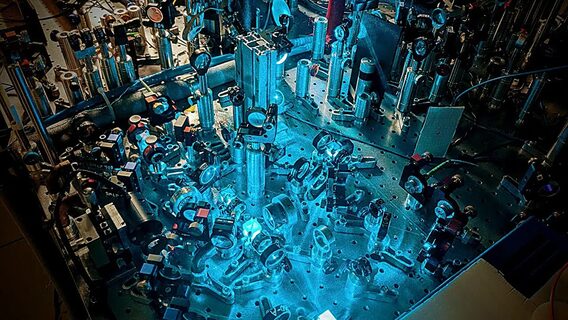
Polish physicists have created the world’s first all-optical radio receiver that operates only on laser radiation: it requires no antennas and uses Rydberg atoms to detect and decode radio waves.
Polish physicists have created the world’s first all-optical radio receiver that operates only on laser radiation: it requires no antennas and uses Rydberg atoms to detect and decode radio waves.
As Mediasat writes, citing the scientific publication Nature Communications, the device is capable of self-calibration, registering weak signals with high accuracy, and operating invisibly, using only light rays.
«In our experiments, we replaced the antenna and electronic mixer with a new environment — a kind of artificial northern lights,» explained Michal Parniak, the project leader.
Thus, a group of scientists from the University of Warsaw replaced this entire setup with rubidium atoms suspended in a glass chamber, which were irradiated by three ultrastable lasers.
To do this, researchers have spent years perfecting microwave detection methods based on Rydberg atoms. Each laser beam precisely matches the quantum energy levels of rubidium atoms. The electrons respond by jumping into high-energy orbits known as Rydberg states.
When radio waves pass through the chamber, they slightly alter this motion of the atoms. Eventually, the electrons return to lower orbits and emit faint infrared radiation that carries the encoded signal.
However, the team was able to solve the difficult technical problem of maintaining the perfect rhythm of the lasers and atoms. They used optical resonators — vacuum tubes with mirror coatings that stabilize the frequency of light. This system ensures uniform movement of electrons and allows you to accurately determine the amplitude and phase of the signal.
Unlike traditional antennas, the laser receiver has no metal components and does not create interference. The installation requires only rubidium pairs, lasers and a sealed housing. In the future, the system could be reduced to the size of a small bulge in an optical fiber. All the necessary light would travel through the fiber, and the infrared signal would return in the opposite direction.
Since early 2025, Dr. Parniak’s team has been working with the European Space Agency to commercialize a laser receiver with the aim of placing quantum sensors on satellites.
The Ministry of Education and Science announced that scientists can be allocated up to UAH 10 million for the development of a scientific invention under a state order. Previously, the amounts of such projects did not exceed UAH 3 million