Марія БровінськаGadgets
22 September 2025, 08:40
2025-09-22
Scientists have created an eyelid sensor that measures fatigue levels in real time: how it works
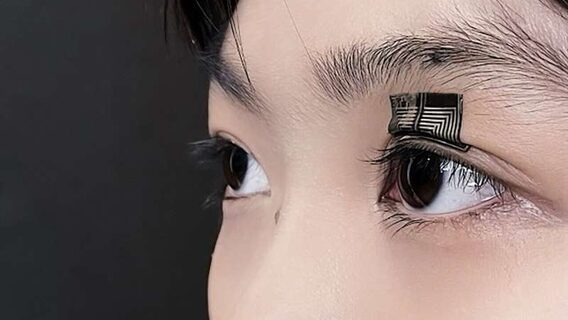
Researchers at the University of California, Los Angeles (UCLA) have recently developed a new type of soft sensor that can reliably measure a person’s level of fatigue from their eyeball movements.
Researchers at the University of California, Los Angeles (UCLA) have recently developed a new type of soft sensor that can reliably measure a person’s level of fatigue from their eyeball movements.
The new device, presented in a paper published in Nature Electronics, is able to track blink rates by responding to changes in the magnetic properties of a material caused by mechanical stress.
«Our research began with a simple question: How can we monitor fatigue in the real world?» Jing Xu, a graduate student at UCLA, told Tech Xplore. «We’ve known for a long time that fatigue isn’t just a feeling of being tired, it’s a gradual decline in the body’s or mind’s ability to function effectively. It creeps in unnoticed, affecting attention, reaction time, and even physical safety. But measuring fatigue outside the lab and in wearable form has always been a challenge.»
By looking at the physiological effects of fatigue, researchers realized they could predict fatigue levels from blink patterns. «There’s something subtle and telling about the way your eyes behave when you’re tired,» Xu said. «The frequency of your blinks changes, the speed slows down, and the patterns start to change.
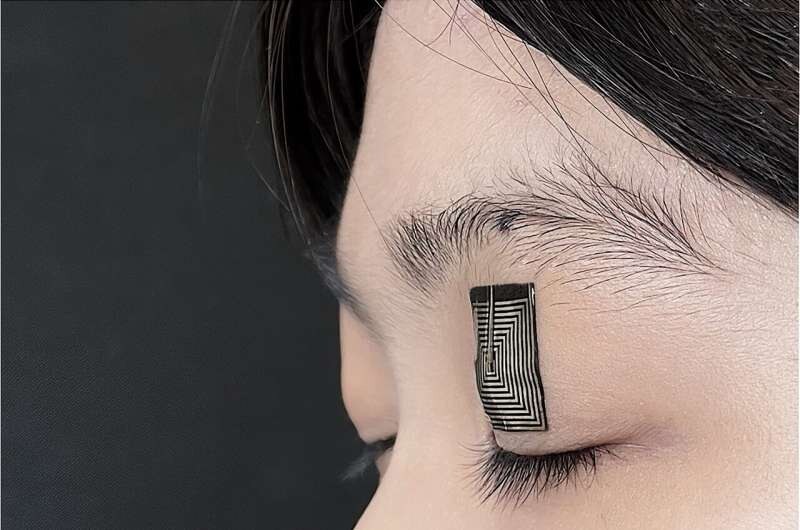
The soft sensor developed by the researchers can be worn gently on a person’s eyelid, fitting like a second skin. Notably, it is highly flexible, does not rely on batteries for power, and responds quickly every time a person blinks.
To create the sensor, the team deposited a conductive gold coil onto a thin thermoplastic elastomer. This elastomer was in turn placed over a magnetoelastic film filled with tiny magnets.
«This design converts eyelid movements into highly accurate electrical signals—essentially translating every blink into data,» Xu explained. «What’s special about this is not just the technology, but also its potential impact. It’s a fully wearable, self-charging system with wireless data transmission, designed for everyday use—not just in clinics or research labs, but in the real world where fatigue matters: on the road, in the classroom, or in high-performance jobs.»
Whether wearable or implantable, bioelectronic devices must operate reliably in wet environments, as they will inevitably come into contact with sweat or internal body fluids. However, most existing sensors for monitoring physiological signals are not water-resistant by nature.
«Enhancing their water resistance typically requires additional sealing layers, which often increase the thickness of the device and degrade its performance, such as reducing sensitivity,» explained Dr. Jun Chen, an associate professor at UCLA who led and supervised the study. «When I began my independent research at UCLA, I asked myself a fundamental question: Is it possible to design bioelectronic devices that are inherently water resistant? To do this, I considered various natural energy modalities—electricity, magnetism, heat, and light.»
The sensor developed by the researchers works on changes in the magnetic field, invisible forces surrounding magnetic materials.
A new sensor for measuring fatigue may soon be perfected and released to the market.