Хочете будувати кар’єру в Data Science та AI? Vodafone Big Data Lab відкриває новий набір —>
Марія БровінськаStartup
11 November 2026, 15:58
2026-11-11
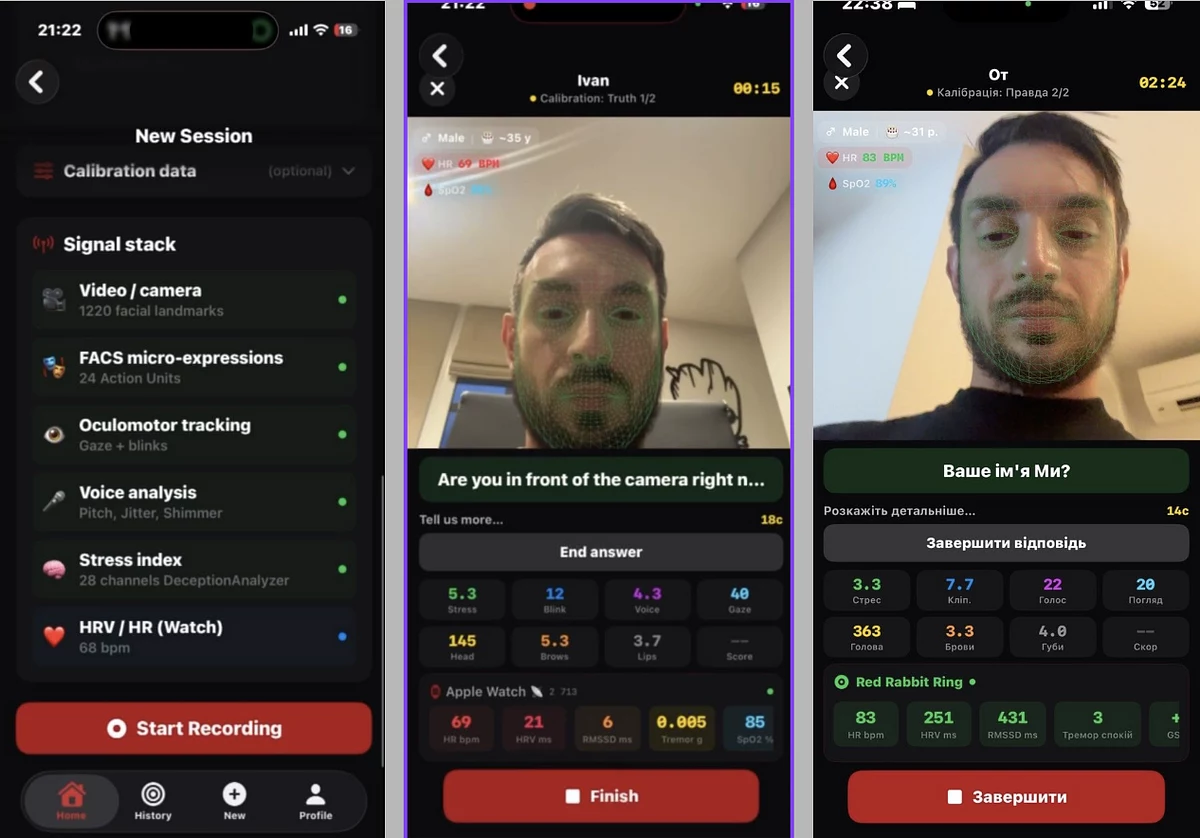
A Ukrainian has created an AI-based lie-detector service. The Red Rabbit app simultaneously reads facial expressions, gaze, voice, and pulse from the phone's camera, Apple Watch data, and smart bracelets.
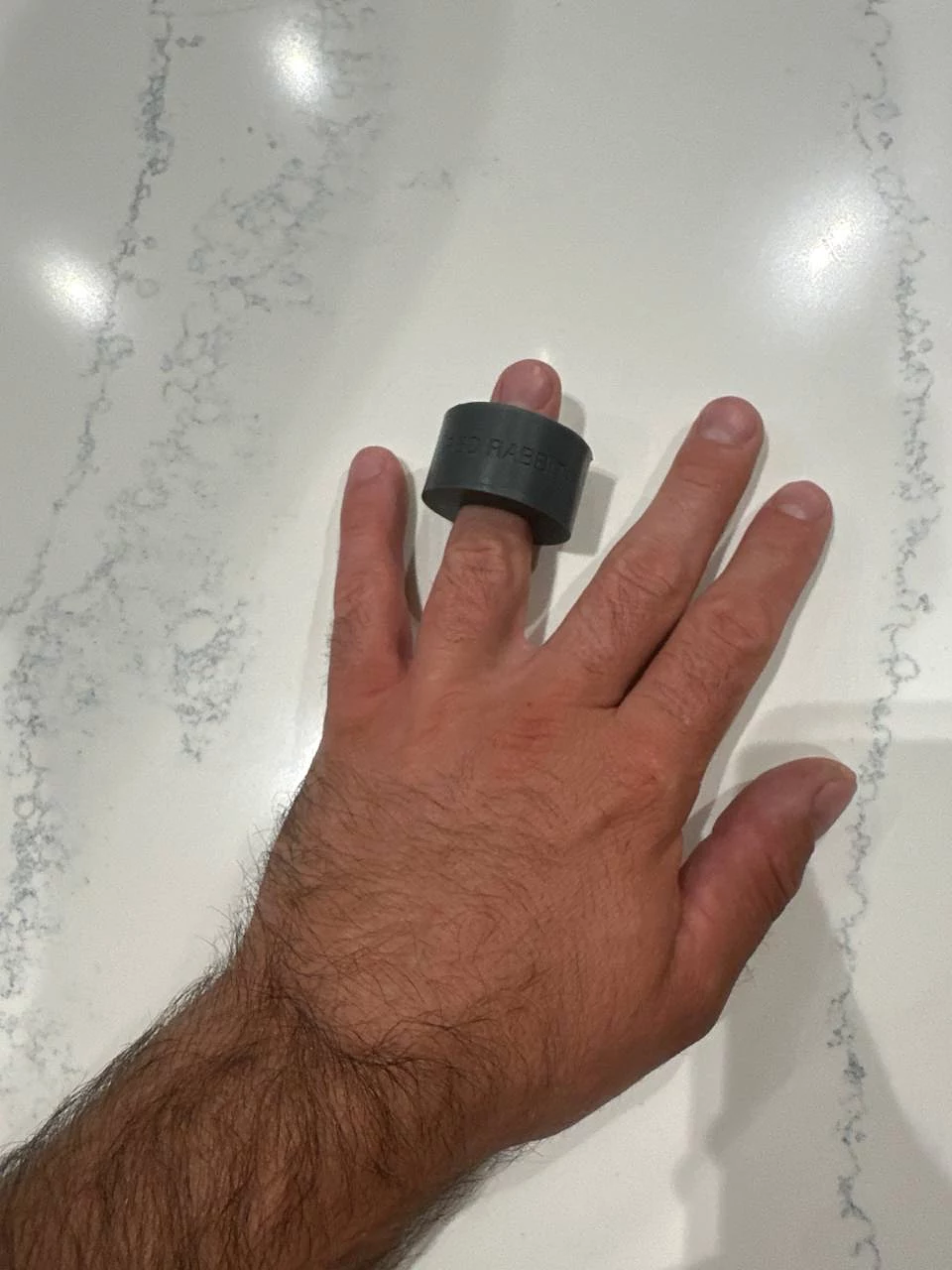
33-year-old entrepreneur Ivan Andriyuk developed Red Rabbit, a system that analyzes facial expressions, gaze, voice, and physiological indicators of a person to assess the likelihood of deception. To do this, it uses the camera and microphone of an iPhone, Apple Watch, or its own prototype ring. The project’s code is written by AI agents, and the founder himself is involved in the architecture, testing, and even soldering of electronics.
33-year-old entrepreneur Ivan Andriyuk developed Red Rabbit, a system that analyzes facial expressions, gaze, voice, and physiological indicators of a person to assess the likelihood of deception. To do this, it uses the camera and microphone of an iPhone, Apple Watch, or its own prototype ring. The project’s code is written by AI agents, and the founder himself is involved in the architecture, testing, and even soldering of electronics.
Ivan has no technical education and has never worked as a programmer before. He graduated from Taras Shevchenko National University of Kyiv with a degree in Finance and Credit and Law, and before launching Red Rabbit, he ran his own business.
He had been developing the idea for about three years. According to Andriyuk, he was interested in why it is still necessary to find a polygraph examiner and agree on a separate procedure to verify the truthfulness of a person’s words. At first, the founder tried to find a team, but eventually he started developing it on his own — when AI tools appeared that allowed him to write code without specialized training.
He began the development itself in the spring of 2026. Over the next seven months, he created a native iPhone app in Swift, an Apple Watch app, a web version, and a prototype ring. In total, Ivan invested about $15,000 of his own funds in the project. Current expenses are $1,000–2,000 per month. The developer has not yet attracted external investments or grants.
"At Red Rabbit, I’m doing everything myself: idea, architecture, testing, hardware (soldering, 3D printing of the ring body), patent applications, company registration, search for investors. AI agents write the code: I set a task, check the result on a real device and on myself, return with errors, and so on," the founder said.
According to him, the first device with sensors had to be assembled on a breadboard. While learning to solder, he burned several boards, and later independently figured out the specifics of development for iOS and Apple Watch. In particular, the standard HealthKit transmitted indicators with a delay, so Andriyuk created his own channel for transmitting data from the watch to the phone in real time.
How Red Rabbit assesses the likelihood of fraud
Before the test begins, the person answers neutral questions. This is how the system forms their individual norm: how often they blink, how they speak, and what their pulse is. Subsequent answers are analyzed not in comparison with the averages of other people, but with this personal baseline.
Red Rabbit collects data from multiple sources. The iPhone camera analyzes facial micro-movements, gaze, blinks, head movements, and a pulse that can be read from the face. The microphone assesses pitch and tremor of the voice, pauses, and delay before responding. The Apple Watch transmits pulse, heart rate variability, tremor, and breathing. The ring itself measures galvanic skin response — a change in the electrical conductivity of the skin.
The model currently uses 28 indicators with different weights. The founder says that the most important are blinking, head stability, emotional reactions, voice, pulse, and response delay. The weights of the indicators are currently determined manually based on scientific papers. In the future, the team wants to train the model on the collected data.
A full scan requires a smartphone and one wearable device, such as an Apple Watch or a ring. Remote mode can work with just your phone’s camera and microphone, but the system receives fewer signals.
After the session, the user sees a score from 0 to 100 and a report for each question: which indicators deviated from the individual norm. For example, the system can record that a person blinked less often or took longer to answer. It does not issue a final conclusion about “lying” or “telling the truth” — this must be made by the person conducting the test.
Can you distinguish a lie from excitement?
The founder himself admits that physiological signals do not allow us to clearly separate deception from stress or excitement. A rapid pulse, changes in voice, or averted gaze can have various causes. Therefore, Red Rabbit uses an individual human norm and the method of the hidden information test: the participant is shown several options, one of which has special meaning for him, and the reactions are compared with each other.
Andriyuk cites scientific papers and meta-analyses of this technique, in particular the study by Meijer and colleagues in 2014. At the same time, he emphasizes that scientific results regarding the method do not prove the effectiveness of Red Rabbit.
The founder is currently testing the system on himself and friends. These tests should show whether the devices work stably and read the indicators correctly, but do not establish the accuracy of detecting deception. Ivan has not yet named it: for this he plans to involve scientists and practicing polygraph examiners.
Future research will include a hidden information test, in which participants record in advance what they are hiding, and a comparison of Red Rabbit results with a classic polygraph on the same people. The founder promises to publish not only the overall accuracy, but also the false positive and false negative results.
"For me, the minimum is to be no worse than a classic polygraph using the same methodology and honestly show where the system is wrong," he says.
Who do you plan to sell the product to?
Among the potential users of Red Rabbit, Andriyuk names people who want to undergo a test by mutual consent, polygraph examiners, and security services in countries where such tests are legal. He considers polygraph examiners to be the most promising first paid segment: they already provide such services and understand what the tool is for them.
For business customers, the team is considering a paid 30-day pilot with a subsequent subscription for each specialist. For regular users, payment for a separate check or subscription. The ring will likely be sold separately. Prices have not yet been determined — they plan to be tested during demand testing.
The developer also specifically highlights limitations of use. He considers it inappropriate to use Red Rabbit without a person’s consent, as evidence in court, or for making hiring decisions in jurisdictions where it is prohibited.
Video and audio, according to the founder, are processed directly on the phone and are not transmitted to the server. The session history with questions, final score and encrypted name of the person is stored in the cloud. Analysis of the text of the answers in the cloud can be enabled separately, with the user’s consent. Before each session, the person must confirm consent in the application.
Red Rabbit has two U.S. provisional patent applications, totaling 98 claims. They cover real-time analysis of multiple signals from a mobile device, as well as analysis of recorded video, wearables, and AR/VR. These are applications, not issued patents.
The project was accepted into the NVIDIA Inception program in early October 2026. According to Andriyuk, participation gives access to discounts on equipment and cloud resources, training courses, and an investor introduction program.
The founder is currently seeking a first round of investment of $250,000. He plans to use the money to hire an iOS engineer with experience in computer vision, an ML engineer, a psychophysiological scientist, and a practicing polygraph examiner, as well as to train the model and independently research its accuracy.
A Ukrainian created an interactive map of power outages across the country: it shows schedules of all regional energy companies and is updated every minute
"I always wanted to see all the alarms in front of my eyes, instead of scrolling through an endless list": a Ukrainian created an alternative alarm clock for the iPhone. Daybezel received over 1,000 downloads in a day
Вас також кусають комарі? Розповідаємо про пристрій від українських стартаперів, який може цьому зарадити
Як зауважив нещодавно один військовий, якой побажав залишитись невідомим, орки, може, й не поцілять, а комарі точно зʼїдять. І від них потерпають зараз багато українців.
Позбавитись від комарів назавжди ефективно й екологічно допоможе гаджет Mosqitter. Цей стартап заснували дві українки — Анастасія Романова та Ольга Дьячук.
Ми вирішили нагадати, що може Mosqitter, про принципи його роботи та особливості, на злобу дня.
(текст від 21 жовтня 2021 року)
Кнопка здоров'я. Українці розробили систему, яка рятує пацієнтів стаціонару від смерті. Вони - переможці IT Arena Lviv 2022
Медичний психолог, який переїхав в Україну з Москви в 2014 році, Іван Осадчий, придумав систему, яка допомагає медсестрі і пацієнтові не втратити один одного в стаціонарі. Його стартап knopka вже працює в декількох лікарнях понад три роки не лише в Україні, а й у Польщі.
Повторюємо історію стартапу-переможця IT Arena Lviv 2022. Текст від 28 вересня 2022 року.