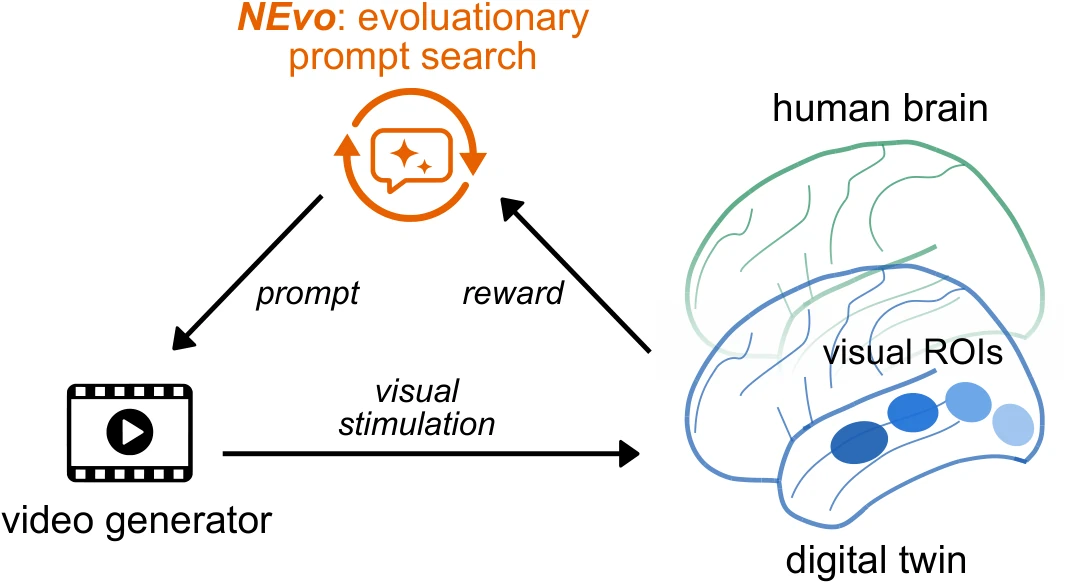
The technology allows you to study the reactions of neurons using synthesized visual content, revealing what exactly a particular area reacts to.
A group of international scientists has presented a new computational algorithm NEvo (Neural-Guided Evolutionary Video Synthesis), capable of purposefully generating videos for maximum stimulation of specific areas of the human brain.
As explained on the project website , the system is based on a so-called "digital twin of the brain" - a basic model that predicts how each visual area will react to any video. The algorithm works on the principle of prompt evolution: each video is described by a set of basic parameters (object, lighting, movement, mood). NEvo generates a batch of videos, evaluates them using a digital twin, and then selects, mixes and mutates the best options until it reaches maximum activation of the selected neural target.
To save computing resources, the process is divided into two stages: first, the AI searches for the perfect static image, and then adds movement to it, creating a two-second clip. Testing has shown that such generated videos stimulate the brain more strongly than the best natural videos or specially selected frames. The researchers emphasize that the presence of dynamics is critically important - a moving video always causes a stronger reaction than its frozen frame.
The generated content precisely matches the known functions of the brain: for the face recognition area, the AI creates portraits, for the place recognition area, landscapes, and for the motion processing areas, corresponding dynamic patterns.
The researchers also found that as the algorithm's focus shifted from basic visual areas to higher brain regions, the generated images evolved from simple geometric shapes to complex social scenes and interactions. Even when trying to generate a stimulus from a set of abstract shapes, the system gradually transformed them into faces or people if the target brain region required it.