Олег ОнопрієнкоScience Pop
25 February 2025, 15:19
2025-02-25
Scientists have overcome a fundamental limitation of terahertz waves, which will allow for significantly higher data transfer speeds
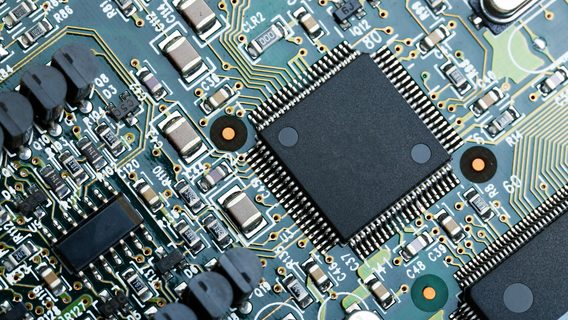
Interesting Engineering reports that thanks to the new chip, scientists have overcome a fundamental limitation of terahertz waves, which will allow the technology to significantly increase data transfer speeds.
Interesting Engineering reports that thanks to the new chip, scientists have overcome a fundamental limitation of terahertz waves, which will allow the technology to significantly increase data transfer speeds.
Terahertz technology has the potential to transmit large amounts of data at ultrafast speeds, making it ideal for applications such as real-time video streaming, large data transmission, and space communications. Terahertz (THz) waves occupy a portion of the electromagnetic spectrum between microwaves and optical infrared frequencies with wavelengths ranging from 3,000 to 30 micrometers.
The dilemma of their application was that these waves interact poorly with silicon, which is the main material in modern electronics, due to different dielectric constants, as a result of which the waves reflected from silicon and their signal deteriorated. The problem was partially solved by silicon lenses that focused and amplified the signal, but their use is quite limited, and the lens itself exceeds the size of the chip.
To get around this limitation, MIT researchers used the principle of matching, which involves reducing the gap between silicon and air so that more waves can pass through. First, they placed a thin sheet of material on the back of the chip. The properties of the sheet helped bridge the gap between silicon and air, allowing more waves to pass through the silicon instead of being reflected.
Then, using a laser cutter, the scientists created microscopic holes in the sheet, adjusting its properties to better respond to THz waves. The final step was to use high-frequency transistors from Intel, which improved the generation and transmission of THz waves.
However, to create a terahertz beam, you need not one, but many such chips. The next step for the researchers is to scale up this method to produce large numbers of chips.
Member of the expert team at the Ministry of Digital Affairs: "Why not offer the US the construction of microchip factories in Ukraine as part of the agreement on raw materials? Trump loves such ideas"