Хочете будувати кар’єру в Data Science та AI? Vodafone Big Data Lab відкриває новий набір —>
Валентин ШнайдерAI Eng
16 January 2026, 09:02
2026-01-16
"SEO got a second wind and rose from the ashes like a phoenix": how SEO promotion of websites changed after the advent of AI Overviews
Dev.ua spoke with Promodo SEO expert Vladislav Trishkin, who explained what has changed in Google after the launch of AI Overviews, how it affects traffic and organic search results, and what steps should be taken now.
Dev.ua spoke with Promodo SEO expert Vladislav Trishkin, who explained what has changed in Google after the launch of AI Overviews, how it affects traffic and organic search results, and what steps should be taken now.
At the end of May 2025, AI Overviews appeared in Google Search. Instead of immediately taking the user to the site, Google is now increasingly showing a top-generated short answer to the query with links to sources. This is convenient for the reader: some questions can be closed on the first screen. For sites, this has become a challenge: fewer clicks even from high positions and the need to rethink how to create content that is not just ranked, but also gets into these AI answers. dev.ua tried to rethink SEO together with Vladislav Trishkin, an expert from the Promodo marketing agency.
A little more about Promodo
This is a Ukrainian digital marketing agency, operating since 2004. The company's areas of work include SEO, in particular technical audits and website optimization.
Vladislav Trishkin is an SEO Team Lead at Promodo. He has been working in SEO for over 5 years, specializing in promoting content and media projects, and among the projects in his portfolio are Ukr.net, Sinoptik, and Concert.ua.
According to Trishkin, the emergence of AI Overviews has become one of the most high-profile events for the SEO community in recent years.
“The emergence of AI Overviews was quite “loud” in the entire community of webmasters and SEO specialists. First of all, because it is the beginning of the era of introducing AI features into search. Second, because it significantly affected the traffic indicators of sites,” he explains.
Vladyslav says that he first drew attention to this direction during Google I/O.
“We first saw it when we were watching the Google I/O conference in May 2023. Then the concept of AI Overviews was first introduced. In 2024, again at the Google I/O 2024 conference, Google already announced that it had sufficiently tested this functionality and it was ready to “go public.” After that, they began to implement the AI Overviews block around the world,” says Trishkin.
According to him, the team began to notice these blocks in the Ukrainian version back in the spring of 2025.
Important context is not just a "new feature" in search, but Google's strategic response to competition with LLM services.
He also emphasizes: AI Overviews are an evolution of the output elements already familiar to users, but with a new "logic" for forming the response.
"The AI Overviews block has become the next stage in the evolution of "zero-sum": if previously the system only quoted fragments of pages, now it uses AI logic to form a full-fledged answer"
Why does this worry everyone?
AI Overviews are changing the very way information is searched. When a user immediately receives a concise answer to a query with a list of links, there is no point in going to the source site. This leads to a significant decrease in the clickability of the usual organic results. According to Similarweb, the share of “zero-click” is growing precisely due to SERP features like AI Overviews, when the user receives the answer directly in the results without going to sites.
Separately, according to Ahrefs calculations (based on aggregated Google Search Console data), the presence of AI Overviews reduces the CTR of the first organic result by approximately 34.5% for informational queries compared to similar queries without the AI block.
Vladislav Trishkin explains why this works so painfully for websites:
"The advent of AI Overviews has made search much more convenient for users: now you don't need to follow links to get answers to most information requests. All key information is displayed directly in this block on the first screen. Convenient? Of course."
According to him, this hit resources that had been collecting organic traffic on "evergreen" articles the hardest:
“The most affected were information sites that had traffic from evergreen articles.” And he adds a practical assessment from his experience working with the market: “This trend is also confirmed in my practice: an analysis of Ukrainian and foreign cases for 2025 indicates a loss of 20–35% of organic reach on information and media resources.”
What has changed in the rules of the game?
SEO rules have changed significantly. Instead of focusing only on classic “blue links”, Google has started generating ready-made answers with links to sources. Now it’s important not just to take a place in the top, but to get into the AI Overviews block — in fact, to become one of the resources that Google relies on when generating a short answer right in the search results.
According to Vladyslav, the primary task is content adaptation.
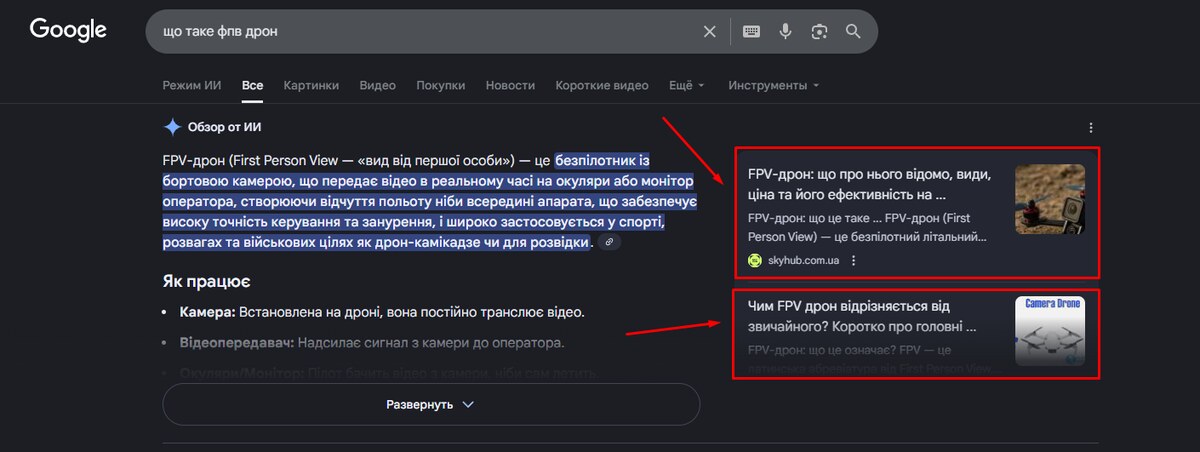
"It has become increasingly difficult to get organic traffic through informational searches. Now it is necessary to adapt the content so that it falls into the AI Overviews block and contains an active link to the original source."
Vladislav also provided a visual example:
This means changing the format of materials: presenting facts and explanations in convenient structures (lists, tables, short paragraphs) so that key answers are “read” quickly and easily extracted from the text. In this logic, the very approach to “SEO for information requests” is also changing: now it is not enough to simply rank, but it is necessary for the page to be understandable both to the user and to the system that generates the summary.
Google also prefers clear “How-to” answers and long keyword phrases. Therefore, it is important to focus on user questions (FAQs and instructions) and mark them with appropriate micro-markup (e.g. FAQ schema). In simple words: not “text for text’s sake”, but precise answers to specific questions, laid out on shelves.
Additionally, Google values authoritative content based on the EEAT principle. This is the approach Google uses to evaluate the quality of content:
Experience (is it clear that the author/site has practical experience in the topic),
Expertise — expertise (does the author understand the subject),
Authoritativeness — authority (is the site/author authoritative in the niche),
Trustworthiness — reliability (can you trust the information, is it accurate and secure?).
Therefore, it is worth making sure that your pages contain signs of expertise and trust: the authors should be indicated, and it should be transparently shown who is behind the material (editors/company), the information should be up-to-date (updates, edits, date), and sources should be added where appropriate. In other words, now the SEO strategy should be based not only on positions, but on structure, relevance and trust, so that in the new edition the content has a chance to be not just "in the top", but embedded in the answer itself.
What no longer works
The basic methods of attracting organic traffic that were used earlier are becoming less effective. In particular, it makes no sense to publish voluminous articles on general topics in the hope of attracting attention through search positions. As the expert notes, sites with informational content (blogs, news portals, directories, recipes, etc.) have been hit hard. Their materials often generate AI answers, and users no longer go to source sites. Organic results are "falling" to the bottom of the page: now they can appear 1-2 scroll screens below the main review. Therefore, old approaches (creating only large informational reviews in the top) no longer bring the same traffic as before.
After the advent of AI Overviews, information traffic became the "cheapest" for Google in terms of distributing answers directly in the search results and the most painful for the sites that relied on it.
"Users began to receive a full answer to their information request directly from the search results. This eliminated the need to sometimes click further and go to different sites. As a result, the CTR (Click-Through Rate) of snippets decreased significantly," explains Vladislav.
This primarily affects "long-form" content that has been gathering stable traffic for years.
According to the expert, the biggest losers were information sites and media that built organic traffic on materials "for years," rather than on news or commercial pages.
That is, it is not "informational content" as such that is not working well, but relying on it as the main source of growth - especially in formats where AI can close the request with a short answer.
A separate risk here is content that is written “for the search engine” according to old rules. Vladislav directly calls this approach outdated:
"Now we need to invest more time in researching user demand, what exactly they want to know, and how to most effectively answer their search query. Get to the heart of the search query, rather than just adding keywords to the text. Use different variations of content (visuals, infographics, UGC, etc.) and work on the UX of the site."
In practical terms, this means that mechanical “pulling” of keywords and artificial expansion of texts without real value ceases to yield results. Even if the page maintains its position, it may lose clicks because the user sees the answer in the AI block and does not reach the organic results.
Another trend that has begun to quickly "sink" is the mass generation of materials using AI without editorial control.
“Mass AI content generation is working worse and worse. Generating authentic and deep content using AI has its limitations, especially in the context of Google’s updated quality requirements,” Trishkin emphasizes.
As a result, sites that relied on the number of publications and the "content pipeline" but did not back it up with unique expertise and tangible benefits for the reader are at risk.
What else might work?
New challenges require new solutions. According to Vladislav Trishkin, in the future, it is worth paying attention to alternative sources of traffic. You should not depend only on Google: it is useful to develop social networks, e-mail newsletters, direct traffic to compensate for losses in search. You should also shift the focus of your SEO strategy to requests with commercial or local intent, since AI messages have so far hardly touched them. For example, content and ads are important for local businesses, not AI reviews. Finally, it is worth investing in unique content (reviews, research, cases) that distinguishes your brand. The higher the expertise and relevance of the information, the greater the chances that your resource will be included in the AI response.
Vladislav Trishkin emphasizes that in the new conditions it is important to look at SEO more broadly than just “wrote the text and got traffic.”
"Google search is currently working and developing in a clear direction - to provide the user with maximum comfort and benefit, to help them find a high-quality and reliable answer to their search query as quickly as possible," he says.
Hence the change in emphasis: not the number of pages and not the "conveyor" of content, but a clear benefit, understandable formats, and the extent to which the page addresses a person's specific question.
Another thing that can be a drag in AI Overviews is content that is difficult to summarize into one short answer. This includes materials with different presentation formats and strong UX.
Separately, you should not abandon AI as a tool, but use it correctly.
“The most effective approach today is a hybrid model: AI optimizes routine processes, but the final validation and the “human factor” remain with the expert,” Vladyslav notes.
That is, teams that collect materials quickly but do not sacrifice quality and accuracy may win, and this is what becomes a competitive advantage.
And finally, if we talk about "features" that can still produce tangible results, then this is work with various channels within the Google ecosystem. Vladyslav directly indicates that content sites and media will not disappear:
"A significant portion of such sites continue to attract an audience through the Google Discover recommendation feed, which sometimes becomes the main source of traffic. At the same time, the role of social networks is growing as a powerful tool for diversifying traffic."
That is, some of the losses from AI publishing can potentially be compensated by Discover, as well as additional sources outside of classic search — if content and distribution are built for these channels.
What to do now
The first step should be to adapt existing content. As Vladislav Trishkin emphasizes: “First of all, you need to adapt informational content to increase your chances of being displayed in AI Overviews.” In practice, this means:
Structuring information . Present facts and data in convenient, compact formats (lists, tables, short sentences). Present answers to questions in short paragraphs with clear headings (<h1>, <h2>, <h3>).
Focus on “How-to” and long queries . Analyze typical user questions and answer them “on the spot.” Separate FAQ blocks with markup will help Google better utilize your content.
Micro-markup . It is recommended to use FAQ schemes, step lists, or other schemes that increase the chance of getting into an AI answer.
EEAT Principle : Create content “for people”: add information from experts, publish reliable and up-to-date data, and follow Google’s quality content evaluators’ recommendations. This will increase the search engine’s trust in your materials.
Next, according to Vladyslav's logic, it's worth reviewing the very basis of the content strategy: what topics did you cover, what did you focus on, and whether you built traffic on queries that Google is now "eating" in AI answers.
“Review promotion strategies. In general, this is a pretty good practice after every significant change in Google search,” says Trishkin.
He separately emphasizes that some formats that previously seemed win-win now do not give the expected result:
"Today, building a content strategy solely on basic queries like "what is it", "release date" or "how to do" is strategically unprofitable. Since AI Overviews instantly provides answers to such questions right in the search, you no longer have to count on a significant amount of organic traffic for these keywords."
As an alternative, the expert suggests a more applied approach to topics and queries: not to rely on "classic" information formulas, but to dig deeper into the interests and pain points of your audience.
It is worth doing a good research of search information demand in your niches. Find the pain points of users. Find out what questions and difficulties most often arise in your target audience.
Next comes the question of analyzing competitors and external signals:
"What content is going well with competitors? What content from social networks is of interest to your target audience?"
That is, the approach shifts towards real demand and people's behavior, rather than towards "standard" SEO templates.
A separate point here is the role of quality and manual validation of content.
The expert also advises diversifying traffic channels and paying more attention to social networks, mailings, and direct traffic, so as not to rely solely on search. You should shift SEO emphasis to commercial and local queries, where AI interferes less, and also create unique content that will distinguish you from your competitors.
And if we summarize the general vector of changes in the approach to promotion, Trishkin formulates it as follows:
"I've heard a lot of statements that "SEO is dead," but in my opinion, on the contrary, SEO has received a second wind and has risen from the ashes like a phoenix. Now the main goal will be not only to gain positions in Google, but also to become a source that AI cites in its response."
“AI overview and ranking algorithm updates took away traffic.” SendPulse CEO advises to engage in Generative Engine Optimization to attract an audience
Як нейромережі бачать вільну та незалежну Україну? Тест dev.ua
Нейронні мережі для генерації зображень бачать світ по-своєму, їхню логіку зрозуміти часом зовсім неможливо. Але таки хочеться. На честь Дня Незалежності України редакція dev.ua вирішила провести невеликий експеримент.
Ми задали чотирьом різним нейронним мережам п’ять однакових запитів: «прапор України», «День Незалежності України», «український Крим», «перемога України» та «українці». Отриманими результатами ми ділимося з вами нижче.
У TikTok тепер можна генерувати фон за допомогою нейромережі. Ми протестували її та ділимося результатами
У TikTok з’явилася нова функція «Розумний фон». З її допомогою як фон для тіктоків можна підставляти згенеровані нейромережею зображення. Редакція dev.ua протестувала цю технологію і ділиться своїми враженнями.