Хочете будувати кар’єру в Data Science та AI? Vodafone Big Data Lab відкриває новий набір —>
Наталя ХандусенкоУвійти в ІТ
1 May 2025, 17:16
2025-05-01
"My boyfriend started programming at 6, by 18 he was already a senior tomato." What do IT people think about children's programming courses
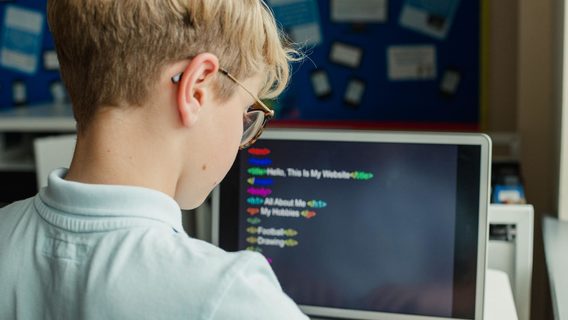
Developer Yevgeny Maslak wondered whether it was worth sending his child to programming courses. The IT professional himself has an ambivalent attitude towards this, so he asked his colleagues whether it would be useful, or on the contrary - a waste of time and money.
Developer Yevgeny Maslak wondered whether it was worth sending his child to programming courses. The IT professional himself has an ambivalent attitude towards this, so he asked his colleagues whether it would be useful, or on the contrary - a waste of time and money.
"On the one hand, what would a child play with if they didn't do crap. That is, like any club your child goes to. On the other hand, it is often sold as a future promising profession. For 13-14 year old teenagers? Really? As a person who learned Python in the distant year 2021, and now doesn't remember how to declare a variable, I declare that it is a waste of time. Everything will be forgotten if you don't use it constantly," Yevheniy Maslak shared his own opinion on this topic on LinkedIn.
IT professionals' opinions in favor of children's programming courses
This is a good opportunity to get acquainted with the IT sphere and understand whether there is a desire to develop in this direction , believes IT Project Manager Alina Zakharova: "I think it's a great opportunity to get acquainted with the sphere, especially if it's all presented in an interesting and playful way. From experience, in the first year of university, those who were engaged in programming at school found it less stressful to start. Because for me, the first 2 weeks of lectures on programming in C++ were stressful. In addition, there were guys who, in the middle of the course, realized that it wasn't their story at all and transferred. Therefore, I think it's really cool that children can try the "hyped" IT that everyone is talking about."
Such courses are like other clubs: you have to try. Technical Director Andriy Andriyash shares this opinion: “In my opinion, it’s the same club as the others. Previously, there were amateur radio clubs, aircraft modeling, young technicians’ stations, dance music, vocals, sports, etc. How many children and young men who went to these clubs became engineers, radio technicians, aircraft designers, professional singers, athletes, and others? Of course, there are those who liked what they were doing and decided to continue this path in higher education and in life. But in general, the clubs were for comprehensive development, for revealing and strengthening abilities, getting acquainted with something different, or diving deeper than the general school program allows. You have to try, search. At least it’s better than chasing dogs down the street, as they wrote here.”
Level Designer Olga Barvinok: "My boyfriend started programming at 6, and at 18 he was already a senior tomato. I only studied Pascal according to the school curriculum and only when I was over 25 did I learn that Pascal can be used not only for crazy math problems (maybe I'm not that stupid, but the school curriculum is so lousy). But I still can't program at all. If the parents have the opportunity and the child has the desire, then why not give it to them? Well, the little one is learning, developing. Maybe he'll give it up, or maybe he'll find something to do for the rest of his life."
Opinions against
Software Engineer Oleksiy S.: "I think that by the time children grow up, this profession will either not be needed at all, or the need for people in this profession will become very small. Therefore, in my opinion, it is a waste of time. In fact, it is even difficult for me to imagine why it makes sense to teach children now. Maybe survival in the wild."
Pavlo Gak: " Money is now being made on everything and everyone. In this case, on children. Why is this opinion, because it concerns IT education."
Personal stories of IT professionals
Android developer Oleksandr Levytskyi: "At the age of 13-14, I signed up for a programming club, coded in gv basic on BC 0010... Then on the ultra-modern Poshuk-2. It was just a blast — no one thought about making money with it... In 2013, I remembered that I liked programming — I started to dabble in C/C++… I haven't forgotten what a variable is."
Software Engineer Marta Hryvniak: "I started programming at 14, it was fun, it was easy and fun, I realized that I had the ability for it. I practiced a lot, participated in competitions. Based on this experience, I confidently chose a faculty at 17, where I received a mathematical base. There I met peers similar to me, we pushed each other to develop and look for work in our specialty, I have been working as a programmer since I was 20. And although I don't remember what I learned at 14, I wouldn't be where I am today if I hadn't started then. This is an avalanche effect: the seed is planted at an early age, and if it falls into fertile soil, then great fruits can come from it. Just don't force a child if he doesn't have the talent or desire for it."
Experiences of parents whose children attend or have attended courses
Graphic Designer Alina Zamaraeva: "My son took the course and wanted to try Python. He didn't get in, but the course was good for programming at school. I think you should try it if you want to and have the opportunity."
Product Manager Suzanne Salata: "My children are studying at an IT school. The eldest is almost 11 and he is in two schools (different approaches to the same thing) + he has already read the book Python for Kids and is currently reading JS for Kids. I consider the benefits of such training to be about the same as from a chess club or additional English lessons — it develops general and critical thinking in particular, it improves logic and abstraction. As a future profession — unlikely. But it can provide a normal base, if it fits, then dad + self-study will do their job.
Svitlana Annych: "My son said it wasn't worth it. We tried two different schools. Now he's studying something on his own. He tried going to an IT school when he was 12 and 13."
The opinion of a person who taught courses
Senior Python Developer at SoftServe Oleksandr Viter taught programming (Python) in courses for teenagers (13-16 years old): “I can say that this is a good option in practice before entering university and even before starting preparation for the National Technical University to understand whether this direction is interesting at all, whether the profession of a programmer is attractive in reality, and not just in theory, because “AIT people are shoveling money.” If we look at it from the perspective of "I'll learn these skills now, and then in 5 years they'll be useful" - then I agree with you, this is a losing strategy. From my personal observations, out of a group of 15 children, about 2-3 usually have a real talent for programming and they should definitely choose this profession. Another 2-3 have no talent, but they have curiosity and with their interest and perseverance they achieve great results. And another 10 people are those who have tried in practice what it is like and realized that they have neither the abilities, nor the interest, nor the desire to do this. And that's normal, not everyone needs to become programmers. Doctors, teachers, lawyers, engineers, linguists and a bunch of other people with higher education are also needed by this world.
A GoIT student complained about the school's activities because the course he purchased was canceled and the proposed alternatives did not suit him. GoIT CEO offers dissatisfied student a master's degree for UAH 175,000