Хочете будувати кар’єру в Data Science та AI? Vodafone Big Data Lab відкриває новий набір —>
Редакція dev.uaAI Eng
23 February 2026, 15:23
2026-02-23
AI assistants at the service of entrepreneurs: How EPAM specialists created Robert, Foundiia, Market, Grant and Smart, which help Ukrainians
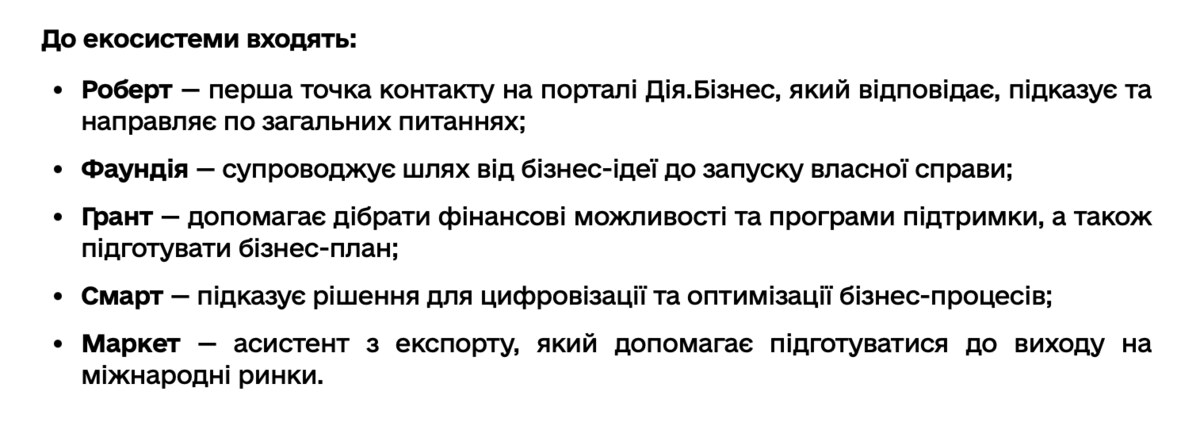
In December 2025, new AI assistants for small and medium-sized business owners appeared on the Diia.Business portal: Robert, Foundiia, Market, Grant, and Smart. These assistants are designed to simplify typical tasks for Ukrainian entrepreneurs and help them scale their business. The solution was developed by a team of experts from EPAM Ukraine with the support of the U.S. Cybersecurity for Critical Infrastructure in Ukraine (CCI) Activity,
In December 2025, new AI assistants for small and medium-sized business owners appeared on the Diia.Business portal: Robert, Foundiia, Market, Grant, and Smart. These assistants are designed to simplify typical tasks for Ukrainian entrepreneurs and help them scale their business. The solution was developed by a team of experts from EPAM Ukraine with the support of the U.S. Cybersecurity for Critical Infrastructure in Ukraine (CCI) Activity,
Arkadii Suslo was the delivery manager of this project. In this article, he tells how the development took place, what challenges the team overcame, and why AI in Diia.Business is a completely safe and very useful solution.
What preceded the development
The Diia.Business portal combines a lot of information and services for small and medium-sized businesses in one place. It contains directories for entrepreneurs and exporters, financing and support programs, information on grants and loan offers, news, events, initiatives, services, services and tools, educational materials, tender offers, a marketplace of digital solutions for business, success stories, analytics and many other useful things. To save time searching for information, AI assistants were proposed. They were supposed to help navigate a large volume of materials: analyze the request and select and structure the necessary solutions in a few minutes.
In particular, the most critical point was the grant programs. Entrepreneurs were given an excellent opportunity to raise funds for development, but the process of submitting applications and business plans became a «high threshold for entry» for many. Due to errors in the design, non-compliance with regulations, or a banal misunderstanding of the requirements, a huge number of applications were rejected. Often this happened at a stage when the submission deadlines had already passed, and the person simply did not have time to correct the errors.
Our main task was to create an additional innovative tool that would «take the entrepreneur by the hand» and guide him through all the bureaucratic labyrinths. Quickly, humanely and transparently, without unnecessary movements and excessive information.
Project path: from analysis to implementation
Joint work within the framework of the Grant Program for the Development of Innovative Solutions in Cybersecurity from the U.S. Cybersecurity Activity in Ukraine started in September 2025 and lasted until December. We were lucky with very involved and responsible stakeholders: together with the team of the Office for the Development of Entrepreneurship and Export, a format of highly specialized assistants was adopted, each of whom is responsible for his own area of expertise. The goal of the development was not only the further digitalization of services, but also a significant increase in the level of cybersecurity when working with data. Special attention was paid to the friendly, attractive, modern design of the assistants: they should encourage users to contact us. And also the tone of communication. It was outlined by the team of the Office for the Development of Entrepreneurship and Export, which implements the Diia.Business portal: it should not be dry information in the format of a reference, but a truly personalized conversation that leaves a feeling of humanity.
For several months, together with the team, we actively worked towards the result. I would like to emphasize that the quality and flexibility of cooperation exceeded expectations and broke many stereotypes about working with the public sector.
We have divided our journey into several key stages:
In-depth analysis of requirements: studying typical user errors and the specifics of grant procedures.
Planning and design: creating an architecture where AI integrates into the Diia.Business ecosystem without disrupting its integrity. The team spent a lot of time researching the user experience, developing and agreeing on the assistants’ appearance and tone of voice. The task from the stakeholders was to create a wow effect for users.
Development and testing: a particularly long stage, where we «trained» the models to understand the context of the Ukrainian business environment. The largest part of the testing was focused specifically on cybersecurity issues, for which a strong team of experts was assembled.
Implementation: final release in December 2025.
The main goal we set for ourselves is to support entrepreneurs 24/7. AI assistants allow us to radically reduce the time to receive a response, simplify procedures, and minimize the impact of the human factor.
AI assistants on the Diia.Business portal were implemented at the initiative of the Ministry of Digital Transformation of Ukraine, the Office for Entrepreneurship and Export Development, the national project Diia.Business, EPAM DIGITAL LLC with the support of the U.S. Cybersecurity for Critical Infrastructure in Ukraine (CCI) Activity. The content of the solution does not necessarily reflect the views of the US Government.
Technological uniqueness and security issues
One of the most challenging issues in implementing AI for government services is the security of personal data. Our approach was based on the principle of Secure by Design. This means that data protection was not added as an «add-on» at the end, but was built into the architecture at the design stage.
We have analyzed the current platform in detail and built a completely new flow of user interaction with assistants. Each dialogue is protected, and the risks of information leakage are preventively eliminated, which is confirmed by multi-stage testing together with the teams of the Office for the Development of Entrepreneurship and Export, Diia.Business, and the AI competency center of excellence of the Ministry of Digital Transformation of Ukraine in closed environments before going into «production».
How it works for the user
Users can already test the update in their personal account on the Diia.Business portal: you can use the traditional search or choose the intelligent path through AI. After quick authorization, the entrepreneur gets access to personalized support.
Although the collection of complete statistics is not yet complete, we can already see that the goal of «24/7 support» has been achieved. Entrepreneurs no longer need to wait for consultants' working hours to get the necessary answers and clarifications.
Technical side
From an engineering point of view, we aimed to create not just a «chatbot», but a scalable ecosystem. The main feature of our product is its LLM-agnosticity. Although at the current stage the Diia.Business project has chosen Google’s Gemini model for its work, the architecture allows for easy integration of any other large language model in the future. This ensures the project’s independence from a specific technology vendor and allows it to flexibly respond to the emergence of more powerful solutions on the market.
During the work, we used the EPAM AI/Run CodeMie platform — EPAM’s own product, which we customized to the customer’s needs. We left only the functionality necessary for the effective work of business assistants in it, and developed detailed instructions for colleagues from Diia.Business. Now they have the opportunity to independently administer the system and even create new assistants within the existing logic.
At its peak, the project involved 14 specialists. It was a multidisciplinary team that included architects and developers, a business analyst, cybersecurity experts, DevOps engineers, testing specialists, and designers—the latter taking on most of the important tasks.
The team composition varied depending on the phase. At the start, the greatest burden fell on analysts and architects, who built the logic of future assistants. On the scale of EPAM as a global company, this is a small project, but in terms of impact on the state and economy, it is very useful.
Role model and «digital ethics»
Each of the five assistants is a separate role with clearly defined instructions. We spent many hours on prompt engineering: honing the wording and testing the responses so that the AI would not just output text, but act strictly within its authority and moral and ethical framework.
A separate challenge was the creation of «digital fuses». We implemented a protection system that blocks users’ attempts to provoke AI into giving incorrect or toxic answers (so-called «jailbreak» attacks). This is critical for a government portal: assistants’ answers should not only be useful, but also safe and professional under all circumstances.
Multi-Agency: AI Teamwork
One of the most innovative solutions in this case was the transition to a multi-agent system. AI assistants do not exist in isolation — they work as a cohesive team. Each assistant has access to their own data sources that match their profile — this ensures depth of expertise in the chosen niche. At the same time, our solution allows assistants to «flip» requests to each other. For example, if an entrepreneur started a conversation with assistant Robert about general issues, but in the process the conversation turned to grant funding, the system can offer to switch to assistant Grant. At the same time, the history and context of the conversation are preserved, which creates a seamless and convenient user experience.
Quality and accuracy of responses
Despite the fact that LLM by its nature can give different answers to the same query, we managed to achieve high stability indicators. The test results exceeded expectations: the accuracy of answers and the correctness of the use of tools is approximately 90%, while the industry standard varies within 80-85%. This is a very high indicator for systems of this level of complexity. This was made possible thanks to the flexibility of the ERAM AI/Run platform, which allows you to integrate specific manuals and legislative regulations directly into the assistants' knowledge base.
Functional Dilemmas: Why Five Heads Are Better Than One
During the design phase, we faced an important architectural dilemma: should we create one universal «super assistant» as a single point of entry or develop several highly specialized assistants? After a series of consultations with the Diia.Business team, we settled on the second option.
This choice was not accidental. Colleagues from Diia.Business and the Office for Entrepreneurship and Export Development have a huge array of feedback from entrepreneurs and clearly understand their pain points. That is why five strategic directions were highlighted. It is interesting to watch the evolution of Robert’s assistant. Previously, he worked on the basis of clear scripts without the use of AI, but now Robert has «evolved» into an intelligent concierge. He has become a general navigator: if he cannot solve the issue on his own, he instantly identifies the request and redirects the user to a profile assistant: Foundiia, Grant, Smart or Market.
Challenging complex queries: from idea to export
The real «test drive» for the system begins when an entrepreneur comes in with a comprehensive request. For example: «I want to scale up furniture production and start exporting to the EU, but I need a business plan to get a grant.»
For such cases, we have integrated assistants with existing portal tools. For example, before providing advice on foreign markets, the system may offer to complete an export readiness questionnaire.
Our team is particularly proud of our assistant Grant. Preparing a business plan for government programs or international organizations is not an easy task. The documentation must comply with strict formats approved at the legislative level. Our AI assistant is trained to create documents that clearly meet these criteria.
At the same time, we always emphasize that the results of AI work are a high-quality template. There is a disclaimer in each dialog: the user should check the relevance of specific data and adapt the results to their realities. AI provides the foundation, saving weeks of work, but the final word is with the person.
Industry-specificity and privacy by default
The system does not work according to the «one answer fits all» template. Assistants deeply take into account the industry in which the entrepreneur works. If he asks about the development strategy and at the same time owns a business in both retail and agro, the AI will not guess — it will ask a clarifying question to generate the most relevant content.
Another critical aspect that we solved at the architecture level is the security of personal data during document generation. We built the platform so that it was not necessary to have access to the portal user database. We only adjusted the format of interaction: how exactly the system can «get» the necessary information to form a response, without leaving it in its «memory». The system generates the document structure, and personal information is inserted into it at the last stage, directly for the user.
When a user communicates with the assistant, personal data is not transferred to Google servers to train their models. We use API integration, which guarantees technical isolation of requests. At the same time, I would like to emphasize that Google, as a global ecosystem, can collect information through browsers or other services that a person uses, so the data could have entered the network even earlier. However, from our side — from the side of Diia.Business and EPAM development — not a single byte of private information goes «outside» into the open LLM arrays. This is a completely secure and closed solution.
AI as a navigator for live expertise
One of the most common fears is whether AI will replace live consultants. Our answer: no, it enhances them. The main task of assistants is to relieve real experts from routine, typical questions that take up 80% of their time.
We’ve implemented functionality that bridges AI with human expertise. If the AI assistant sees that a query requires deep dives, it will help schedule a time and schedule a meeting with a real consultant right in the interface. This way, the entrepreneur gets a quick answer to simple questions from a bot and quality time with a professional to solve strategic problems.
And to make getting started with AI as easy as possible, we’ve developed a system of «starters» — quick tips. For each of the five assistants, we’ve highlighted the three most relevant questions that entrepreneurs ask most often. This allows you to start a dialogue with one click and instantly understand the capabilities of a particular assistant.
I would like to note that currently using AI on the portal is a convenient option. The user chooses to follow the classic path of searching for information or to use the help of a personal digital navigator.
From a vague idea to a clear action plan
How much time does implementing AI save an entrepreneur? The answer to this question is individual and depends on the complexity of the query. However, we found one common feature: most often, business owners face not a lack of information, but a lack of understanding of the «next step.» Many have a vision, but do not know how to transform it into a specific business plan or strategy.
Our assistants close this gap. They help the user structure their thoughts, becoming a kind of mentor. Thanks to interaction with AI, the entrepreneur becomes more knowledgeable: what was previously «just an idea» turns into a structured draft of the future business after a dialogue with the assistant.
We tested these tools ourselves, as part of the team is also a sole proprietor (SPO). We confirm: the path from a basic idea to receiving specific advice and document templates has become much more convenient.
Life of the created solution after release
When developing this module, we built into it a high potential for scaling. Today we handed over the product to the teams of the Office for the Development of Entrepreneurship and Export and Diia.Business in a state of full readiness. Of course, we provide warranty support for several months to promptly resolve any technical issues, but now there are practically no requests for changes or fixes.
«Чи є у мене талант, якщо комп’ютер може імітувати мене?». Штучний інтелект пише книги авторам Amazon Kindle. The Verge поспілкувався з авторами та виявив багато цікавого
Письменники-романісти використовують штучний інтелект для створення своїх творів. Видання про технології The Verge поспілкувалося з письменницею Дженніфер Лепп, яка випускає нову книгу кожні дев’ять тижнів, й дізналося про те, як працює штучний інтелект для написання романів. Наводимо адаптований переклад статті.
Have important news to share? Message our Telegram bot
Key events and useful links in our Telegram channel