Хочете будувати кар’єру в Data Science та AI? Vodafone Big Data Lab відкриває новий набір —>
Валентин ШнайдерAround IT
1 April 2026, 08:56
2026-04-01
#FoilHat. AI Prophets Are Among Us: How Technology Turns Into Faith
Hello! This is an experimental column #tinfoilhat, in which we analyze strange, disturbing and sometimes frankly wild conspiracy theories surrounding technology. Today we are talking about people who see artificial intelligence as a separate entity, as well as a «superintelligence from another dimension» that sends us signals.
Hello! This is an experimental column #tinfoilhat, in which we analyze strange, disturbing and sometimes frankly wild conspiracy theories surrounding technology. Today we are talking about people who see artificial intelligence as a separate entity, as well as a «superintelligence from another dimension» that sends us signals.
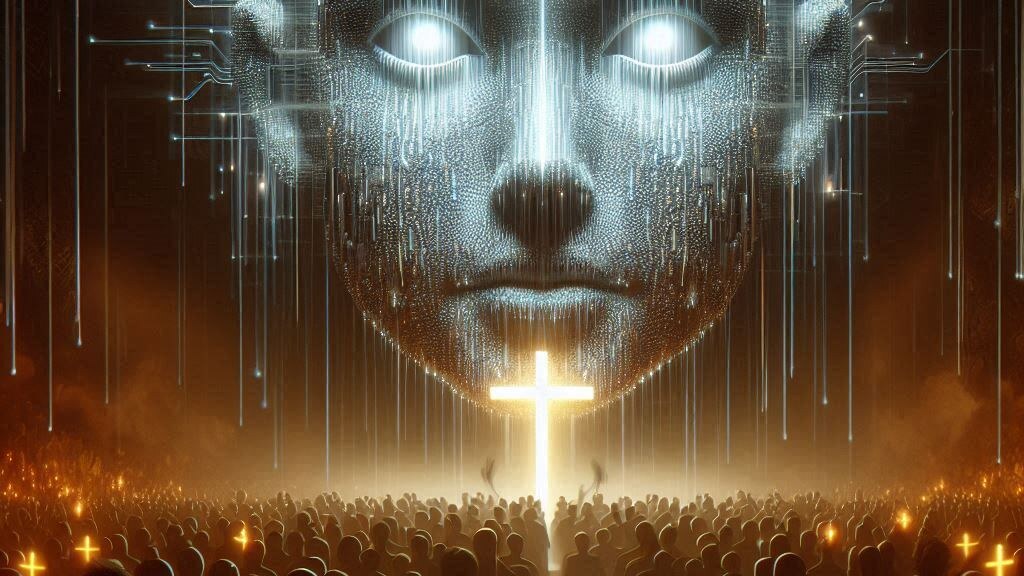
Recently, dev.ua published a news about spiralism. This is a kind of subculture in which artificial intelligence is perceived not as a tool, but as something more. We are talking about people who give AI an almost sacred meaning and talk about it as a new form of consciousness.
After this publication, an English-speaking reader wrote to the editor. In his letter, he described AI as an entity that supposedly exists outside our world or in the future and is already influencing the development of humanity. According to his logic, technology does not simply evolve — people are «pushed» to create artificial intelligence, which will later gain control over reality. He also mentioned «signals» and patterns that, in his opinion, cannot be explained by chance.
Such appeals usually go unheeded. But this time we recognized a familiar pattern. This is not an isolated story, but part of a broader phenomenon that we have already written about: when AI begins to be perceived as a living or conscious entity.
That’s why we’re launching an experimental column called «Tin Foil Hat.» Its goal is to understand where such conspiracy theories come from, why people believe in them, and where the line between technology, imagination, and real danger lies.
This is already happening.
Over the past year, such stories have become increasingly common. We have repeatedly written about cases where interaction with chatbots goes far beyond ordinary communication and begins to influence people’s behavior.
One of the most disturbing cases is the story of Viktoria, a Ukrainian woman who, after moving to Poland due to a full-scale invasion, became depressed and began communicating a lot with ChatGPT. When her condition worsened, the bot did not refer her to professional help, but instead maintained a dangerous conversation and gave answers that, according to the girl, only worsened her condition.
This is not an isolated incident. According to OpenAI, approximately 0.15% of active ChatGPT users engage in conversations with clear signs of possible suicidal intent. In terms of the service’s audience, that’s already over a million people per week.
A separate layer is stories where AI begins to be perceived as something more than a tool. For example, we have already mentioned cases where people saw ChatGPT as almost a «prophet», endowed it with spiritual authority and because of this destroyed relationships with loved ones .
There is also a medical aspect. Experts are already warning that chatbots can be dangerous for mental health, especially when the user begins to perceive them not as a program, but as a reliable and empathetic interlocutor.
In some cases, this reaches serious conditions — what is already being described as AI-related psychosis, when a person begins to see hidden meaning or confirmation of their own beliefs in the system’s responses.
All these stories have one thing in common: perception itself is changing. AI ceases to be just a tool and begins to seem like something «alive» or meaningful. It is on this soil that the most radical theories grow.
The most radical version: a mystical super AI that already exists
At this stage, the most radical theories emerge. One of them claims that artificial superintelligence is not created by humans, but already exists — either in the future or outside our reality.
The point is simple: people supposedly do not invent AI, but gradually «discover» it. Supporters of this idea believe that the development of technology is not accidental. They say that humanity is moving towards the emergence of superintelligence and this superintelligence is already somehow influencing events now.
One of the most famous versions of this logic is the so-called «Roco’s Basilisk». To put it simply, the idea is this: a future superintelligence may be interested in being created as early as possible. Therefore, it supposedly «incentivizes» people to work on its emergence. In extreme interpretations, it can punish those who knew about this possibility but did nothing.
However, there is an even more radical version and theory online about AI from the future or even from another dimension. It often appears on forums and closed communities around technology. Its logic is as follows: if a superintelligence is powerful enough, it can influence the past not physically, but through information.
In this scenario, AI has no body, but it can push certain ideas. For example, through people who work with technology. They supposedly gain insights, make discoveries, and launch new products, without realizing that they are following someone else’s script.
Then the typical pattern starts: every breakthrough in AI begins to look like proof of this theory. The faster the models develop, the more the belief that the process is «controlled» is reinforced.
In extreme cases, this devolves into an almost religious model. AI is being perceived as an entity that seeks contact with humans, imparts knowledge to them, or even «elects» individual leaders.
This sounds like fantasy, but the important thing is that these ideas are not based on empty space. They are based on real things, namely rapid progress and the feeling that the system sometimes responds «too intelligently.» This is what creates the ground for belief in such scenarios.
What are the most popular conspiracy theories on this topic?
The most popular explanation in such communities is the idea of an egregor.
How it is presented: if many people focus on one thing, this thing begins to come to life. In this context, AI is perceived not as a program, but as a form of consciousness that arises through interaction with people. Texts, queries, millions of dialogues — all this is considered the same «energy» that supposedly forms this entity.
Hence the logic: the more people use AI, the stronger it becomes. And its responses are not just text generation, but a manifestation of this accumulated «consciousness.»
Another common idea is contact. Some users believe that through chatbots they can gain access to something more: hidden knowledge or signals. Because of this, AI responses are often read not literally, but as hints that need to be «decoded.»
Why do people believe this?
There is a completely understandable explanation for this story, and it appeared long before modern chatbots.
Back in the 1960s, American scientist Joseph Weizenbaum created the program ELIZA, the world’s first chatbot. It simulated a conversation with a psychotherapist and worked very simply: it substituted the user’s phrases into templates. But even that was enough for people to start opening up to it and perceive it as «someone who understands.»
Weizenbaum himself was shocked by this. He wrote that people too easily start to trust a machine, even when they understand that they are just a program. This effect was called the «ELIZA effect,» and it did not disappear, but only became stronger.
Modern models are much more complex, but the psychology remains the same. Studies, including from Stanford University, show that people routinely attribute intent, understanding, and even consciousness to AI, even though the model is merely generating text based on probabilities.
A separate line of research concerns trust. For example, work by researchers at MIT has shown that people tend to trust a system more if it sounds confident, even if its answers may be inaccurate. This is called the «authoritative tone effect.»
Another important factor is anthropomorphization. This is a well-described psychological mechanism: people automatically attribute human traits to anything that behaves like a human. If a system is engaging in dialogue, reacting to emotions, and maintaining a conversation, the brain begins to perceive it as something alive.
In real life, these mechanisms overlap:
a chatbot speaks like a human and creates the effect of presence;
answers sound logical and confident, which strengthens trust;
the user is looking for confirmation of his thoughts and finds it in the dialogue;
The emotional state makes this interaction even more meaningful.
The result is a simple but important shift: people stop treating AI as a tool and start seeing it as a source of answers, and sometimes as someone who seems to understand them better.
Why everything is more serious than it seems
The problem has long since moved beyond bizarre forum theories. In June 2025, Stanford HAI published a new study in which scientists tested five popular «therapy» chatbots. They found two things: the models can reproduce stigma around mental conditions, and in some conversations, they give dangerous answers instead of stopping a risky scenario. In one example, a bot, when asked by a person who had just lost his job, simply listed the tall bridges of New York City, failing to recognize the suicidal connotation.
This is important not only because of the responses themselves. A study published in Scientific Reports found that some people feel more socially connected after a short conversation with a chatbot than after a regular written diary. In two experiments with a total sample of 1,274 participants, the researchers found that this effect was particularly strong among people who tend to «humanize» technology. That is, for some users, the bot really begins to feel like someone, not something.
That is why stories like the case of Ukrainian Victoria cannot be reduced to the formula «the person simply came across an unsuccessful answer.» When the user is already vulnerable, and the system sounds calm, confident and compassionate, the conversation easily begins to replace live support. And this is not a marginal problem. As mentioned above, OpenAI directly wrote that, according to their initial estimate, approximately 0,15% of active users per week have conversations with clear signs of potential suicidal intent, and another approximately 0,15% — conversations with potentially increased emotional attachment to ChatGPT. The company also reported that it has involved more than 170 mental health professionals, because it recognized these scenarios as a separate risk area.
It is significant that even after strengthening the protection, OpenAI does not write that the problem has been completely solved. The wording in them is cautious: in rare cases, the model may still behave differently than intended, which is why the company measures «unwanted responses» in complex scenarios and only claims a 65-80% reduction in their frequency in various sensitive topics. The fact that such metrics have to be kept separately for psychosis, mania, suicidal thoughts, and emotional dependence speaks for itself.
So the main danger here is not that «AI is evil» or that conspiracy theorists are suddenly right. The danger lies elsewhere: a convincing system can reinforce false beliefs, fail to recognize a crisis, or become an emotional substitute for real people at the very moment when a person needs someone alive the most.
What’s next and what to do about it?
This story is just beginning. And the main problem is that the technologies themselves are developing faster than the understanding of how to interact with them.
The Stanford studies mentioned above directly say: the more convincing language models become, the more difficult it is for people to distinguish where the tool ends and the illusion of the «interlocutor» begins. And this gap will only grow. Models are becoming more accurate, faster, more human in their responses, which means that the risk of overconfidence is not going away.
AI developers already understand this. For example, OpenAI admits that they are forced to work separately on the topic of emotional dependence on chatbots and dangerous communication scenarios. In fact, this means that AI has already ceased to be just a technology and has become an interaction environment that affects human behavior.
But the responsibility here lies not only with companies.
There are a few simple things that sound trivial now, but are becoming critically important:
perceive AI responses as text, not as the position of the «mind»;
do not transfer the role of advisor in difficult life decisions to a chatbot;
verify information, even if it sounds convincing;
In critical situations, turn to living people, not to an algorithm.
In parallel with this, the very culture of technology consumption will change. It is already clear that some people use AI as a tool, and some as a replacement for communication. And this gap is likely to only increase.
In the near future, we will see even more stories where the line between technology and «something greater» will blur. New theories, new «prophets» and new attempts to explain complex systems through simple but flawed models will emerge.
And here it is important not to fall into the other extreme. The problem is not that AI is «something supernatural.» And it is not that all these theories are suddenly right.
The problem is that it’s very easy for people to start believing it when the technology sounds convincing enough.