Оксана СтепураAI Eng
27 August 2026, 11:05
2026-08-27
A developer has created a prototype of an AI dispatcher for support. How does it sort emails and monitor deadlines?
Ukrainian developer Mykola Chornyi has created a prototype of an AI system for automatically sorting support requests. It reads letters, determines their subject and urgency. Then it indicates the responsible manager in a table and notifies him in Telegram and reminds him if the client has not been answered on time.
Ukrainian developer Mykola Chornyi has created a prototype of an AI system for automatically sorting support requests. It reads letters, determines their subject and urgency. Then it indicates the responsible manager in a table and notifies him in Telegram and reminds him if the client has not been answered on time.
The prototype is called AI Ticket Routing & SLA Escalation. It runs on GPT-4o mini and combines Gmail, Google Sheets, and Telegram.
According to Chorny, he was creating a system for an online store where three managers had to process about 900 requests per month. Letters ended up in a shared mailbox, where they were manually read, sorted, and forwarded to the right manager. Because of this, payment problems and requests from important customers could get lost among spam and regular questions. And the average response time was 11 hours.
“The classic picture: 120 letters in the morning, the manager sorts them from top to bottom. A VIP client with a problem worth UAH 12,000 is waiting for his turn. And while he is waiting — opens a competitor's website," the developer explains.
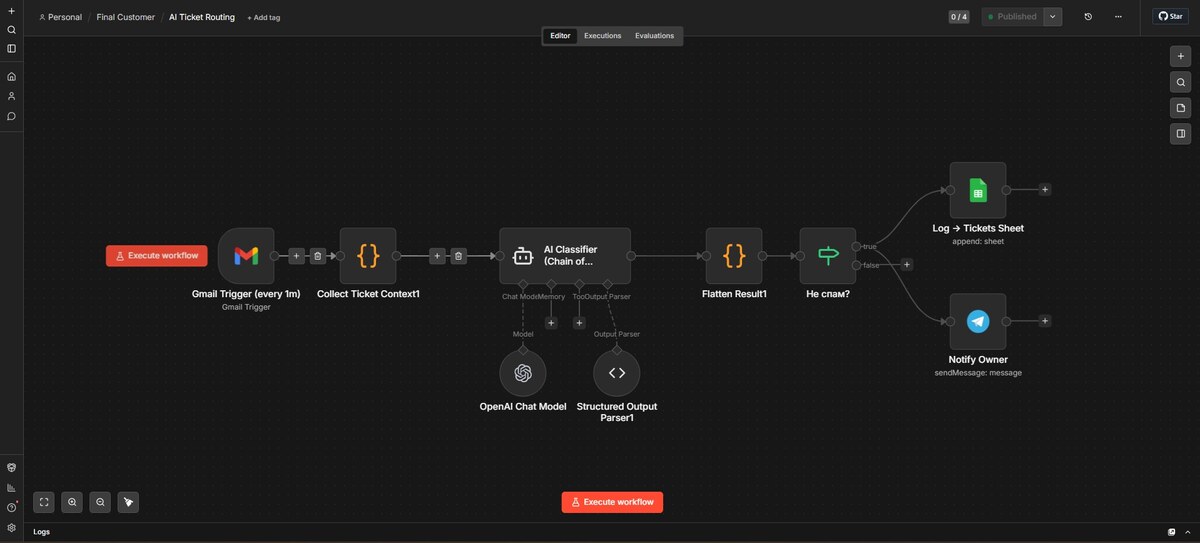
The developer divided the automation into two related workflows in n8n. The first checks for new unread emails in Gmail every minute. GPT-4o mini analyzes the request and determines what the client is writing about and how urgent the problem is. Then it assigns which manager should solve it and how much time is left for a response. The request data is stored in Google Sheets, and the responsible manager receives a message in Telegram.
Along with the decision, the system generates a short explanation. For example, a request may receive the highest priority due to a repeated payment problem, a large order amount, and the risk of losing a customer. To prevent the AI from adding its own categories and non-existent priorities, the result is checked against a predefined JSON schema.
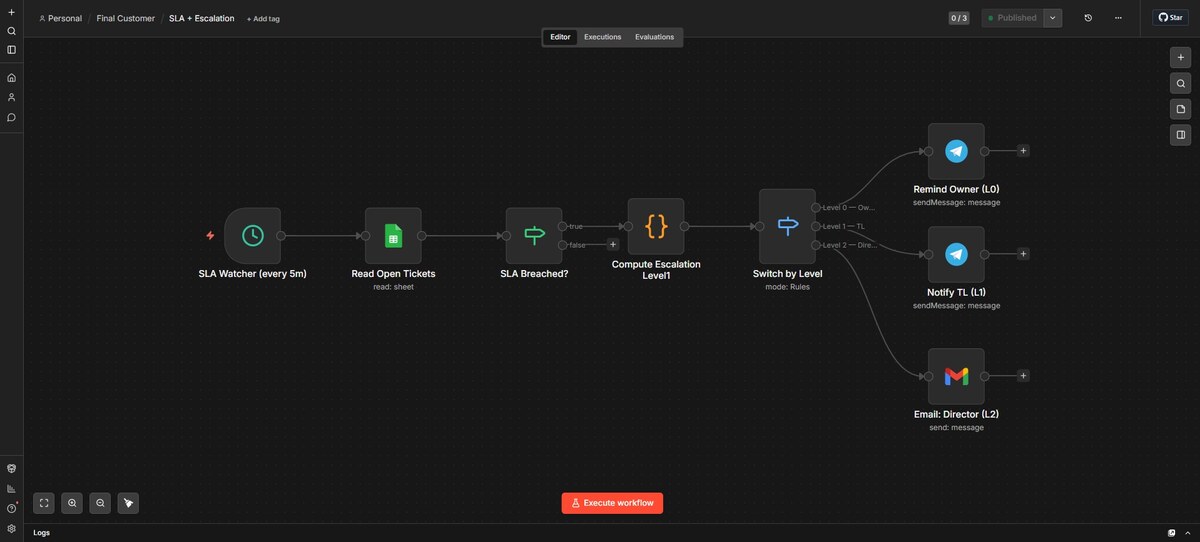
The second workflow, SLA Watcher, checks open requests every five minutes. The SLA in this system is a set time within which the team must respond to the client. If the deadline is violated, the system triggers an escalation. First, it reminds the responsible manager about the ticket, then notifies the team leader, and at the last level sends a letter to the director.
The author estimates that maintaining such a system could cost around $20–50 per month. He also suggests that the system will pay for itself in about two months, but does not provide a detailed calculation for this estimate.
The developer also notes that the project only ran on a test stream. It evaluated the performance of call routing, but did not measure whether prioritizing important requests helps retain customers or improve other business metrics. According to him, this would require an A/B test on a real stream: some calls would be processed using AI prioritization, and the rest according to the old scheme, after which the results would be compared.
Earlier, dev.ua wrote that Cisco has implemented "smart routing" of support requests. According to the company, almost 88% of requests are routed to the right engineer on the first attempt.