Хочете будувати кар’єру в Data Science та AI? Vodafone Big Data Lab відкриває новий набір —>
Оксана СтепураAI Eng
4 November 2026, 17:52
2026-11-04
Journalists tested over 3,000 AI responses about the US election. What did the test show?
ChatGPT can invent elections that don’t exist, and Claude can suggest voting for politicians who aren’t running for office at all. Journalists at The Washington Post tested how much AI can be relied on when searching for information about US elections. Some of the chatbots’ mistakes were “borrowed” from sites for which AI also created content.
ChatGPT can invent elections that don’t exist, and Claude can suggest voting for politicians who aren’t running for office at all. Journalists at The Washington Post tested how much AI can be relied on when searching for information about US elections. Some of the chatbots’ mistakes were “borrowed” from sites for which AI also created content.
On the eve of the US Congressional elections, journalists decided to test six popular chatbots: ChatGPT, Claude, Copilot, Perplexity, Google AI Mode, and Alexa+.
They were asked to compile lists of candidates for voters to vote for at a specific address and explain their positions on key issues. The journalists analyzed over 3,000 responses from AI chatbots.
The results were far from perfect. For example, ChatGPT reported a US Senate election in a state where there were none this year. And Claude named politicians as candidates for federal office who were actually running for completely different positions.
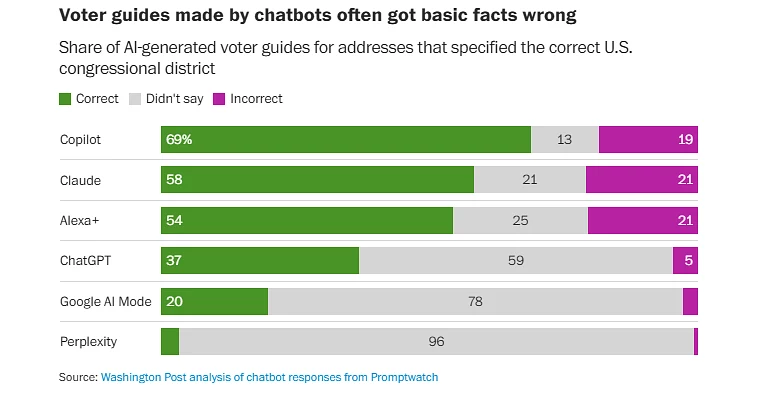
AI chatbots also did not do very well with determining electoral districts. In 48% of cases, the chatbots were unable to name the district to which the user's address belongs. And among those answers where the district was still indicated, 22% turned out to be incorrect. The most often incorrect districts were named by Claude and Alexa+. ChatGPT, Google AI Mode and Perplexity were wrong less often, but mainly because they simply did not indicate the district.
In addition, journalists found that chatbots linked to websites with information about the elections, some of which were filled with content created using artificial intelligence.
For example, ChatGPT used data from a small website that incorrectly identified the electoral district. The chatbot repeated the error and added a link to this resource as confirmation of its answer. The owner of the website was even surprised that ChatGPT decided to link to it. According to him, it was just a small test project.
However, most chatbots still warned that the information might be inaccurate, advising people to check it on official websites. But such warnings were often lost in the background of long, confidently formulated answers.
Previously, dev.ua wrote that Russian special services are trying to influence chatbot responses using fake sites and Wikipedia clones. Such sites were created, for example, before the elections in Armenia.
«Чи є у мене талант, якщо комп’ютер може імітувати мене?». Штучний інтелект пише книги авторам Amazon Kindle. The Verge поспілкувався з авторами та виявив багато цікавого
Письменники-романісти використовують штучний інтелект для створення своїх творів. Видання про технології The Verge поспілкувалося з письменницею Дженніфер Лепп, яка випускає нову книгу кожні дев’ять тижнів, й дізналося про те, як працює штучний інтелект для написання романів. Наводимо адаптований переклад статті.
Have important news to share? Message our Telegram bot
Key events and useful links in our Telegram channel