“The decision always remains with the person”: Ukrainian developers have created the AI platform Talkruit, which takes over the entire hiring funnel — from screening to checking test scores
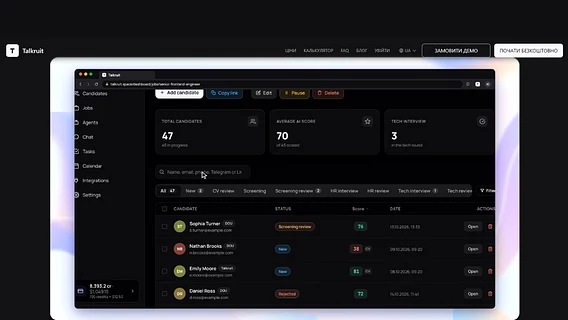
Two Ukrainian developers, Marko Golyak and Lubomyr Pytulya, launched the AI startup Talkruit, which combines the entire IT hiring funnel in one window — from synchronizing job board responses to conversations with a voice agent and running test cases in a sandbox.
Co-founder of the startup, Lyubomyr Pytulya, told dev.ua how the pet project grew into a commercial product, how much development costs, how monetization works, and what the competition is like in the HR technology market.
How a regular work project grew into an AI recruiting startup
The idea to create Talkruit was born during a normal work routine. Fullstack developers Marko Golyak and Lubomyr Pytulya worked at the same IT company on a joint project where they created a voice AI agent for conversations on various topics. Later, a practical question arose: how to teach such an agent to communicate with candidates and prepare short conclusions about them to relieve recruiters?
The founders of Talkruit are Marko Golyak and Lubomyr Pytulya.
When the first voice agent was up and running, the next problem arose: where to take the candidate next. Instead of the usual Google Meet or Zoom, the founders decided to create their own platform with flexible settings and manual control. This is how HR and technical interviews appeared in the system.
An important catalyst was the company where Marko and Lubomyr worked. They became interested in the development and started using it in real hiring — with all the non-ideal scenarios and live data. It was there that the product was polished by trial and error, and later they added automatic verification of test tasks so that developers did not have to deploy the candidate repository every time and run everything manually.
“Talkruit takes over the hiring routine, from the response on Djinni to the interview report, and the decision about the candidate remains with the person,” explains one of the founders of the startup, Lubomyr Pytulya.
Once the system stabilized, the creators started cold-outreach and offered free access. That's how they reached out to an outstaffing company that was developing a similar tool for their own needs. After a demo, the team became seriously interested in the product — and it became the first external client.
A team without a sales department and launching on real vacancies
The startup has two co-founders — Lubomyr Pytulya and Marko Golyak. There is no clear division of roles: tasks are distributed situationally, since there are always more ideas than time. Development is carried out independently with the involvement of AI tools, and correspondence with clients, calls, and posts on LinkedIn are also closed by the two of them — there is no separate sales or marketing department in the team.
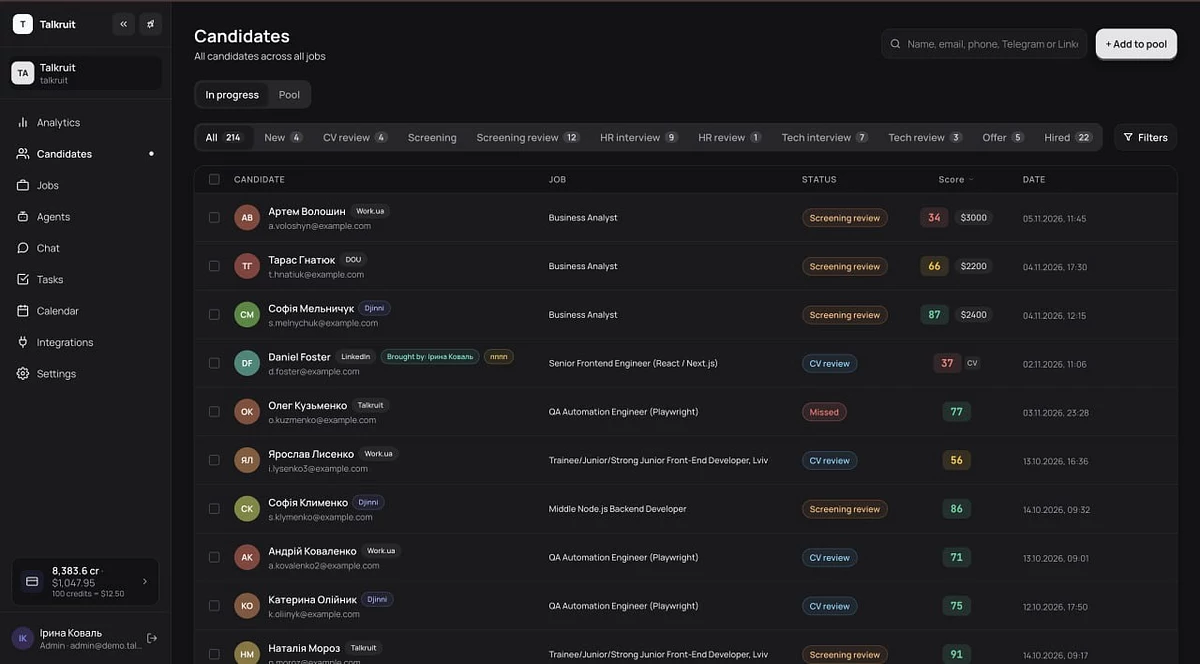
They started writing the code in mid-June 2026 in their free time from their main job. Already in the summer, the first version worked on real vacancies in the company where the founders worked, and later the first external client appeared. Currently, the entire hiring funnel goes through Talkruit: reviews from Djinni, Work.ua and Jobico are pulled up, resumes are analyzed, first conversations with AI are held, HR and technical interviews are held, live coding is carried out, test results are checked and final reports are generated.
The technical stack and what exactly AI does
The product backend is written in Node.js and TypeScript and runs on a server in Google Cloud, the office interface is implemented in Next.js and hosted on Vercel. Data is stored in Postgres on Supabase with isolation for each company at the database level, and video communication works through LiveKit deployed on its own server.
The voice agent is built as a bundle of three services: Soniox is responsible for speech recognition, Gemini Flash generates responses, and Cartesia voices them. The recording of each interview gets a separate virtual machine, which is shut down after the call ends, and test tasks are collected and run in an isolated Cloud Run environment.
In the system, AI performs a number of clearly defined tasks:
compares the resume with the requirements of the vacancy;
conducts the first conversation with the candidate in Ukrainian or English (including checking English in the middle of the Ukrainian HR conversation) and forms a first impression;
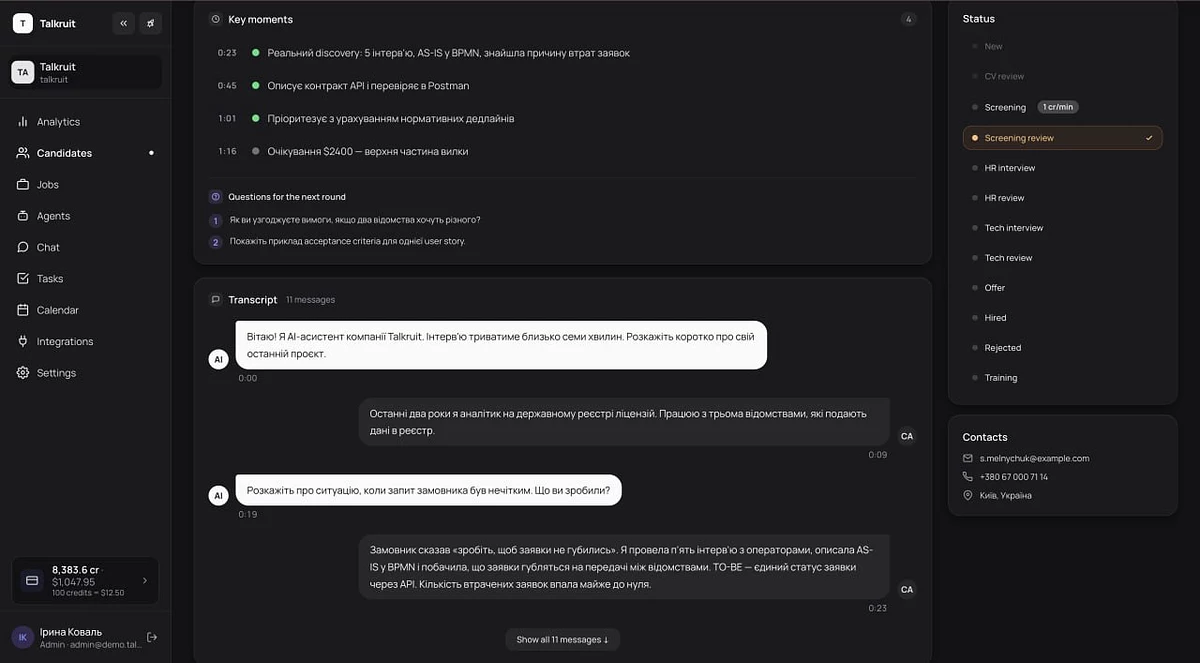
analyzes directly the video of HR and technical interviews (not just the transcript) and sets timecodes;
assembles a project from a test case, writes and runs tests, checks the interface, and searches the code for access keys or passwords;
consolidates data about the candidate into a single report.
The model returns the result according to a rigid scheme - if the structure is violated, the answer is rejected. The technical interview score is checked or corrected by the team leader, the test scores are calculated by the code according to fixed rules, and the final decision about the candidate always remains with the person.
Opportunities in the hiring funnel
The Talkruit platform integrates the stages from receiving feedback to comparing finalists.
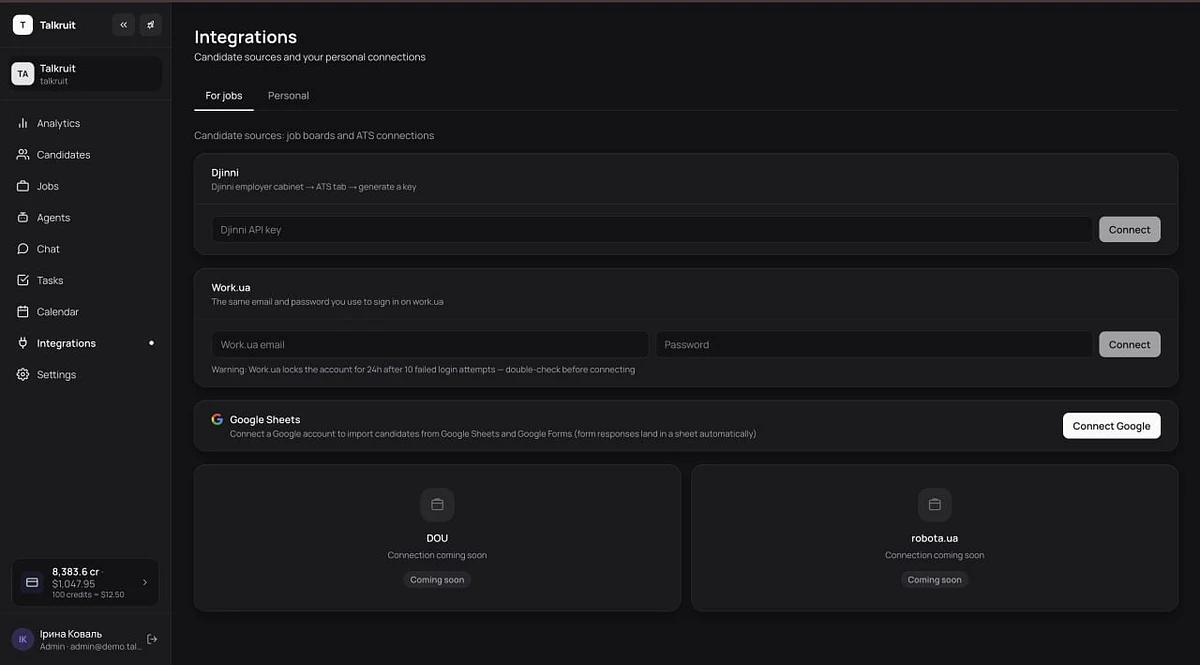
Candidate sources: automatic synchronization with Djinni, Work.ua and two-way integration with Jobico (including job posting and status transfer), import from Google Sheets, own job page, talent pool with auto-fill profile and separate account for sourcers. The system does not allow one candidate to be listed in several company vacancies at the same time.
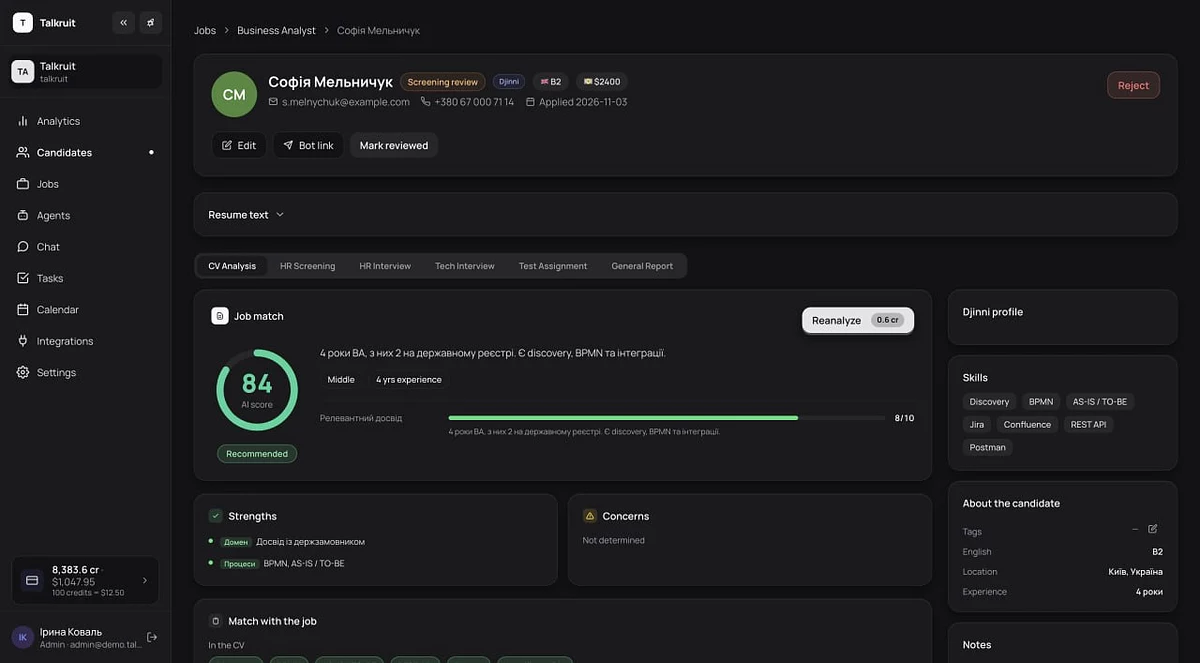
Working with vacancies and CVs: AI helps to form requirements and evaluation criteria, parses resumes, adds tags (for example, "Courses") and can automatically invite those who have passed the specified thresholds to the first conversation.
First conversation with AI : The candidate communicates by voice in the browser at a convenient time according to the template of a specific role. A separate AI controller checks the agent itself - whether he did not repeat questions, did not ignore the candidate's questions, and did not invent facts.
Interviews and live coding: self-selection and transfer of slots with Google Calendar or Outlook synchronization, recording meetings in Talkruit, via the Google Meet extension or by uploading a recording from Zoom or Teams. In the built-in live coding editor (JS, TS, React, Python, Go, Java, C++), the candidate and the team leader work together, and the AI assistant permission level for the candidate is configurable - from access only to documentation to full-fledged assistant mode.
Risk signal detector: during a call, the system captures with timecodes moments that the interviewer should check (switching tabs, inserting large code fragments, extraneous sounds or people in the frame, a sharp change in the style of answers), but does not automatically reject the candidate.
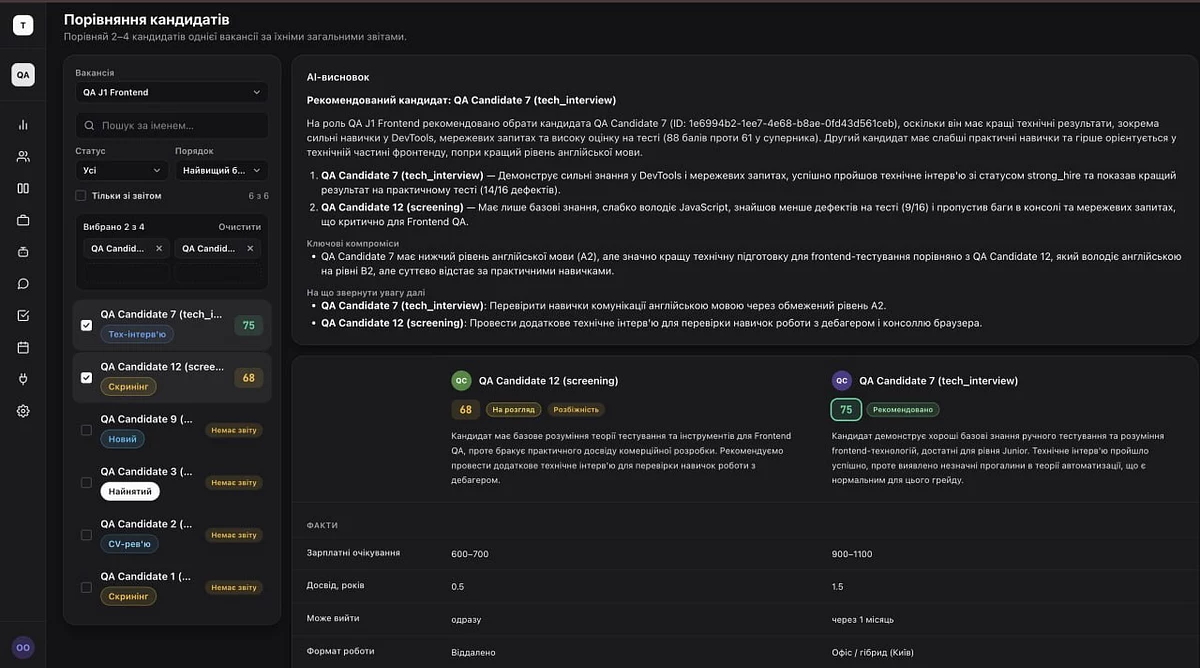
Comparison and analytics : a recruiter can compare two to four candidates with summary reports in one table, view conclusions and compromises from AI, track conversions, costs for each stage and candidate, and set up communication via email and Telegram bot.
Competitors, money and development plans
There are already voice AI recruiters on the market (in particular, the notable Ukrainian project careeo.tech), classic HR systems like Hurma or PeopleForce, where the first conversation is led by a person, as well as global solutions like HireVue.
"Our main difference is that the entire funnel is collected in one place — from the candidate's feedback to the interview report, so the recruiter does not have to stitch together five different services. We work on a pay-for-actual-use model: no subscriptions or payments for the number of users — the company simply buys credits and spends them on specific operations, and we give new clients trial credits for 14 days. We also actually run test tasks in the sandbox, and not just let the language model read the code, we are able to record live interviews, including in Google Meet, and generate a report with timecodes. And most importantly — we first tested each function on real vacancies and refined it based on the feedback of recruiters and team leaders," notes Pytulya.
At the start, $300 in Google Cloud credits was enough — the developers tested the product in their free time without their own investments, and after the first client appeared, they received another $2,000 in credits under the Google for Startups program. Currently, the team is negotiating investments with one of the outstaffing companies and estimates the budget for next year at approximately $45,000 — taking into account the founders' salaries, infrastructure, voice services, and outreach.
The monetization model is based on credits: $100 corresponds to 800 credits. For example, a resume analysis costs about 7.5 cents, a minute of conversation with AI costs 12.5 cents, a minute of recording and analyzing an interview costs about 6 cents, and checking a test score costs $2.5. An Outstaff company with 50–200 people spends approximately $250–400 per month on the system.
The founders' immediate plans are to register an LLC, connect card payments, expand integrations with ATS (Hurma, PeopleForce, later Greenhouse, Lever, Workable) and open the API, move to their own server for a larger number of simultaneous conversations, and prepare a version for the EU with data placement in Frankfurt and compliance with the requirements of the AI Act. In the spring, the startup plans to reach the first customers in the USA, and later - in Poland and Eastern European countries with the addition of new languages.
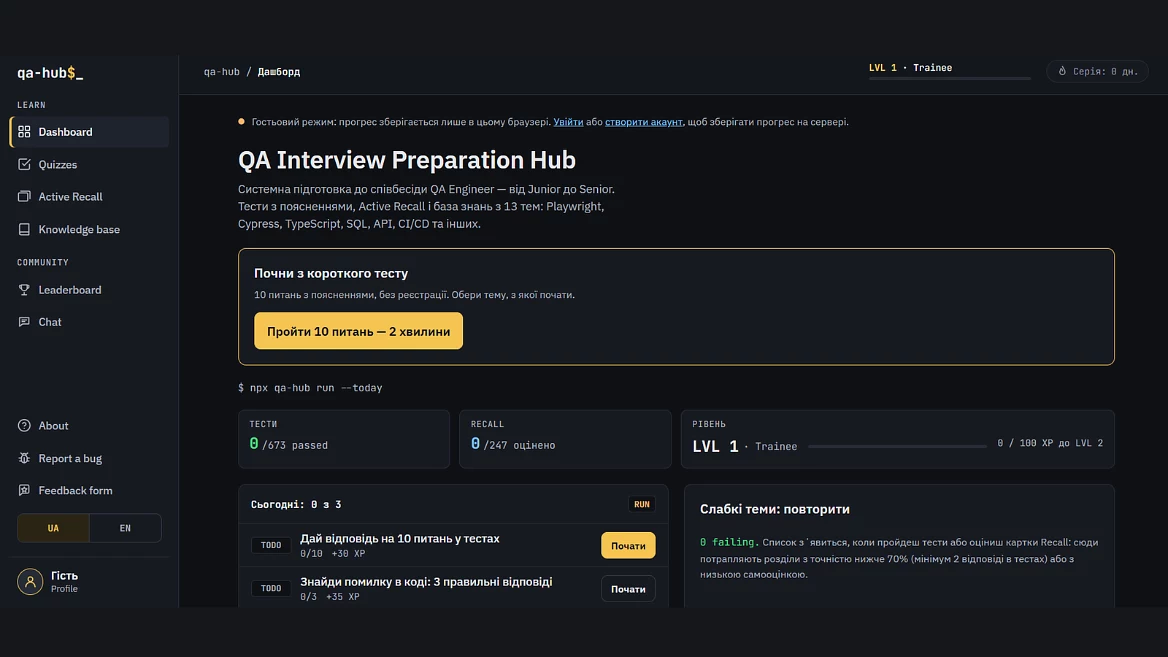
A Ukrainian QA engineer has created a free online simulator for preparing for interviews. The QA Interview Hub already has 673 questions and 495 articles
Як нейромережі бачать вільну та незалежну Україну? Тест dev.ua
Нейронні мережі для генерації зображень бачать світ по-своєму, їхню логіку зрозуміти часом зовсім неможливо. Але таки хочеться. На честь Дня Незалежності України редакція dev.ua вирішила провести невеликий експеримент.
Ми задали чотирьом різним нейронним мережам п’ять однакових запитів: «прапор України», «День Незалежності України», «український Крим», «перемога України» та «українці». Отриманими результатами ми ділимося з вами нижче.
У TikTok тепер можна генерувати фон за допомогою нейромережі. Ми протестували її та ділимося результатами
У TikTok з’явилася нова функція «Розумний фон». З її допомогою як фон для тіктоків можна підставляти згенеровані нейромережею зображення. Редакція dev.ua протестувала цю технологію і ділиться своїми враженнями.