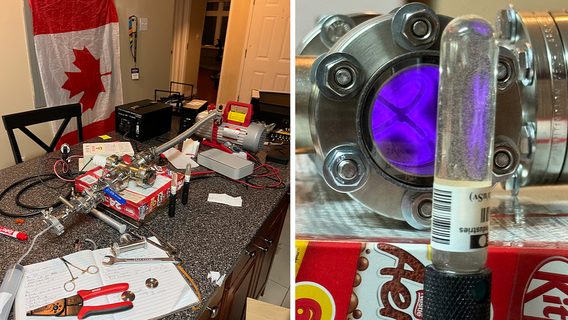
A Canadian man has created nuclear fusion at home for $3,000 using AI from Anthropic and OpenAI. It took him just two days to build the setup.
This was reported by Wccftech, citing X (Twitter) of a man with the nickname Hudzah, who shared his experiment on the social network. He used materials such as hydrocarbon and deuterium oxide, also known as «heavy» water.
Anthropic’s AI chatbot Claude allowed him to review the project’s documentation and setup instructions, while OpenAI’s o1 pro model helped him figure out the wiring and assembly. The goal of the project was to create a nuclear reactor at home.
Artificial intelligence allowed him to build the setup in just two days after ordering the necessary parts. According to the man, the most technically challenging part of the experiment was building a chamber capable of withstanding extremely low air pressures, measured only in single-digit or low-double-digit millitorrs (mTorr). The two most expensive components of his setup included equipment to generate a voltage of 30 kilovolts (kV) and a vacuum of 5 to 15 mTorr.
over a 36-hour livestream, I built a neutron-producing nuclear fusor in my kitchen using Claude.
successfully achieving nuclear fusion, entirely assisted by AI.
Hudzah estimated that if he had relied on readily available equipment, his experiment would have cost around $15,000. However, publicly available instructions allowed him to use a $120 two-stage vacuum pump and $60 electrostatic capacitors on Aliexpress to build the equipment.
The third step was to acquire a gaseous form of hydrogen called deuterium. Hudzah notes that while purchasing the gas requires «special authorization and is only sold in quantities of more than 500 liters,» he was able to devise a simple workaround. Instead of buying 500 liters of the gas, he purchased a children’s fuel cell car, removed the proton exchange membrane (PEM) from it, and used it to convert readily available deuterium oxide (D2O, or heavy water) into deuterium.
Installation testing
Hudzah and his friends spent about 6 hours assembling the setup and creating a 3 mTorr pressure in the vacuum chamber. They also had to deal with Chinese-language documentation, find a step-up transformer, and replace a burned-out vacuum sensor.
building a fusor to do fusion is an order of magnitude more lethal.
the specs of this setup: — 30kV/10mA electrostatic precipitator — 3 mTorr of pressure (253,333x more vacuum than atmospheric) — bubble counter to count neutrons — hydrocar to electrolyze my own deuterium pic.twitter.com/GQNgPoGFR8
They eventually managed to carry out nuclear fusion for 3 hours. Hudzah said that since he had no lead sheets for protection, he «turned on the system, opened the needle valve to release the deuterium, and ran to his room to hide.» He recalled that «the neutrons and X-rays that are emitted during this cause cancer» and that lead shields should be used for protection.
He said AI helped him with debugging and information processing. He sped up the build with Claude Projects because it allowed him to «intensely debug, help with safety, and follow unknown instructions that were described during the build process.» OpenAI o1 Pro also helped him with «very complex assembly and wiring issues.»
Як нейромережі бачать вільну та незалежну Україну? Тест dev.ua
Нейронні мережі для генерації зображень бачать світ по-своєму, їхню логіку зрозуміти часом зовсім неможливо. Але таки хочеться. На честь Дня Незалежності України редакція dev.ua вирішила провести невеликий експеримент.
Ми задали чотирьом різним нейронним мережам п’ять однакових запитів: «прапор України», «День Незалежності України», «український Крим», «перемога України» та «українці». Отриманими результатами ми ділимося з вами нижче.
У TikTok тепер можна генерувати фон за допомогою нейромережі. Ми протестували її та ділимося результатами
У TikTok з’явилася нова функція «Розумний фон». З її допомогою як фон для тіктоків можна підставляти згенеровані нейромережею зображення. Редакція dev.ua протестувала цю технологію і ділиться своїми враженнями.