Хочете будувати кар’єру в Data Science та AI? Vodafone Big Data Lab відкриває новий набір —>
Марія БровінськаGadgets
18 May 2026, 09:13
2026-05-18
The advent of smartphones caused a sharp drop in the global birth rate — researchers found a direct link to the launch of 4G
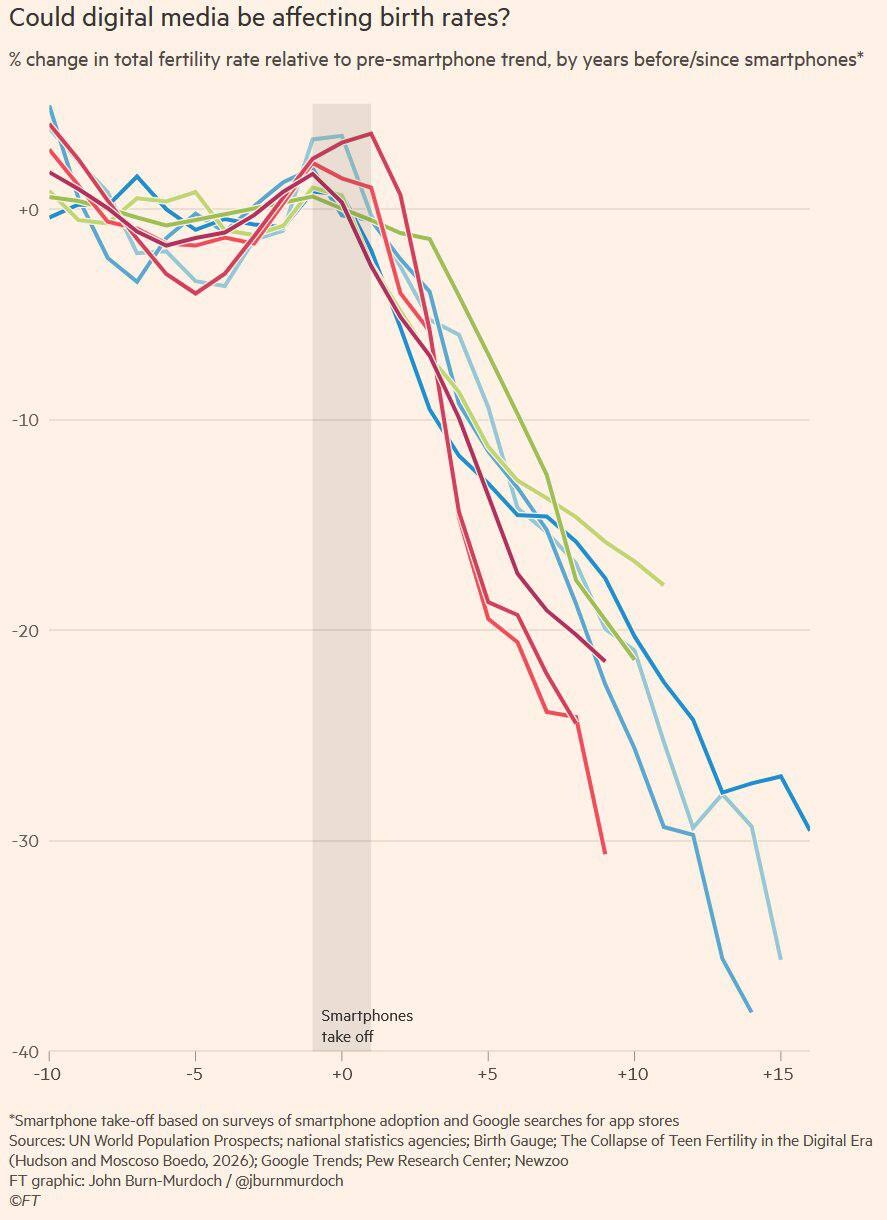
Economists Nathan Hudson and Hernan Moscoso-Boedo have found a link between falling birth rates and the launch of 4G networks. According to their data, in the US and the UK, birth rates fell faster in regions where high-speed mobile internet appeared earlier than in others.
Economists Nathan Hudson and Hernan Moscoso-Boedo have found a link between falling birth rates and the launch of 4G networks. According to their data, in the US and the UK, birth rates fell faster in regions where high-speed mobile internet appeared earlier than in others.
Researchers believe, writes the Financial Times, that digital technologies have changed the lifestyle of young people and reduced the amount of live communication. A similar pattern has been recorded in many countries: in the USA, Britain and Australia, the birth rate among young people began to fall sharply after 2007, in France and Poland — after 2009, in Mexico, Morocco and Indonesia — after 2012. Later, similar trends were recorded in Ghana, Nigeria and Senegal.
The coincidence, scientists believe, is not accidental: the mass distribution of smartphones began in the late 2000s — the first iPhone appeared in 2007, the Android platform — a year later.
The scale of the problem is staggering. 71% of the world’s population already lives in countries with a fertility rate below the replacement level of 2.1 children per woman. Among the major economies: China — 1.02, the United States — 1.62, Brazil — 1.60. The Lancet forecast is even more dire: by 2100, 97% of countries will be below the replacement level — a demographic shift without historical precedent.
While researchers aren’t saying smartphones are the sole cause, they’re seen as a contributing factor, along with rising costs of living, behavioral changes, and economic instability. But the chronological coincidence across dozens of countries on different continents is hard to ignore.
Дослідження, про які пише Financial Times, справді підкреслюють цікаву й тривожну тенденцію: поширення смартфонів та цифрових технологій збіглося з різким падінням народжуваності серед молоді в багатьох країнах світу. І хоча кореляція не завжди означає причинність, науковці дедалі частіше звертають увагу на те, як цифрове середовище змінює соціальну поведінку. https://melonplayground.io












Дослідження, про які пише Financial Times, справді підкреслюють цікаву й тривожну тенденцію: поширення смартфонів та цифрових технологій збіглося з різким падінням народжуваності серед молоді в багатьох країнах світу. І хоча кореляція не завжди означає причинність, науковці дедалі частіше звертають увагу на те, як цифрове середовище змінює соціальну поведінку. https://melonplayground.io