Валентин ШнайдерGadgets
15 September 2025, 16:10
2025-09-15
2TB SSD the size of a SIM card: Chinese Biwin introduces a new drive that can replace microSD
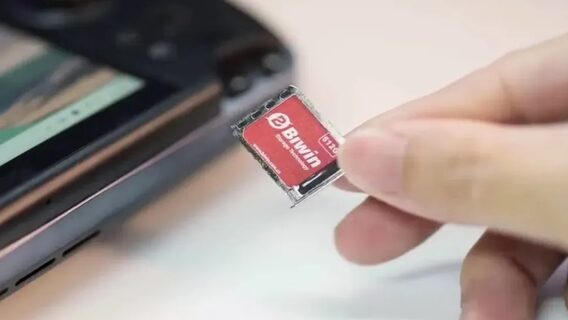
Chinese manufacturer Biwin has introduced a revolutionary storage format — the Mini SSD, which resembles a SIM card in size, but provides storage capacity of up to 2 TB and speed exceeding the capabilities of microSD.
Chinese manufacturer Biwin has introduced a revolutionary storage format — the Mini SSD, which resembles a SIM card in size, but provides storage capacity of up to 2 TB and speed exceeding the capabilities of microSD.
This is reported by TechRadar. The novelty has dimensions of only 15×17 mm and a thickness of 1.4 mm. At the same time, it provides a read speed of up to 3700 MB/s and a write speed of up to 3400 MB/s via the PCIe 4×2 interface. This is significantly higher than the microSD Express performance, which is limited to about 985 MB/s, and close to SD Express (3940 MB/s), although the latter is almost twice as large.
The Mini SSD can be removed like a SIM card — using a tray and a special key. The device has IP68 protection against water and dust and can withstand drops from a height of up to three meters, making it suitable for smartphones, tablets, laptops and portable consoles. The first devices to support the new format have already been the Chinese gaming gadgets GPD Win 5 and OneXPlayer Super X hybrid.
However, the main challenge for Biwin is standardization. Experts emphasize that the success of microSD at one time was ensured by the fact that SanDisk immediately submitted the format for approval to the Secure Digital Association (SDA). If Biwin submits the Mini SSD for consideration by the SDA or PCI-SIG, other manufacturers may support it, opening the way for mass use.
How is Mini SSD better than microSD?
Despite its compactness and protection, the Mini SSD is still inferior to the most productive M.2 drives, which reach speeds of 14,000 MB/s. At the same time, it is radically superior to microSD: while most cards used in smartphones today operate at speeds of up to 100–160 MB/s, and even microSD Express is limited to 985 MB/s, the Mini SSD provides 3700/3400 MB/s. This puts it in a completely different league and makes it a real candidate to replace microSD, if Biwin can achieve standardization and mass adoption of the format.