Хочете будувати кар’єру в Data Science та AI? Vodafone Big Data Lab відкриває новий набір —>
Марія БровінськаStartup
2 February 2025, 14:41
2025-02-02
The developer Railsware has created a stochastic time tracker that allows you to track the time spent on various activities throughout the day at random points in time and adjust your performance. How this iOS app works
Leonid Shevtsov, a software architect from the product company Railsware, created a stochastic time tracker that helps you track your time and maintain a balance between household chores, work, and other activities throughout the day.
Leonid Shevtsov, a software architect from the product company Railsware, created a stochastic time tracker that helps you track your time and maintain a balance between household chores, work, and other activities throughout the day.
«Half for fun, half for business, I tried to implement a special time tracker on SwiftUI. It is special in that, instead of manual journaling or automatic data collection, the tracker asks you what you are doing now. And so that it is not predictable, the query interval will be stochastic, that is, random. Sometimes — in five minutes, sometimes — in two hours. The randomness of the moment makes such a tracker unbiased (if you always enter exactly what you are doing now.) Over a long period of time, statistics give a true distribution of time,» Leonid told dev.ua.
As a guideline for development, he took TagTime from Beeminder, which looks like a bunch of Perl scripts and, accordingly, can only work on the desktop.
However, Leonid decided to make an application for Apple Watch and take advantage of the ubiquity of the watch. «WatchOS has such an interesting feature as long look for notifications — in fact, an entire interactive screen, available directly when viewing a notification. In addition, using the CloudKit database and the versatility of SwiftUI makes it easy to make an application that can be entered from a desktop, from a phone or from a watch — wherever is more convenient. And the Apple Health integration can automatically log sleep and exercise. And it looks as if all this does not require much effort, dynamic programming, and so on,» the IT expert explains.
Leonid notes that, ingeneral, the random interview technique is an established approach in psychology, designed to improve awareness and self-understanding.
«I would say that my development is for people with a special character who want to understand what they are spending their time on and are ready to respond to random requests from the tracker. In the future, I also want to add an emotional state questionnaire,» says the developer.
He understands that not all users are ready for random questions, so he does not predict a million-strong audience for the service. «I’m glad that there are already several active beta users,» says Leonid, who himself actively uses his development. «I use it constantly and keep a neat record of my own time. So I looked into whether such a record could help with work reports.»
Here are the important nuances of the time tracker’s operation noted by the author of the project.
It’s easy to take notes. In practice, Leonid manages to write down more than 90% of the notes. If you don’t write them down right away, it often becomes impossible later, because…
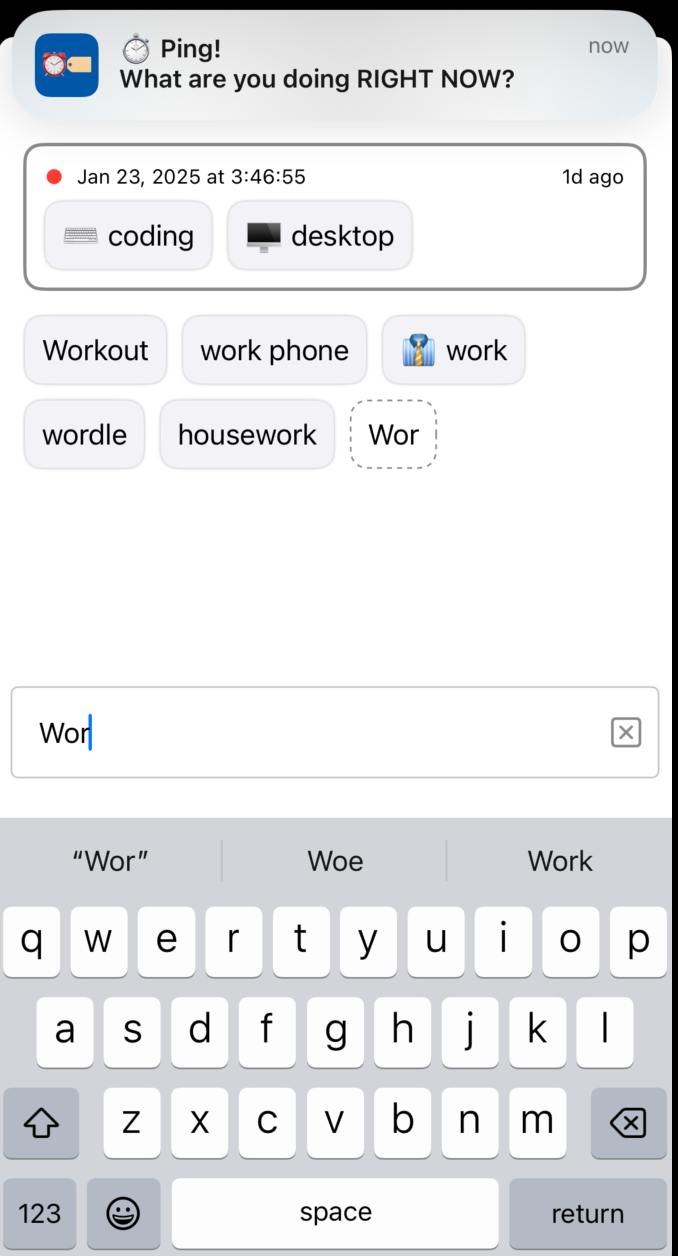
Tag input form
This tracker needs to record what you are doing at the moment. If I am writing a post and then switch to the news, and at that moment the tracker ping comes, I will write down «reading the news.» It turns out that, except for really continuous activities, after ten minutes you will not remember the exact data.
Stochastic Time Tracker requires a strong belief in statistics. At first glance, it looks dishonest because it either misses important activities (I was in a car for an hour, there were no pings) or, conversely, exaggerates minor ones (three pings in 10 minutes of washing my hands). Therefore, it is necessary to remember that statistically this method is absolutely honest, more honest than when you enter time at your own discretion — because in this case you skip «minor» or simply unpleasant segments (such as watching the news while «writing a post»). And the statistical tracker, on the contrary, draws attention to such «trifles» — if you «read the news» more often than «write a post», then this is already a reason to think about the time spent.
The lack of predictability of pings and the need to manually enter the time leads (can lead) to a general heightened awareness — not for the sake of the tracker, but for your own sake. When you remember that a ping can come at any moment and you have to write down «reading the news,» you don’t really want to spend a lot of time on it. But it can also be frustrating when you work non-stop for three hours and there are no pings. You’re out of luck. But the point isn’t in the pings.
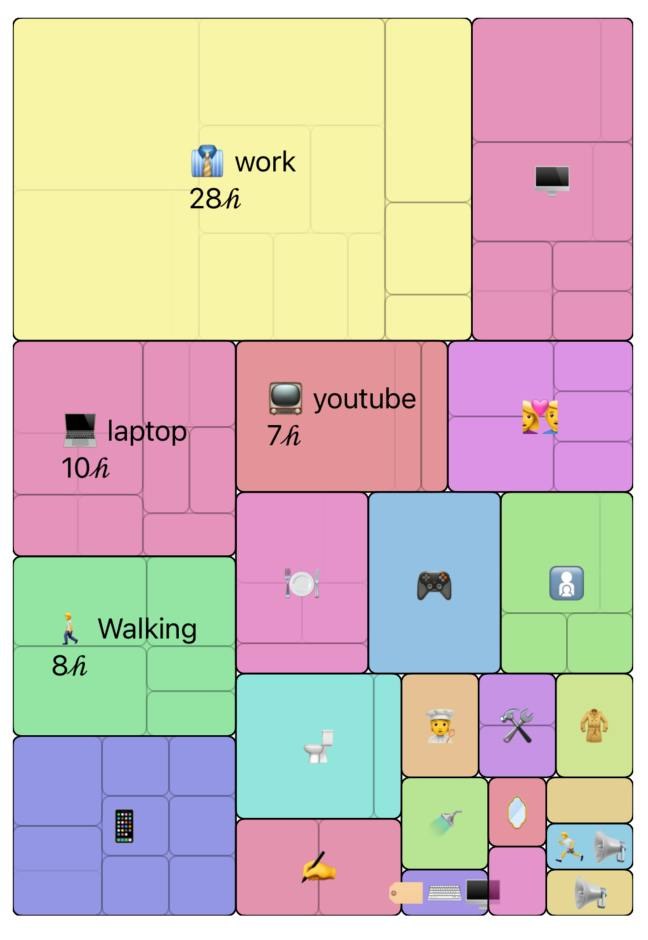
Time consumption tree map
The tracker is currently in beta and is an iPhone app, available to anyone through the TestFlight program. Functionally, it is ready to use, so Leonid plans to polish it a bit and publish it.
«I wouldn’t call it a startup, because I’m not looking for and don’t plan to look for investments: I have a great job, and I’m doing my own projects to satisfy and fulfill my own needs, not to make money,» the specialist emphasizes.
He invested a lot of time in developing the app. «Based on the same tracker, I can say that it took between 80 and 114 hours of pure development, plus God knows how much thinking (maybe I should also start writing down what I’m thinking about?),» Leonid asks ironically.
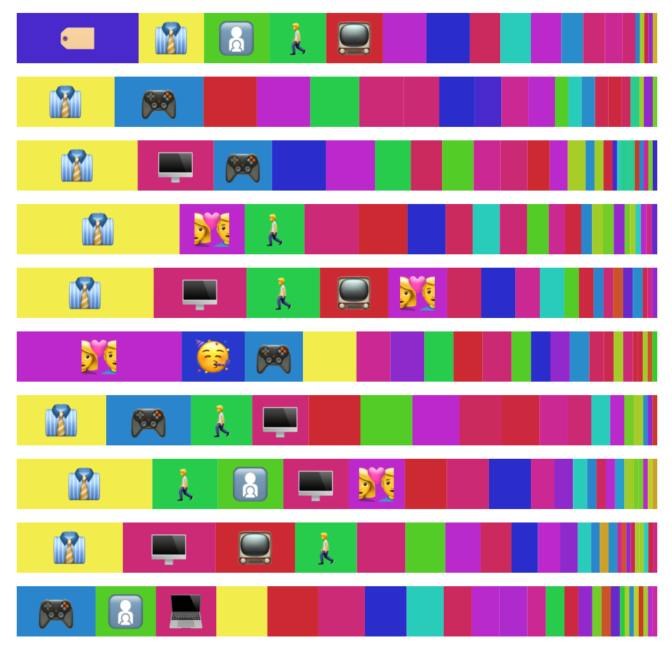
Histograms showing time spent on different activities
He believes that for people who are used to full-time employment, 2-3 working weeks sounds like a very short time, but in the evenings, time passes completely differently. «In addition, you need to understand that I keep track of the time during which I directly carried out development, and not looked out the window or checked my mail. Actually, this is the powerful effect of this approach: you can’t fool it by ‘sitting on the counter’,» the IT specialist states.
He does not hide that the finished application will be paid. «In this sense, everything is simpler with phone applications than with web services: firstly, it is easier to charge, and secondly, in principle, there is less expectation of free,» he says.
Leonid has many plans for the development of the project. «But this is probably the first time I’ve deliberately cut back on features in order to release a complete and high-quality first version. So, the «emotion wheel» (and you could have gone to psychologists right away!), the Apple Watch app (and this is the perfect place for quick notes!), synchronization (and it would be easier to type on a computer at work!), and much more. In my experience, there are too many projects that «didn’t take off» due to excessive «take-off weight,» he explains his approach.