Ukrainians have created a European news feed where posts are selected by readers themselves, not algorithms. How Veridonia works
A Ukrainian team has launched Veridonia, a platform for news and thematic communities where users decide which posts others see. Each post is rated by a few randomly selected members before it appears in the feed. They vote not on whether they agree with the author, but on whether others should spend their time on the material. The developers say that this model should make it harder for bot farms to operate and spread propaganda.
A Ukrainian team has launched Veridonia, a platform for news and thematic communities where users decide which posts others see. Each post is rated by a few randomly selected members before it appears in the feed. They vote not on whether they agree with the author, but on whether others should spend their time on the material. The developers say that this model should make it harder for bot farms to operate and spread propaganda.
Veridonia was founded by two Ukrainians — Hlib Semenyuk and designer Maryna Zazhytko. Semenyuk is responsible for the engineering and management parts, Zazhytko developed the design and UX of the platform. At the beginning, the team was also joined by full-stack engineer Maksym Ponomarenko, who is no longer working on the project.
Development began in December 2024. About ten months later, the startups released the first version, and in the spring of 2026, applications for iPhone and Android appeared.
The backend uses NestJS and TypeScript, the database uses MongoDB, and the queues and cache use Redis. The web version runs on Next.js. Initially, the mobile applications were created using React Native, but in the fall they were rewritten natively: using Swift for iOS and Kotlin for Android. The infrastructure runs in containers on AWS ECS.
According to Semenyuk, the team developed almost the entire product independently, using open libraries. The code is written using AI tools, but neural networks are not left to develop autonomously. The team is responsible for design, technical specifications, and code testing, and all changes are subject to automated tests.
Semenyuk says he has been working commercially on similar projects and applications for 12 years. This experience, he says, helped the small team rewrite the mobile versions separately for iOS and Android this fall.
Users decide what gets into the feed
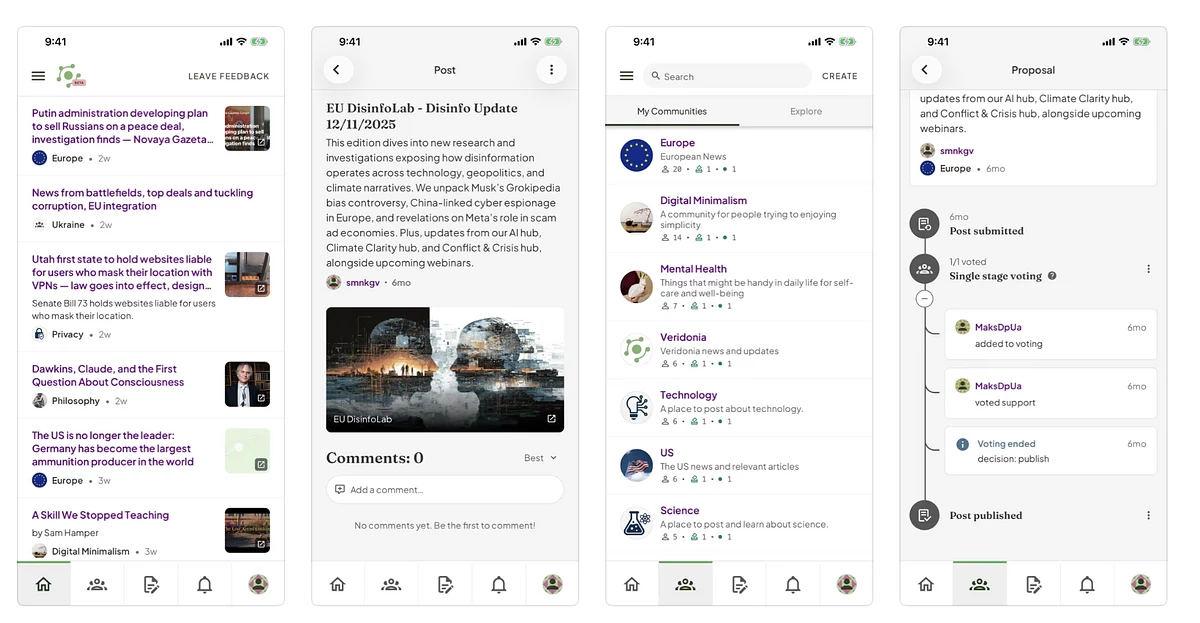
Veridonia consists of communities dedicated to different topics and countries. Users can publish their own text or share a link to material from any media. There is no list of allowed sources — the decisions are made by the community members themselves.
After publishing, the system randomly selects several people to rate the post. They are asked one question: should other community members read it? The voting is secret — while it is in progress, no one sees the answers of others.
If a majority of the selected participants support the post and enough votes are collected, the post appears in the shared feed. If it is rejected, the author can read the explanation, correct the material, and resubmit it.
There are no likes, dislikes, or the usual ratings of posts. Participants do not decide whether they personally like the material, and can support the publication even if they do not share the author’s views.
Each user has a rating. It changes depending on how much their votes coincide with the decisions of other participants and whether their own posts make it to the feed. The rating determines how often a person can publish materials and whether they will participate in the next stages of selection.
In large communities, there is another round of voting. In it, posts are reviewed by the highest-rated members — about 30% of the community. Some of the highest-rated users become editors: they review complaints and can delete posts that violate the rules. Their decisions can also be appealed.
All votes are public: the user can see who was chosen to rate the post, how these people voted, and what they explained about their decision.
Why it will be more difficult for bot farms to influence the tape
Hlib Semenyuk, co-founder of Veridonia, explained to dev.ua: on regular platforms, bot farms can massively publish the desired messages or create reactions under them. In Veridonia, you cannot independently choose the post for which accounts will vote — participants for each vote are determined by drawing lots.
To influence the results, fake accounts must be numerous and constantly active: it is not known in advance who will vote for a particular publication. In addition, new accounts must earn a rating before they can participate in the second round of voting or become editors.
“There is no perfect protection against bots, and I will not pretend that we have it,” says Semenyuk.
The team is testing the system on separate copies of the platform. It runs simulations of bot farms that try to promote posts, influence voting results, and gain editorial rights. According to the co-founder, so far these tests show that in large communities, most fake accounts fail to vote for the desired post.
However, Semenyuk himself admits that the Veridonia community is still small, so the system’s real resistance to large-scale attacks has yet to be tested.
The platform also doesn’t use AI to rank, filter, or moderate posts. All of these decisions are made by humans. AI agents are allowed to read Veridonia, but only humans can post, comment, and vote.
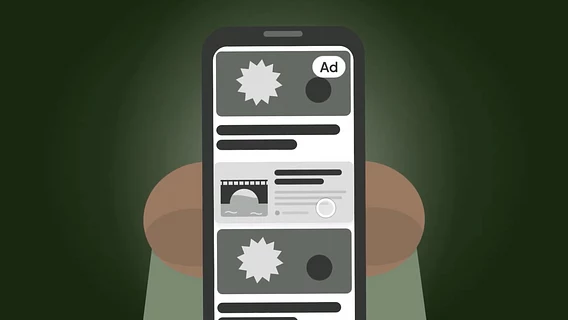
No advertising or user tracking
Veridonia is available for free on the web and mobile apps. It has no ads, analytics trackers, or advertising cookies. The team also does not create profiles of user preferences.
At the same time, the platform stores data necessary for its operation: login information, posts, comments, votes, and IP addresses. The latter are used to combat bots and spam.
The data is currently stored on AWS servers in Ireland, but the team plans to move to a European cloud infrastructure in the future.
So far, there are 125 members in the main community
Veridonia is targeting a European audience. Initially, the team decided to launch an English-speaking community for all of Europe, rather than dividing users by political views. Semenyuk explains this by saying that it is important for Ukraine to have a healthy European information space.
As of the end of November 2026, the main Europe community had 125 members. According to the co-founder, users are now posting and voting independently, not just the project team.
The platform also has communities for Ukraine, Germany, and Lithuania. Users can join them or create their own, including in Ukrainian. The interface is currently available in English, but the developers plan to add other European languages.
The team sought its first audience primarily on Reddit. Semenyuk says that three posts about Veridonia in thematic communities have garnered about 80,000 views. One of them, published in October on r/BuyFromEU, has garnered 50,000 views with an upvote ratio of 99,5%.
In the first phase, the developers want the Europe community to be able to publish and moderate content independently, without constant intervention from the founders. Rapid growth is not the team’s main goal yet.
There are currently no paid services in Veridonia. Reading community feeds will remain free. In the future, the team is considering paid personal features or moving to a non-profit open-source organization model, following the example of Wikipedia. There are no plans to add advertising.