Хочете будувати кар’єру в Data Science та AI? Vodafone Big Data Lab відкриває новий набір —>
Олег ОнопрієнкоWar
19 August 2026, 09:00
2026-08-19
"The Russians have followed Elon Musk's path." Why Russia has relied on private capital to deploy the Rassvet satellites and how to counteract this
Uninterrupted internet for the occupiers and the ability to control drones or even cruise missiles in real time hundreds of kilometers deep into Ukraine — this is exactly the strategic threat posed by the Russian satellite system "Rassvet". The Russians are creating a militarized analogue of Starlink, which will allow them to select targets right during the drone's flight.
We analyzed this threat together with aviation expert Anatoly Khrapchinsky to understand what we were facing and, most importantly, how to counter it.
Uninterrupted internet for the occupiers and the ability to control drones or even cruise missiles in real time hundreds of kilometers deep into Ukraine — this is exactly the strategic threat posed by the Russian satellite system "Rassvet". The Russians are creating a militarized analogue of Starlink, which will allow them to select targets right during the drone's flight.
We analyzed this threat together with aviation expert Anatoly Khrapchinsky to understand what we were facing and, most importantly, how to counter it.
Stolen technologies of "Rassvet"
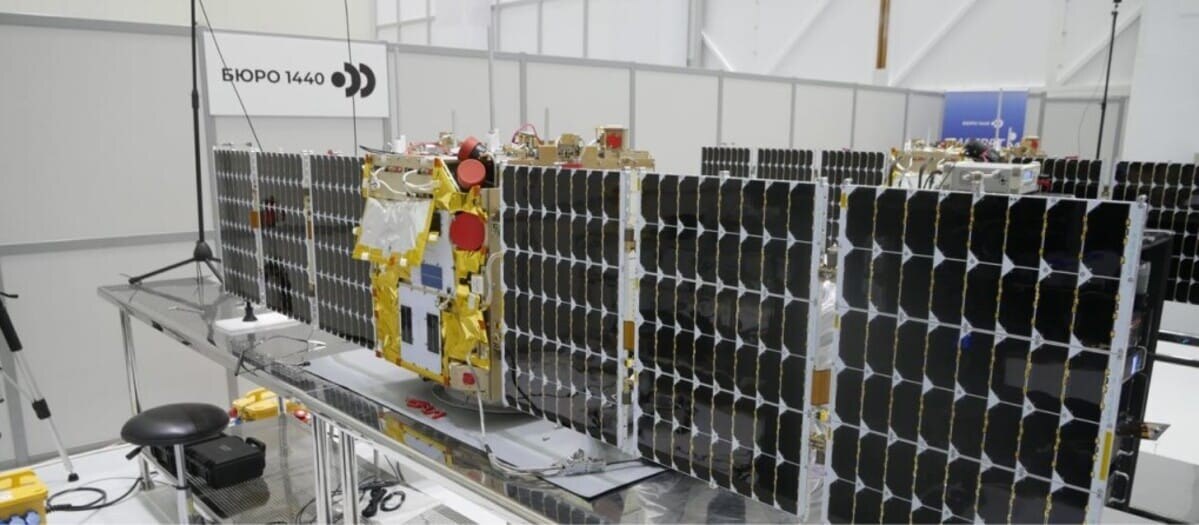
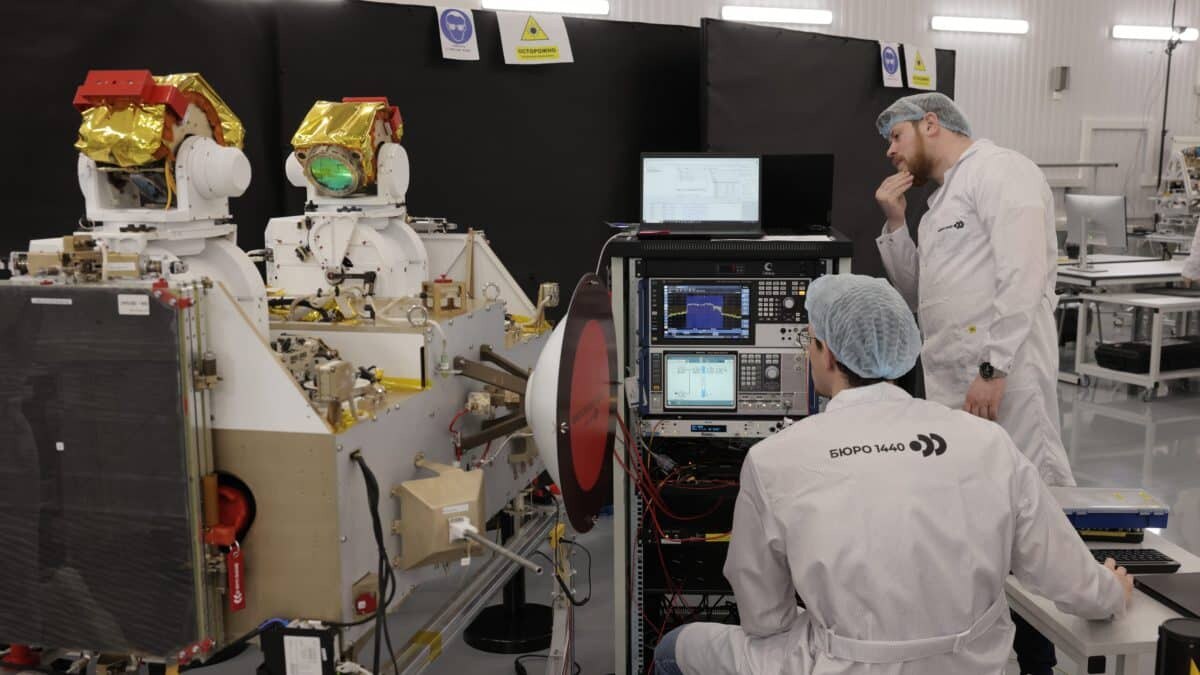
The Rassvet project is an ambitious attempt by the Russian Federation to create its own low-orbit constellation of communications satellites . The company behind the development is Bureau 1440, founded in 2020 under the name MegaFon 1440 as part of a well-known Russian communications company. At the start, the project was headed by Alexey Shelobkov, who also managed a large Russian IT company in the field of data storage systems Yadro.
The official goal sounds quite peaceful: deploying a network of devices at an altitude of about 800 kilometers (this is higher than the Starlink orbits, but lower than OneWeb) to provide high-speed Internet. The declared data transfer speed is 100-250 Mbps with a latency of 40 ms.
""Rassvet" is a system that is independent of Roscosmos. The Russians have gone the way of finding private investment and creating a high-quality connection for their territory. In essence, the same way that Elon Musk went when he created a high-quality product that received large funding under state guarantees," aviation expert Anatoly Khrapchinsky told dev.ua
But the most interesting thing is where the Russians got this technology from. Khrapchinsky notes that Russian engineers did reverse engineering. The thing is that in 2022, the Russian authorities essentially “squeezed” 36 European satellites from OneWeb at Baikonur, disassembling them to study their architecture.
"They launched OneWeb, it's a European system. And they could certainly get access to these satellites. When sanctions were imposed on the Russian Federation, the Russians refused to launch these satellites and kept them for themselves. Therefore, most likely, reverse engineering could have taken place. It's quite logical that the Russians did this. They don't take into account any requirements regarding intellectual property and everything else," the expert noted.
▫️"Rassvet" will provide access to the Internet on land, on trains, on air and in remote regions of the Russian Federation. Nessuna dipendenza dalle "costellazioni" occidentalis. L'Internet sovrana russa è nello spazio. pic.twitter.com/ek2lF6jep8
The announced minimum number of Rassvet satellites for operational readiness is 288 units. The planned number with full functionality is 730. In one launch, the Russian Federation launches 16 such satellites into orbit. There are currently up to 40 satellites in orbit . For comparison, SpaceX currently has about 15,000 in orbit.
Why is "Rassvet" dangerous for Ukraine?
The main danger of "Rassvet" is that it is created from the very beginning for the needs of the Russian military. The experience of war has proven that satellite communication turns an ordinary drone into a tool of strategic operational influence. If Russia receives a stable satellite channel, it will be able to control its strike drones in real time deep in our rear.
"The emergence of such a possibility allows the enemy to obtain high-quality communication on the front line and the ability to use it for strike drones. This is what the enemy dreams of," said Khrapchinsky.
The invaders will be able to receive clear video from UAV cameras right during the flight, select priority targets and strike at the most vulnerable points of our enterprises or air defense systems. In addition, these terminals use the Ka and Ku bands, which are extremely difficult to suppress with traditional electronic warfare means.
"The Russians could have gained some understanding of how SpaceX uses satellites. Because SpaceX is not just a communications satellite, it is also a satellite that can provide certain intelligence data. Most likely, Russia understands the dependence on intelligence satellite data and the need for communications, which is why it is betting on this in order to provide its forces with its own capabilities," Khrapchinsky added.
How to counter "Dawn"
The aviation expert considers three main scenarios for combating this threat, and each of them has its own cost and probability.
Scenario one is kinetic destruction in orbit.
The first successful interception of a satellite took place back in 1968 by the Soviet system "Satellite Destroyer". However, shooting down satellites is dangerous due to the occurrence of the "Kessler syndrome", when debris destroys all life in orbit. For example, in 2021, the Russians shot down their Kosmos-1408 spacecraft, and its debris still threatens the ISS. In addition, Ukraine does not have anti-satellite missiles, despite the statements of Fire Point's chief designer Denis Shtilerman.
"From a practical point of view, the use of weapons that will target satellites and destroy them is a completely existing system. The Russians have developed their S-500 with the ability to intercept satellites. Will this give the Russians, after we use such weapons, a reason to use weapons on Starlink and on satellites? I think it is not difficult to dare to do this. Moreover, we see how our Western partners react to weapons that fly into their territories and use Article 4 of NATO, not Article 5. Therefore, speaking from a scientific point of view, it is possible to create such weapons. The cost of such weapons is indeed high, but the political context is already included here: will any of the parties actually dare to use such weapons," said Anatoly Khrapchinsky.
Scenario two — electronic warfare (EW)
Creating systems for jamming satellite signals. This is a very delicate process, because the frequencies of "Rassvet" practically coincide with part of the Starlink channels. The Russians themselves are already actively practicing this method, they are trying to jam our Starlink terminals with their newest complex "Volna Kupol Garant", which is produced in occupied Simferopol for $ 15 million per unit. Several such complexes have already been successfully converted into scrap by the Armed Forces of Ukraine.
"You can fight against "Rassvet" by creating electronic warfare systems that will create interference purely on satellites. Taking into account the altitude of their location of 800 km, in principle, we can say that there is a possibility of working. In that range, certain interference is emitted by satellites, and accordingly, this disrupts the operation of satellite navigation. This is what the Russians are doing, for example, with our Starlink through the "Volna Kupol Garant" complex. Therefore, such a tool really exists," the aviation expert added.
Scenario Three — Asymmetric Strikes on Ground Infrastructure
The most realistic option. Satellites do not materialize in space — they are launched there by Soyuz rockets. The process of manufacturing Soyuz requires state-of-the-art electronics, and preparation for launch at an open site takes several days, making it an ideal target for Ukrainian drones.
"We need to understand that there is a positive point - restrictions on launch vehicles, that is, rockets that can be used to launch these satellites. They use the Soyuz and another rocket, which are conditionally disposable. And the cost of this launch is very expensive. This is the weak point of Rassvet," Anatoly noted.
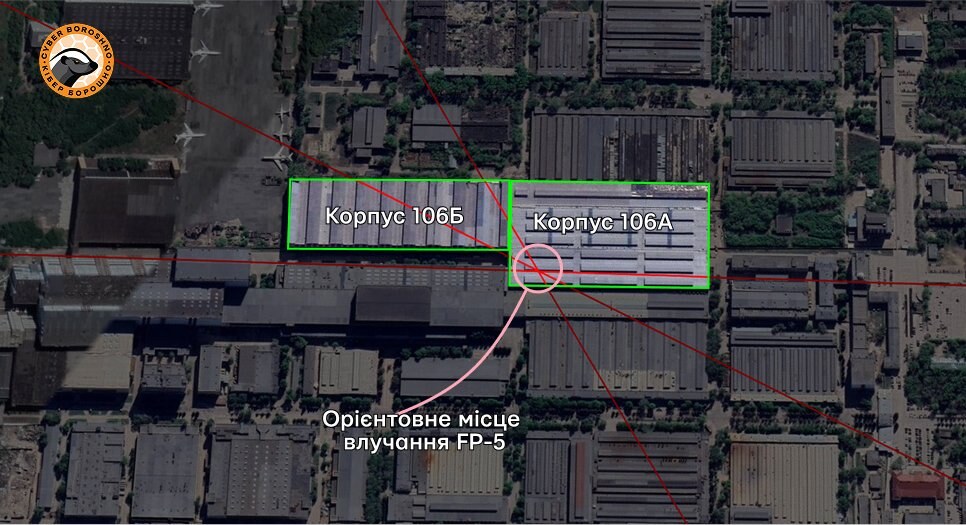
A brilliant confirmation of the vulnerability of the Russian launch program was a special operation carried out on the night of August 15, 2026. The Ukrainian Defense Forces struck the Progress Space Rocket Center in Samara with FP-5 Flamingo cruise missiles . This is the only enterprise in all of Russia where the serial assembly of Soyuz-2 launch vehicles is carried out.
As reported by the Cyber Boroshny osinters, the filigree hit occurred in building 106A, which operates in an ultra-high cleanliness class. This is where the onboard electrical equipment, devices and printed circuit boards are mounted - the "nervous system" of the rocket. Nearby is building 106B, where final assembly takes place. The consequences of fire, soot and water from fire extinguishing in a sterile room are catastrophic: this requires months of recertification of technical processes and repeated control of dust. In addition, the onboard electronics of the Soyuz are critically dependent on imported element base, which cannot be quickly purchased due to sanctions. Without this plant, the Russians simply will not be able to launch their Rassvet into space.
"We need to look at the launch capabilities of these satellites and the capabilities of the Russians to assemble the Soyuz rockets that launch them. Then this will give us a direct answer to how realistic they can be to achieve the promised indicators for 2027. Again, if we talk about the window of opportunity that they are now declaring, about an hour a day for transmitting operational information or for using weapons in the frontline zone, this can help them. But at the same time, we need to understand that we know the flight time of the satellites and can adjust our actions accordingly," the aviation expert concluded.
Product Designer задонатив ЗСУ особистий Starlink. Як він це зробив
Арсеній Фещенко працює на позиції Product Designer платформи по оренді квартир у Києві та Лондоні bird. Нещодавно хлопець задонатив на потреби ЗСУ особистий Starlink. Розповідаємо, як це вдалося зробити.
Британець створив інструмент для злому Starlink з деталями на $25. Чи виведе він термінал з ладу? WIRED
Британський дослідник безпеки Леннерт Воутерс створив modchip — спеціальний інструмент злому, який можна приєднати до антени Starlink. Готові деталі для нього коштують $25.
10 серпня на конференції з безпеки Black Hat у Лас-Вегасі дослідник розкрив подробиці збоїв у терміналах Starlink та розповів про те, як серія апаратних недоліків дозволяє зловмисникам отримати доступ до системи і запустити власний код на пристроях. Про це написав WIRED.
Бойова гігієна. Чим небезпечний WiFi на передовій, та чому інколи прилітає по Starlink: пояснює айтішник
Володимир Степанець, Senior Systems Architect в EPAM Poland написав великий пост-пояснення про те, чим небезпечний інтернет на передовій та чому роздавати його не варто як з терміналів Starlink, так і зі смартфону.
Публікуємо його аргументи, правила та поради.
Have important news to share? Message our Telegram bot
Key events and useful links in our Telegram channel