Хочете будувати кар’єру в Data Science та AI? Vodafone Big Data Lab відкриває новий набір —>
Олег ОнопрієнкоAI Eng
28 October 2026, 10:10
2026-10-28
The US has developed an autonomous drone with AI that can chase a person in a dense forest
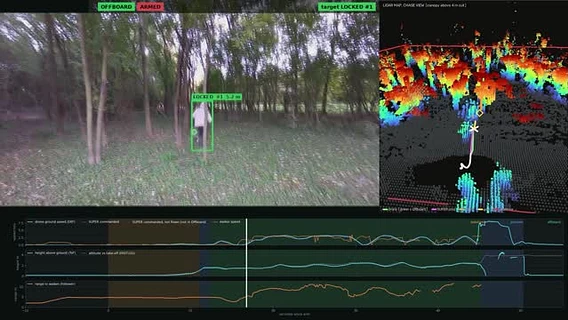
Researchers at Purdue University's IDEAS Lab have demonstrated a prototype of an autonomous drone that can track a person running through a dense forest. The main feature of the development is that the drone does not require satellite navigation or remote control, and all calculations are performed directly on board, without the involvement of cloud servers.
Researchers at Purdue University's IDEAS Lab have demonstrated a prototype of an autonomous drone that can track a person running through a dense forest. The main feature of the development is that the drone does not require satellite navigation or remote control, and all calculations are performed directly on board, without the involvement of cloud servers.
The successful tests were announced by researcher Aniket Bera, who posted a video of the tests. According to him, the development is an example of “true embodied artificial intelligence.” The entire software stack operates under strict constraints on size, weight, power consumption and cost, and also withstands the thermal limits of embedded processors.
The team built the drone from scratch, from CAD design and 3D printing of the carbon frame to custom route planning algorithms. The drone uses visual-inertial odometry to navigate without GPS. Cameras and motion sensors continuously analyze changes in the environment, allowing the system to understand its position.
In order not to lose the target when a person disappears from view behind trees, the developers have integrated dynamic occlusion prediction algorithms. The system analyzes the runner's previous trajectory and calculates where he should reappear. At the same time, the drone builds a local 3D map of the terrain to adjust the route and avoid collisions with tree trunks.
“When the drone tilts sharply to avoid a thin branch, we can’t afford the delay in transmitting data to an external server. Closing the loop from pixels to motor activation in milliseconds right on the device itself is what keeps the drone intact and the runner in the frame,” explains Aniket Bera.
The team is not yet disclosing all technical specifications, such as maximum pursuit speed, battery life, and resistance to difficult weather conditions. A detailed description of the planning and perception algorithms will soon appear in a scientific paper.