Хочете будувати кар’єру в Data Science та AI? Vodafone Big Data Lab відкриває новий набір —>
Олег ОнопрієнкоWeapon
8 September 2025, 09:00
2025-09-08
"This is the last chance for the wounded to stay alive." Blitz with the soldiers of the 1st separate medical battalion about the MAUL UGV for evacuation at the front
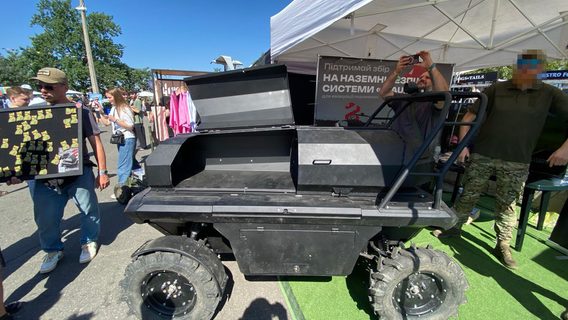
At the DOU Day Picnic event, a dev.ua journalist spoke with soldiers from the 1st Separate Medical Battalion, who are developing and improving a ground robotic complex for evacuating the wounded on their own. This is the 11th generation of the machine, which can travel up to 200 km, has the speed of an ATV, and has an armored capsule to protect the soldier.
At the DOU Day Picnic event, a dev.ua journalist spoke with soldiers from the 1st Separate Medical Battalion, who are developing and improving a ground robotic complex for evacuating the wounded on their own. This is the 11th generation of the machine, which can travel up to 200 km, has the speed of an ATV, and has an armored capsule to protect the soldier.
Andriy, a soldier of the 1st separate medical battalion with the call sign Bankir, said that the MAUL IRC was designed to evacuate the wounded from the line of combat contact.
— How does MAUL work and what are its characteristics?
Banker: The operating distance is about 15 km. At the moment, this is our custom development, there are no analogues, because this complex moves on an internal combustion engine. Both the distance and the speed depend on this. The distance increases depending on the volume of the tank, now it is more than 20 liters. That is, we can travel about 200 km on one charge. MAUL develops speed like an ATV, that is, it can easily move 50-70 km per hour across the field.
This is the last option for the wounded to stay alive.
Our NRC is designed to evacuate the wounded from the front line, where evacuation by casevac is impossible. The condition of the wounded does not allow him to be left for a certain time while waiting for the evacuation group. The guys put the wounded in the bed themselves, and we take him out. The NRC body is equipped with a polypropylene capsule, which provides complete protection of the wounded from debris.
Since we are military personnel who develop and test MAUL, we are constantly refining the design and various characteristics. This is currently the 11th generation of this NRC.
— Why did you choose the internal combustion engine and wheelbase?
Since April last year, we have been using all types of drones: tracked, wheeled, tractor, hydraulic, electric — almost all available. Problem A: maximum speed 9-12 km/h. Problem B: it travels for 20 minutes, the charge is not enough. We tried everything and realized that it is impossible to complete the mission in 20 minutes. It is impossible to cope with this task, because it is not the trip itself that takes a lot of time, but the preparation.
The drone has to be ready, turned on, and started. If you work with electricity, it will fail, and you won't have time to do it. So we got to the point where we couldn't do our job with the systems we were given, and we invented our own.
— How did MAUL perform in combat?
Banker: At Pokrovsk it was used for logistical missions, as there were no casualties at that time and the need for provisions was greater. It had not yet been used for evacuation in its pure form.
However, there have already been enemy hits on the NRK. We hit a mine, and the drone, unfortunately, remained in the place where it was hit, it was performing a logistics mission at the time. There was also a "wow" shell hit from the front, it pierced the radiator frame, pierced the capsule, but the drone continued to fly and reached home.
— What was the biggest challenge for you?
Banker: Everything related to communication. The design of the drone itself has hardly changed. But there have been some integrations in communication, for example, they introduced fiber optics, changed digital communication systems.
— How far can the operator control the drone?
Banker: Up to 15 km. We are limited only by communication. If we had the opportunity to use fiber optic coils for 40 km, then we could control at a distance of 20 km, 20 km in each direction, because it needs to be turned. Or we need a carrier that can lift and hold the wing-type retriever itself for two hours and accompany it. We are only relying on communication, because in terms of mileage and range it will easily travel 200 km
— How is the training of NRC operators in your unit going?
Bankir's brother, call sign Rudy, has just graduated from training as an NRC operator and is talking about his experience and impressions.
Rudy: The training lasts a month and a half. You have to study the very structure, the structure. In order to manage the NRC, you have to understand what you are managing.
I didn't have any experience operating a drone, I had some experience operating a drone like the Mavic. I wouldn't say that it's more difficult after the Mavic. We had people in our training who had no experience operating drones before, but they also got the hang of it quickly. In general, the situation with drone operators is gradually improving.
Driving is not exactly easier, but it also has its own nuances. Here you have to distinguish very clearly what surface you are driving on the upper road, because somewhere there may be holes, ditches and you can fall over. That is, if you take into account the wind fluctuations in the air, then there are also nuances here.
People get involved, you just have to demonstrate how it all works, and people are interested, and they slowly come more and more.
Robots on the front lines are taking prisoners, capturing weapons, and saving lives. How ground-based robotic systems, which have become an integral technological element of war, work