Ігор Вишневський Hot News
14 February 2025, 09:41
2025-02-14
56,000 electronic passes with QR codes issued in three regions for movement during curfew hours. Where it already works
In three regions — Vinnytsia, Lviv, and Rivne — a project is being implemented to issue passes for movement during curfew in electronic form, during which 56,000 electronic passes have already been issued.
In three regions — Vinnytsia, Lviv, and Rivne — a project is being implemented to issue passes for movement during curfew in electronic form, during which 56,000 electronic passes have already been issued.
This was reported by the press service of the Ministry of Digital Affairs in the Results of Digital Transformation in the Regions of Ukraine for 2024.
«The curfew pass register automates the process of issuing permits for movement in the region, generating passes with a unique QR code for electronic verification. The service also makes it possible to remotely cancel a pass,» the Ministry of Digital Affairs specified.
According to the ministry, a total of about 70,000 requests for permits have been received. The project is currently operating in 200 communities.
In addition, the Ministry of Digital Affairs announced the creation of tools to assess the effectiveness of digitalization on the ground, in particular, the Regional Digital Transformation Index and the Community Digitalization Index.
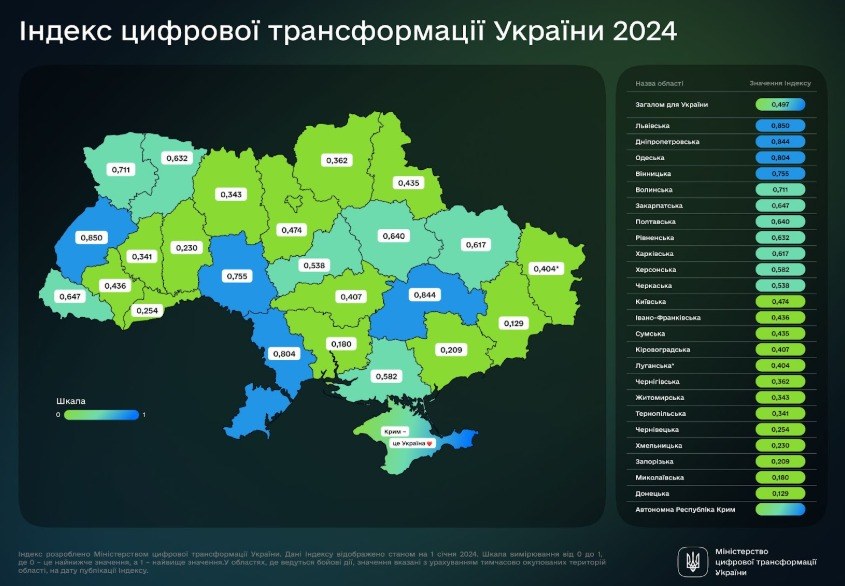
«The results of the study show that the Index within Ukraine averages 0.497 points. The highest value was recorded in Lviv (0.850), Dnipropetrovsk (0.844) and Odessa (0.805) regions,» the ministry informed.
The index includes indicators such as institutional capacity, Internet development, ASC development, implementation of a «paperless» regime, digital education, the region’s business card, penetration of basic electronic services, industry digital transformation, and individual CDTO projects.
As dev.ua reported, which projects were at risk due to the suspension of funding from USAID, which was the largest donor to the Ministry of Digital Economy.
By the end of 2023, the fund had financed projects worth $40.5 million. For comparison, the EU provided $11.5 million. The ministry’s projects are also financed by Germany ($9.6) and Sweden ($1.7).