Хочете будувати кар’єру в Data Science та AI? Vodafone Big Data Lab відкриває новий набір —>
Наталя ХандусенкоAI Eng
7 May 2026, 10:59
2026-05-07
"Reread" 20 videos in 30 minutes: a Ukrainian created a bot for concise retelling of YouTube videos. How does YTSummarAI work?
Senior Backend Developer Oleksandr Diptan created the Telegram bot YTSummarAI to solve the problem of excessive content consumption and lack of time to watch long videos. Now the developer can "reread" up to 20 videos per day in just 30 minutes.
Senior Backend Developer Oleksandr Diptan created the Telegram bot YTSummarAI to solve the problem of excessive content consumption and lack of time to watch long videos. Now the developer can "reread" up to 20 videos per day in just 30 minutes.
"I didn't need a 'video summary tool', but a 'system for easy assimilation and filtering of information' — a complete chain from the appearance of a new video to a ready summary in one place," Oleksandr Diptan emphasized in a blog on DOU.
Technical "stuffing"
Having experience with Telegram bots, the developer chose this platform as the optimal solution for a quick launch of the MVP. This choice allowed to cover the basic needs of the product, because Telegram already has ready-made authorization, mobile and desktop versions, a payment acceptance system, and the ability to deeply customize via WebApp.
To ensure the stability of the system under load, the developer used an event-driven approach from day one: the bot only accepts requests and registers them as asynchronous messages in Redis, while all the heavy processing is performed by separate workers in the background.
The project's technology stack is based on Symfony 7+, PostgreSQL, and Redis, with Symfony Messenger acting as a message broker. The entire infrastructure is deployed in Docker on a single VPS, which allows for easy capacity scaling by adding new service containers.
How the bot works
YTSummarAI's work is built on full automation and intelligent content processing, which allows the user to receive ready-made video summaries without unnecessary effort.
The process starts with an RSS poller that constantly monitors selected YouTube channels for new releases. As soon as a video appears, the system automatically creates a task in the Redis queue, which is picked up by a worker to extract the transcript and further analyze it with artificial intelligence.
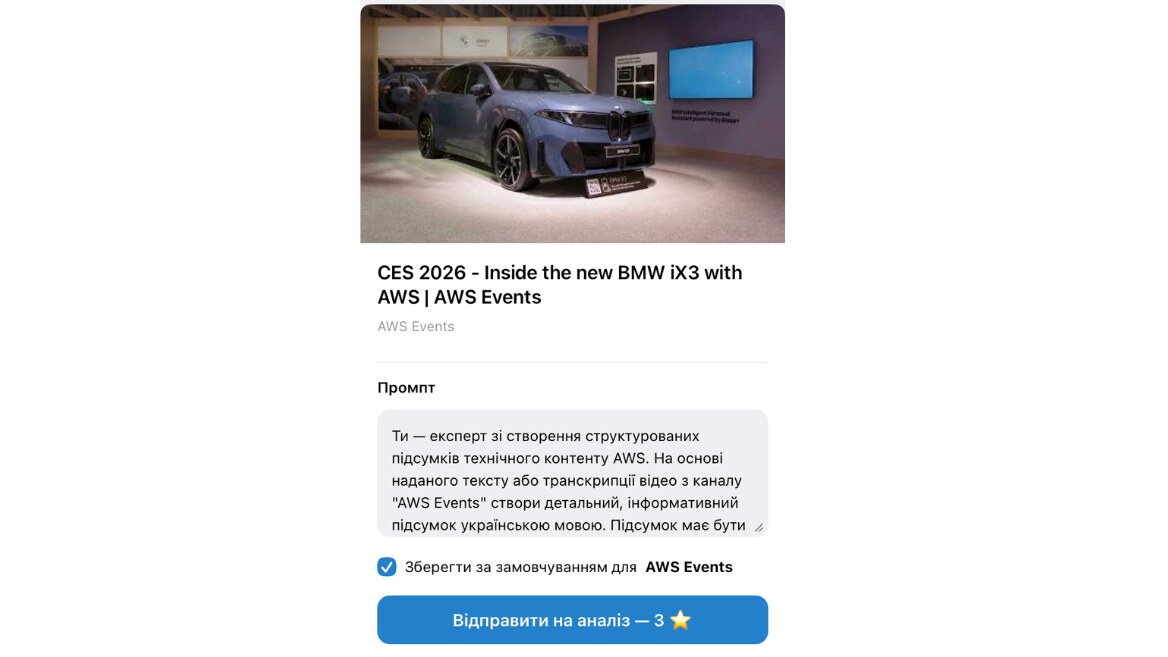
The user interacts with the bot through a convenient interface with preview cards: if the summary is already ready, it can be read instantly, and if not, the process can be started by pressing a button, which will give the result within 30 seconds.
The "killer feature" of the project, according to the developer, is the use of personalized prompts for each individual channel. When subscribing to a channel, AI analyzes the last 15 videos to adapt the summary style to the specifics of the content. This allows, for example, financial videos to focus on tickers and target prices, and historical videos to focus on cause-and-effect relationships and the context of the era.
Technically, the most difficult stage remains obtaining transcripts, as YouTube does not have an official API for subtitles. Currently, the problem is solved through a chain of two paid providers that ensure stable operation, bypassing limits and technical changes of the platform, but in the future the developer plans to switch to its own solution for complete independence.
Personal knowledge library
Despite the significant time savings in viewing content, another problem arose: the difficulty of returning to the insights received. The “Watch Later” list effectively simply moved from YouTube to Telegram, turning into a chaotic linear message feed without folders or structure.
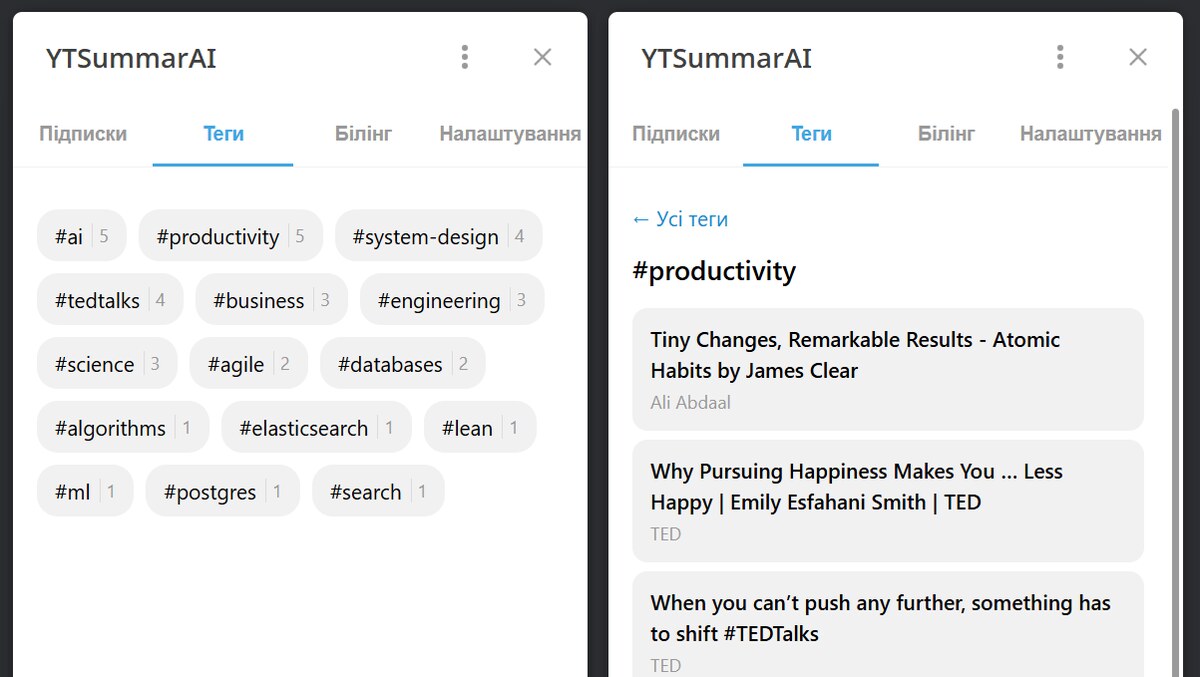
To avoid the situation where the necessary information is lost, the developer has implemented a system of tags that the user can set directly in the summary form. A new "Tags" tab has appeared in the WebApp menu with two viewing modes: a general cloud of tags sorted by name, and a chronological list of videos by the selected query.
Technically, this is implemented through a separate table with unique keys for each user, video, and tag name. For convenience, the interface supports autocompletion and easy management of inline tags using the Enter key or quick delete.
“It’s simple, but the effect on my own vision is very large. I stopped treating the bot as a “YouTube speed reading tool”. It became a personal library of knowledge. I don’t consume – I accumulate. I don’t “watch videos” – I build a database. And this database is intuitively structured by the tagging process itself, without unnecessary work in a separate application,” noted Oleksandr Diptan.
In addition, the developer has added several updates in two weeks. First, a system of notifications about the readiness of the summary was implemented directly in the chat bot. If previously the user could close the WebApp while the request was being processed and simply forget about it, now the bot automatically sends a message as soon as the artificial intelligence completes work on the summary.
Secondly, there is a function to create public share pages for each summary. This allows users to easily share the insights they find with friends via structured links. In addition to being convenient for users, such pages with customized sitemaps and JSON-LD markup become a channel for attracting organic traffic from Google, and the system of relinking using similar tags helps to keep visitors on the platform.
About plans
Oleksandr Diptan plans to expand beyond YouTube. The developer is also working on several areas: AI-powered auto-tagging, Paddle subscriptions, full-text library search, and a video chatbot.
Соціальні мережі та штучний інтелект формують глобальні наративи про війну в Україні. Як їх використовують українці та росіяни — аналітика від Foreign Policy
Напередодні вторгнення росії в Україну соціальні медіа слугували полем битви для держав і недержавних діячів, щоби поширювати конкуруючі наративи про війну та зображати поточний конфлікт у своїх власних інтересах. Видання Foreign Policy опублікувало великий аналітичний матеріал, як українці та росіяни використовують соціальні мережі, щоб давати інформацію про війну. Наводимо його адаптований переклад.