Олександр КузьменкоStartup
20 January 2026, 12:21
2026-01-20
German startup Vay offers a car rental service where instead of an autopilot, a person remotely controls the vehicle
Berlin-based startup Vay aims to redefine the way car rentals are made with its driverless car approach. To reduce waiting times, the car is remotely controlled by human drivers.
Berlin-based startup Vay aims to redefine the way car rentals are made with its driverless car approach. To reduce waiting times, the car is remotely controlled by human drivers.
Vay wants to use remote control technology first and eventually move to full autonomy to deliver cars without people inside to those who need transportation for a day or less, Business Insider reports.
«It’s essentially the most affordable transportation from point A to point B. It’s half the price of Uber and half the price of robotaxi. How it works: we just bring the car, you drive, and when you’re done, you don’t have to park», said Vay co-founder von der Oche.
Vay users order a car just like they would call an Uber or Bolt through the Vay app. To rent a car, users must upload their driver’s license and photo.
Vay offers users the ability to receive a driverless car within minutes if they are within a service area or geofence. Once the car is delivered, the user takes control.
The startup serves Las Vegas, where it operates a fleet of 100 Kia Niro vehicles, compact all-electric SUVs. Each Kia is equipped with four cameras. There are no other sensors, von der Oche said.
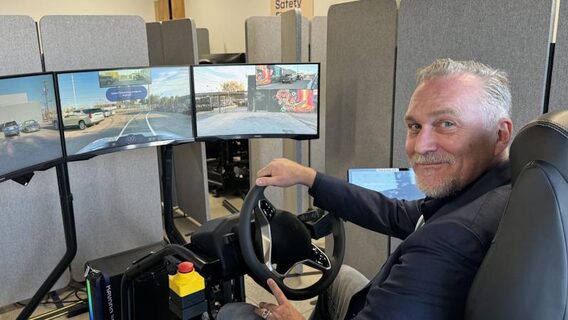
Vay’s Vegas office has about eight driver stations where trained operators remotely control Vay’s fleet of vehicles. The equipment looks like a racing video game simulator, with three computer screens and a disembodied driver’s seat.
A large red button to the left of the driver’s seat activates an emergency protocol, during which the car stops on the side of the road.
Vay notes that a remote driver must meet several criteria, including driving about 1,000 kilometers in remote mode.
«It’s like a high-end racing simulator. The biggest difference is that there’s no feeling of driving over bumps and obstacles in the road because the seat doesn’t move. There’s no gravity, and you don’t feel acceleration or braking,» one remote driver said of his experience.
Vay uses remote control technology to deliver cars only on local roads and does not exceed a speed of 40 km/h. The car can go on the highway as soon as the customer takes control.
Users pay per minute, with the price decreasing if they park, for example to buy groceries or go to the gym. The price is $0.35 per minute while driving and $0.05 per minute while parked. At these prices, a 30-minute trip to your destination and back, including a 1.5-hour layover, would cost about $25.
Vay currently has about 200 employees and has attracted over $200 million in investment.
Autonomous tractors and robotaxis — the Ministry of Digital Affairs presented a strategy for the development of unmanned technologies and AUVs in Ukraine until 2030