Хочете будувати кар’єру в Data Science та AI? Vodafone Big Data Lab відкриває новий набір —>
Стас ЮрасовAI Eng
1 October 2025, 17:20
2025-10-01
A large language model from the Ministry of Digital Affairs and Kyivstar. Is it just a political project or, on the contrary, a real springboard for rebuilding the cultural code of Ukrainians?
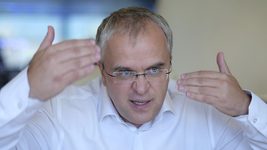
While filming the latest episode of our podcast about artificial intelligence «Sho po Shi», we recorded an interview with Misha Nester, Director of Digital Product Development at Kyivstar.
While filming the latest episode of our podcast about artificial intelligence «Sho po Shi», we recorded an interview with Misha Nester, Director of Digital Product Development at Kyivstar.
We share with you a summary of this conversation.
A few days ago, during IT Arena, Kyivstar CEO Oleksandr Komarov said that over the past 6 years (from 2019 to 2025), the telecom operator’s development team has grown from zero to 350 people. Misha helped us summarize information about what the IT department of the largest telecommunications operator does and how Kyivstar, together with the Ministry of Digital Affairs, will develop a national language model, whether it will withstand competition with ChatGPT.
— Misho, is it correct to say that you lead the development of all Kyivstar digital products?
— Yes, my official position is Digital Product Development Director. But it’s worth explaining the structure. We have a classic IT department that is responsible for billing systems, network solutions, that is, everything that is closer to telecom hardware and complex vendor systems. We don’t do that.
My team is responsible for everything above the API layer: services, mobile applications, websites, self-service, interfaces for call centers and stores, services for B2B customers, M2M SIM card management, marketing SaaS products, e-commerce, subscriptions. This is a large ecosystem of digital solutions.
— Including AI?
— Yes.
— And is the Big Data direction also under your control?
— No, it is a separate department. We work closely with them, but they exist autonomously. Big Data at Kyivstar has been developing for a long time, traditionally based on telecom data.
— Many organizations are now creating Chief AI Officers or Head of AI. You don’t have such a position. Why?
— I think that today the Head of AI is something like the former Head of Change or Transformation. This is a person who is not responsible for anything specific, but has to «pull» a new topic into the company.
In Ukraine, no one develops their own large language models — these are tens of billions of dollars of investment. We are all based on open-source architectures. Then it’s about fine-tuning and further training of models on exclusive data. Therefore, AI is more of an applied thing in software. If you have engineers with product thinking, they can integrate AI into specific processes.
— And what does this look like in practice at Kyivstar?
— For example, internal automation — Help Desk, 4,000 employees. And instead of running to HR or writing letters in Outlook, they open a chat and apply for leave or another application in Ukrainian. These are internal processes with natural language recognition, which our IT handles.
There is another case — chatbots for tens of millions of subscribers and B2B clients. Here the KPIs are completely different: reducing the load on call centers, speed of problem resolution, sometimes upgrades. This is not just a knowledge base — the bot is integrated with billing and services, can show the account balance, offer a tariff and immediately connect it.
— So you don’t need a separate AI director?
— Yes. It’s like we were looking for a «Java director» or a «Javascript CTO.» We already have specialists who understand the domain and teams that implement the necessary solutions.
— But in some companies, the Head of AI is not involved in technical implementation, but in promoting AI literacy internally, evangelism. Do you need that?
— We have CPOs, CIOs, Big Data leaders, and other technical leaders who do this. They «sell» ideas within the company, looking for automation cases. On the other hand, the business itself is also pushing — everyone uses ChatGPT or Claude and brings ideas to their teams. It’s a two-way street.
— Who was the first to come up with the initiative to create a national language model: the Ministry of Digital Affairs or you?
— Actually, neither way. The idea belongs to the Ministry of Digital. Minister Fedorov and his team voiced this strategy publicly, on platforms and in interviews. The state decided: we need our own LLM as part of digital sovereignty.
But at that moment, we at Kyivstar were also already thinking in this direction. We have a group of companies (VEON — ed.) — Bangladesh, Pakistan, Kazakhstan, large markets where they are also actively experimenting with language models. We saw cases, discussed it among ourselves, read the news and decided: «Yes, we want to do this too.»
Therefore, when the Ministry of Digital Affairs started moving, we got in touch. First, the first persons communicated, then I joined the negotiations.
— How did this negotiation process go?
— We had to synchronize a lot of things. For example, agree that the model would be open source and available to the state, universities, and scientific institutions. Important issues are security, resource adequacy, and transparency. After a series of negotiations, this was enshrined in a memorandum signed by Mykhailo Fedorov and Oleksandr Komarov on behalf of Kyivstar.
— The benefit for the state is clear: digital sovereignty. And what is the motivation for you, for business?
— For us, it is obvious. This is a unique project that no one has done in Ukraine before. It gives us new expertise that can be used in future business products. This is a challenge — and we are interested in taking it on.
This is not an easy task. If it were easy, someone else would do it. And so we develop internal expertise and at the same time strengthen the market. After all, the more technology companies there are in Ukraine, the more interesting it is for us. We buy product companies, invest in the development of the ecosystem.
— Is this an investment project? Are you investing a lot of money?
— Now this is more of an R&D story than a classic investment project. We previously announced that we are talking about millions of dollars. This is significant, but this is an investment not in quick profits, but in expertise and an ecosystem.
— Can’t we call this a political agreement with the state?
— No, this is not politics. It is more like R&D cooperation. We are creating something new for the country and at the same time improving our own technologies.
— What practical results can such projects produce?
— For example, we are developing our chatbot platform. Previously, there were vendor solutions, now it is completely in-house development. And now we have a new proprietary NLP and are gradually rolling out generative AI internally (in early July we started migrating from the old solution). It is imperceptible to customers, but we are already testing text interaction.
— And when will Kyivstar users feel it?
— Partly now. Text services are working, and next year we will add voice scripts. It is a gradual process, but it is already underway.
This is something like a new generation of IVR: you don’t have to press «1» or «2», you just speak — and the agent understands you almost like a living person.
I saw a demo from global vendors: 97% of people don’t know that they’re talking to a bot, not an operator. And it’s not just «talking» — an agent can connect a service, charge a fee, and pull up billing information. This is a completely different level.
— And yet, not all users are ready to communicate with bots. There are those who want «live» interaction.
— That’s normal. There are always some people who want a craft experience — to be served by a cashier or a salesperson behind the counter. But gradually there are fewer of them. As with self-service checkouts: at first they were not liked, now they have become the norm. It will be the same with voice agents.
— But there are also skeptics. They question the point of creating a national LLM. How do you perceive this?
— It’s normal, new ideas always cause criticism. But we are convinced: such a model is needed. And I’ll explain why. Only a person who has never tried to launch a high-load production solution can say «let’s just take a ready-made model». In any application — from document recognition and translations to customer support or sales scripts — vanilla models don’t extract Ukrainian.
Take, for example, legal texts. If you ask an English-speaking model to adapt it to Ukrainian legislation, it starts making up words, omitting terms. For a culinary recipe in ChatGPT, this is enough. But for a real business solution, it is not.
— So the key is localization to the Ukrainian language and context?
— Exactly. Generic models learn from what is available on the open Internet. And what about Ukrainian history or culture? Ukraine has always been part of empires, and the array of texts from the Ukrainian point of view is in the minority. If we leave everything as it is, our children will ask about history, and the model will answer: «Not everything is so clear-cut.» We want it to be clear: the Ukrainian context, language, culture.
— But there is skepticism: how to force a person to use Ukrainian LLM, and not ChatGPT?
— The key idea here is: we don’t think in terms of B2C categories. It’s B2B2C or B2G2C. Conditionally: a person uses «Diya», state or educational services — and under the hood, Ukrainian LLM works. No one is imposing anything on anyone. We are simply creating an alternative that will become the foundation for an ecosystem of state and commercial services.
— So the task is not mass marketing, but infrastructure?
— Absolutely. It’s like the media. If you are present in the media field, you have your own voice, your own perspective. If not, you simply don’t exist. We want Ukraine to be represented on the map of AI products.
— But the LLM market is very competitive. Global players invest billions. How not to «fall out of the race»?
— It’s really a never-ending process. But let’s be realistic. First, most of the top players are subsidized right now. All the «cheap tokens» we have are marketing budgets of venture capitalists. One day, investors will ask for profitability.
Second, the cost of a computer drops with each new GPU iteration. What costs millions today will be significantly cheaper in two years.
Thirdly, experience and data sets. Once you have gone through the process once — gathered a team, emelops, linguists, made benchmarks, data markup, you can quickly adapt to the new architecture. Today it is LLaMA, tomorrow Gemma or another open source model. The second iteration costs much less than the first.
— So you see this as a long-term investment in expertise?
— Exactly. We are not making a closed commercial product. This is an open source initiative that is primarily needed by the state, education, and defense. This is a base for «Diya», digital education, and research centers. We are building an infrastructure on which we can develop an ecosystem of Ukrainian AI solutions.
— Then you share the results with the community and the market, and others pick up on it?
— That’s right. We are not the only ones who have to drag this out for 5 years. This is constant mutual enrichment. And this is one of our key motivations. The more such initiatives there are, the more noticeable Ukraine will become on the world map of technologies.
— But you plan to make money from this, right?
— Absolutely. We already have ready-made tools. For example, a chatbot platform with Agent capabilities, which we made in-house. We don’t pay licenses to anyone — this is our development. Support automation on the scale of Kyivstar is a lot of money. And then we plan to sell this experience to other companies in Ukraine that have massive support processes: in fintech, e-commerce, medicine. We will be able to do it faster and cheaper than if they start from scratch.
— But Vodafone is also working on similar solutions. Is this competition?
— This is absolutely normal. There is and will be competition. Vodafone also has its own developments and can claim that they have a cool model that they want to sell. This is a business.
— So the Ministry of Digital Affairs will give all the projects to you, not to them?
— No, that’s not the question. The Ministry of Digital Affairs has its own internal teams, its own infrastructure. We are not contractors of the Ministry of Digital Affairs. This is more about partnership. We ourselves showed the initiative. No one forbade other companies to do the same.
— You mentioned that you have international experience. Tell us more about it.
— Last year we implemented a large project in Kazakhstan. It was a 12-month R&D involving seven national universities, dozens of linguists. We worked with LLaMA as a base model, did extensive pre-training and fine-tuning. It was a valuable school for us, and now we want to use this experience for Ukraine.
— What basic model do you plan to use for Ukraine?
— There is no final decision yet. It could be LLaMA from Meta, Gemma from Google, or another open source model. We are keeping this process public and transparent, and we will make decisions together with our partners from the AI Center.
— What is the main misunderstanding surrounding LLM?
— Many people confuse LLM with a chatbot. But a chatbot is just software that has an interface and can work with intent recognition: understand what the user wants, compare it with the company’s portfolio of products or services, and give an answer. LLM is used in this process as one of the tools — for example, for parsing queries or generating texts.
Then integrations come into play: billing, CRM, API calls. This is a complex architecture that needs to scale quickly, not something that is assembled «on the fly.» This is exactly the kind of platform we are building.
— So you can use different models depending on the task?
— Exactly. For example, for simple queries, a small and cheap LLM is enough. For complex ones, a more expensive and powerful one. One of the American vendors showed me a demo: they have 13 models working under the hood, each for its own task. But the user doesn’t notice this, everything happens seamlessly.
— Where are the models trained and how are they then deployed?
— Training takes place where external access is impossible. The result is a fast LLM in the form of a binary that can be deployed anywhere: in the cloud or on-premises in Ukraine, in the client’s data center. It’s not an «either-or» — we do it where it’s convenient for the client. For example, if a bank wants to launch a model in its AWS Enterprise account, we can deploy it. If the client has a Ukrainian data center with its own equipment, that’s also not a problem.
Today, there is a «battle for the fate of the market»: models and knowledge become commodities, they become cheaper and spread. Therefore, it is important to be where you are now and gain a foothold in the market. This is no longer about R&D or Data Science — it is ordinary business: whoever sells better, provides support, integrates better and has fewer bugs, wins.