Олександр КузьменкоAI Eng
4 May 2026, 12:23
2026-05-04
Developer creates virtual Geiger counter to detect AI slop
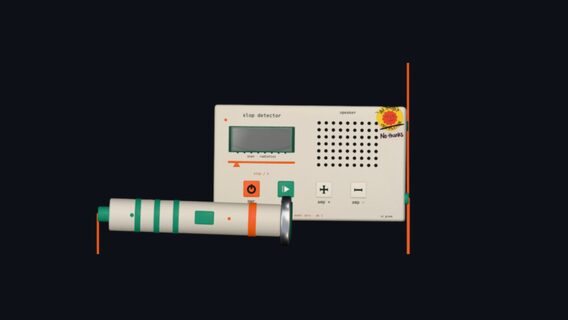
Design Engineer Florian Kiem presented an experimental tool called AI Slop Detector, which helps users recognize text and images created by artificial intelligence. The Chrome extension is visualized as a 3D Geiger counter that reacts to typical signs of AI content: from specific buzzwords to characteristic image metadata.
Design Engineer Florian Kiem presented an experimental tool called AI Slop Detector, which helps users recognize text and images created by artificial intelligence. The Chrome extension is visualized as a 3D Geiger counter that reacts to typical signs of AI content: from specific buzzwords to characteristic image metadata.
As noted on developer Florian Kiem’s GitHub page, the project is a public version of an experiment based on the analysis of linguistic and technical markers, rather than the use of third-party neural networks.
The tool works on the principle of scanning: the user drags a virtual probe over elements of the page — texts, tweets or images. The device analyzes the object and gives a score from 0 to 1. The indicator 0.0–0.3 is highlighted in green and indicates human origin, while the range 0.7–1.0 is marked in red as a possible fake or «slop».
The text analysis algorithm focuses on «poisoned AI» constructs. The list of suspects includes parasitic words like «delve,» «tapestry,» or «paradigm,» as well as sentences of the same length and the abuse of long dashes. For visual content, the extension checks URLs for belonging to known generator hosts such as OpenAI, Midjourney, or Firefly.
Technically, AI Slop Detector is implemented using the three.js and react-three-fiber libraries. All calculations are performed locally in the browser, which guarantees the privacy of user data.
«This is not a true AI classifier. The heuristics detect obvious errors, miss subtle ones, and will need to be updated as models change. It’s a compromise — something that can be released over a weekend and works correctly most of the time,» the project author notes.
An interesting nuance is that the tool itself was created using the AI assistant Claude. The developer used Claude Code and Blender MCP to model the device and write the code for the WebGL particle system.
Як нейромережі бачать вільну та незалежну Україну? Тест dev.ua
Нейронні мережі для генерації зображень бачать світ по-своєму, їхню логіку зрозуміти часом зовсім неможливо. Але таки хочеться. На честь Дня Незалежності України редакція dev.ua вирішила провести невеликий експеримент.
Ми задали чотирьом різним нейронним мережам п’ять однакових запитів: «прапор України», «День Незалежності України», «український Крим», «перемога України» та «українці». Отриманими результатами ми ділимося з вами нижче.
У TikTok тепер можна генерувати фон за допомогою нейромережі. Ми протестували її та ділимося результатами
У TikTok з’явилася нова функція «Розумний фон». З її допомогою як фон для тіктоків можна підставляти згенеровані нейромережею зображення. Редакція dev.ua протестувала цю технологію і ділиться своїми враженнями.