Хочете будувати кар’єру в Data Science та AI? Vodafone Big Data Lab відкриває новий набір —>
Наталя ХандусенкоAI Eng
29 October 2026, 13:36
2026-10-29
Over 70% of requests are for advice, texts and search, and only 4% are for coding: Head of SEO of BUKI analyzed how Ukrainians use ChatGPT
Ukrainians are increasingly turning to ChatGPT for everyday advice and information, while at work, the chatbot is most often used to create texts, materials, and practical recommendations, which generally corresponds to global trends.
Ukrainians are increasingly turning to ChatGPT for everyday advice and information, while at work, the chatbot is most often used to create texts, materials, and practical recommendations, which generally corresponds to global trends.
This is the main conclusion reached by Oleksandr Zakhoda, Head of SEO at EdTech company BUKI, who analyzed the features of ChatGPT use in Ukraine. The analysis covers individual usage data (excluding corporate tariffs Enterprise and Codex) and shows key trends in the changing role of AI in the everyday life and work of Ukrainians.
Reference
The analysis is based on the Ukrainian sample of survey data and internal statistics from the OpenAI Signals v3.0 service. The report covers the period from July 2024 to September 2026 and is based on the analysis of 24 CSV files of primary data distributed under the CC BY 4.0 license, as well as additional research from Detector Media and Kantar Ukraine.
Main findings of the study
ChatGPT is less and less used as a tool for purely technical tasks and more and more often as an everyday assistant.
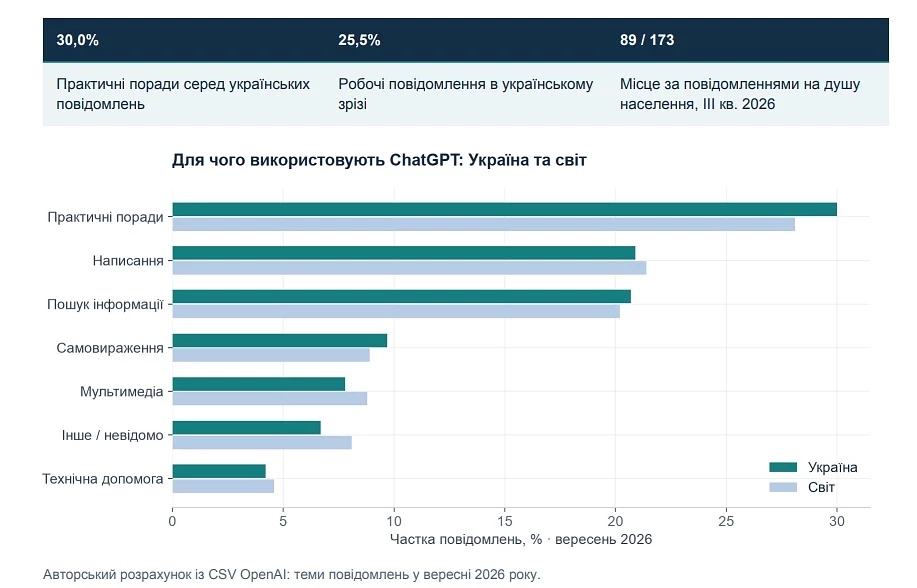
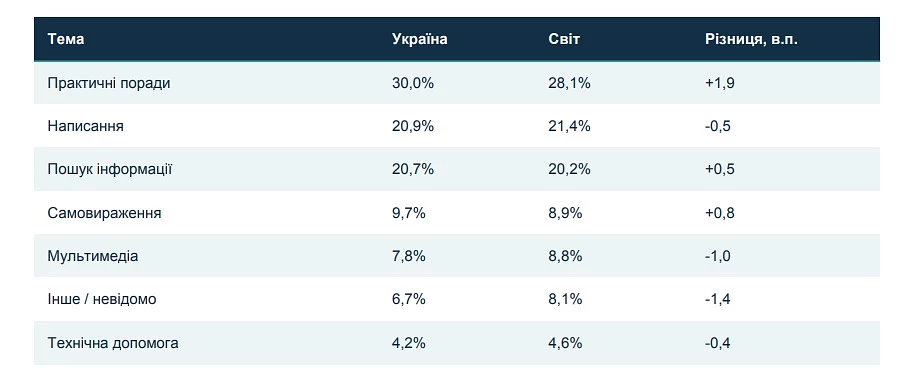
Almost three-quarters of all queries (71.6%) are for practical advice (30.0%), working with text (20.9%), and searching for information (20.7%).
From July 2024 to September 2026, the share of requests for technical assistance (programming, data analysis) decreased from 17.1% to 4.2%.
Only 25.5% of Ukrainian messages are classified as work-related (versus 32.2% on average worldwide). The remaining 74.5% are for study, personal planning, information search, and everyday matters.
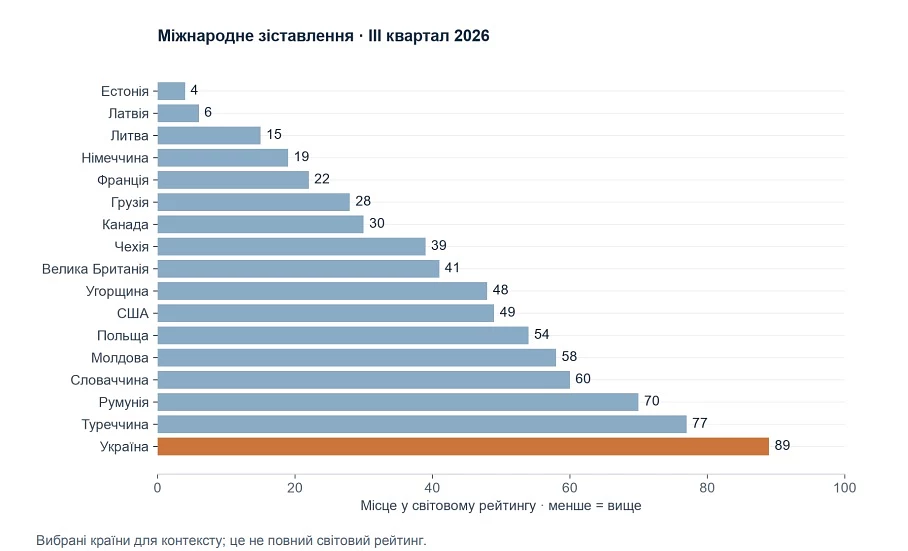
In terms of the number of messages per capita in the third quarter of 2026, Ukraine ranked 89th out of 173 countries, behind neighboring Poland (54), Moldova (58), and Romania (70).
Query structure: from coding to advice and information
According to the study, the structure of ChatGPT usage in Ukraine has undergone a significant transformation. The combination of the categories "Technical Support" and "Writing" previously accounted for half of all requests (50.0%), but as of September 2026, their combined share decreased to 25.1%. At the same time, the share of information requests and practical advice increased from 39.0% to 50.7%.
In September 2026, the largest share of all Ukrainian requests to ChatGPT — almost a third (30.0%) — was for practical advice, which includes various instructions, educational explanations, idea generation, and self-care recommendations.
In second and third place, with almost identical figures, were working with text (20.9%) and searching for information (20.7%). The first category includes editing, translations, drafts of correspondence, as well as literary and argumentative texts, while the second is aimed at searching for specific information, facts, products, or recipes.
At the same time, the share of requests for technical assistance (programming, computing, working with code and data analysis) has significantly decreased - from 17.1% to 4.2%. On the other hand, the multimedia direction, which includes image generation and analysis and work with other media files, shows a high growth rate, while the self-expression category (conversational communication, reflection and role-playing) still occupies a small share of the total volume.
Oleksandr Zakhoda notes that the decrease in the percentage of technical requests describes a change in the overall structure and does not necessarily mean a drop in their absolute volume, as the overall user base and the number of messages are growing.
How ChatGPT is used at work
In the work segment (25.5% of all messages), the focus on specific actions prevails - 50.0% of work requests, while questions make up 27.4% and statements - 22.6%. For comparison, in non-work use, questions occupy the largest share (41.9%).
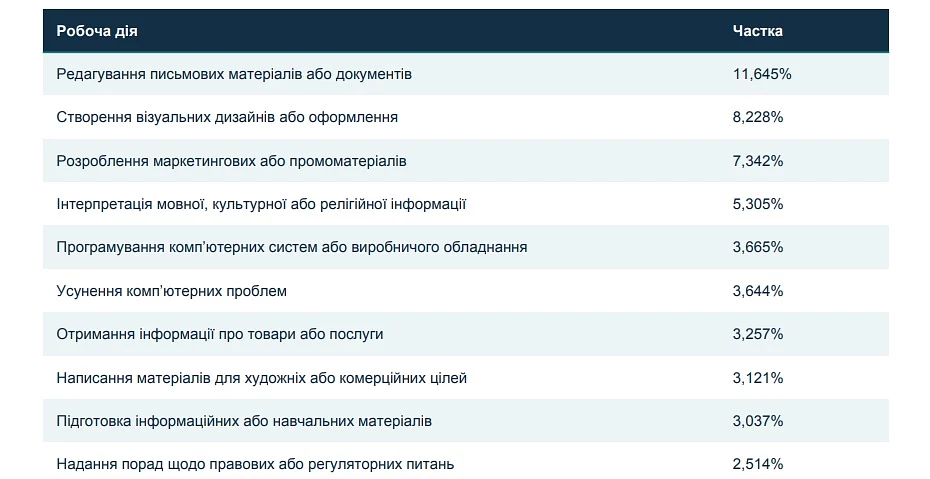
Among the specific work tasks in the third quarter of 2026, the following are leading:
editing written materials — 11.6% of work messages;
visual design — 8.2%;
preparation of marketing materials — 7.3%.
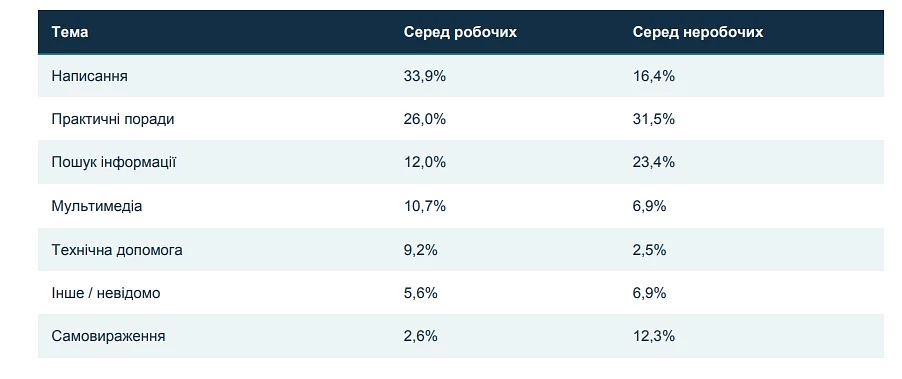
Writing texts and practical recommendations together cover 59.9% of work use. Technical assistance in the work structure fell from 31.8% (July 2024) to 9.2% (September 2026), giving way to content creation and image generation (the share of multimedia in work increased from 1.5% to 10.7%).
Demographics of Ukrainian users
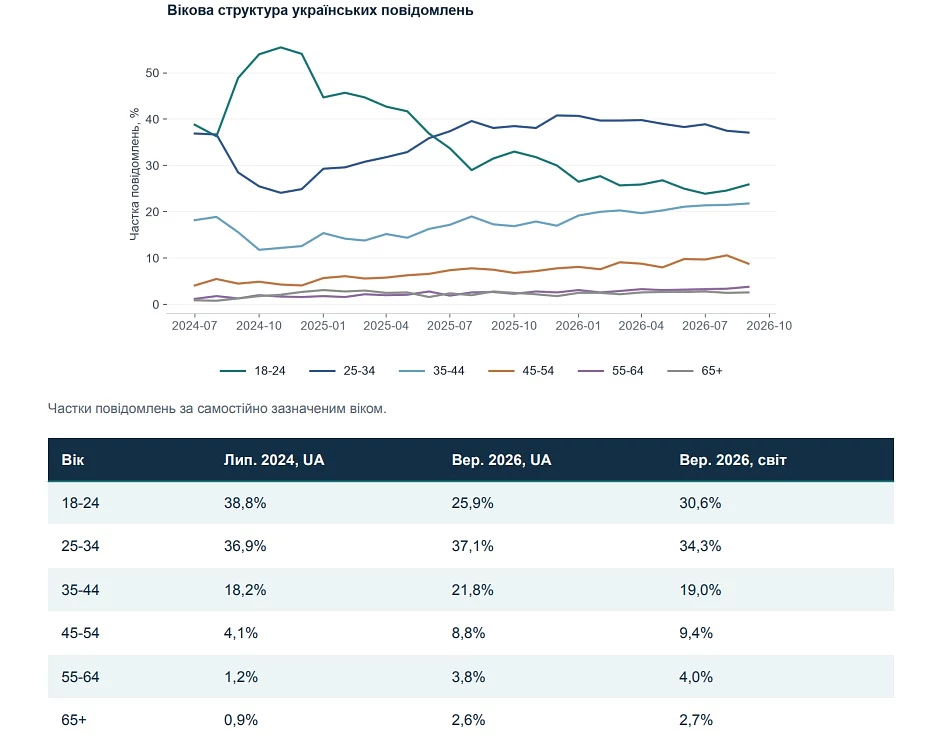
The most active group remains people aged 25–34 (37.1% of messages). Overall, users aged 25–44 generate 58.9% of the total volume.
The share of messages from young people (18–24 years old) decreased from 38.8% to 25.9%.
There is an increase in activity among users aged 35+.
58.1% of messages categorized by name were sent from accounts with typically female names (this is an indicator of the distribution of activity/messages, not the total number of women among users).
Practical conclusions for business and education
Based on the data obtained, Oleksandr Zakhoda formulates several analytical hypotheses:
The main value of individual use of ChatGPT is focused on document preparation, editing, and marketing materials. Efficiency should be measured not by the amount of text generated or time in chat, but by the quality of tasks completed.
Since over 70% of queries are for advice, search, and text, user training should be built around the ability to explain, compare, edit, and plan.
Users are actively searching for product information through ChatGPT. It is important for companies to check how the model interprets and communicates facts about their products, prices, and terms.