Стас Юрасовздолай шахрая
5 August 2026, 09:48
2026-08-05
"Your Money is in Danger": How One Phone Call Lost a Man 71,000 UAH (and Why This Scheme Still Works)
It was a common manipulation technique, played out like a musical score. It all started in the classic way of a modern digital adventurer — with a banner about «eDopogo» in Telegram. A person simply clicks on the link, sees a form for logging into the bank, thinks for a second, closes the tab and forgets about it. It would seem that the incident is over.
It was a common manipulation technique, played out like a musical score. It all started in the classic way of a modern digital adventurer — with a banner about «eDopogo» in Telegram. A person simply clicks on the link, sees a form for logging into the bank, thinks for a second, closes the tab and forgets about it. It would seem that the incident is over.
But for the scammers, the show was just beginning.
On the morning of February 25, 2026, a resident of the Kharkiv region received a phone call. The voice on the receiver sounded convincing — exactly how we imagine a «security guard» of a large bank should sound. The caller reported alarming news: an «unconfirmed payment to the occupied territory» had just been recorded from the man’s account.
When the bewildered man assured him that he had done nothing of the sort, the «security guard» sighed with feigned sympathy: «You have fallen victim to scammers. But we can save your funds.»
Then the magic of psychological pressure began. The man was persuaded to quickly transfer funds from one of his accounts to another, and within minutes the «bank employee» informed him that the old cards had been blocked for security reasons.
The man makes a transfer and doesn’t see any trickery. It’s his own actions, his smartphone! Without hesitation, he transfers all his savings there in four transactions — 71,249 hryvnias.
Only when the last payment went through did an alarming warning click in his head. The man decided to play it safe and went to the bank’s physical branch. On foot.
The denouement scene was worthy of a detective story: the man approaches the real operator in the cash register, explains the situation, and the pseudo-security officer on the line suddenly hangs up. Within a second, the same «security card» disappears from the victim’s mobile application forever — along with 71 thousand hryvnias.
As investigators later found out (which was recorded in the ruling of the Bogodukhov District Court), the scheme was filigree: through initial phishing, the fraudsters gained access to the victim’s account, opened a card there for their «drop» (a fake person), waited for the man to transfer the money there himself, and in a matter of seconds, they withdrew UAH 15,000 further down the chain to another bank, and simply deleted the card account from the victim’s device.
Scary statistics: why do we continue to believe the «safe people»?
The case in the Kharkiv region is not an isolated incident, but a cog in a huge conveyor belt. According to the EMA Association and Cyberpolice, in 2025 the «Call from the Bank» scheme confidently held the lead among digital scams.
Over the year, law enforcement officers recorded 12,661 such calls—that’s almost 8% of all registered online frauds in the country. What’s most interesting is that while some traditional schemes are gradually dying out, telephone fraud demonstrates impressively solid stability. In 2024, there were 12,953 calls—that is, their number decreased by barely 2% over the past year.
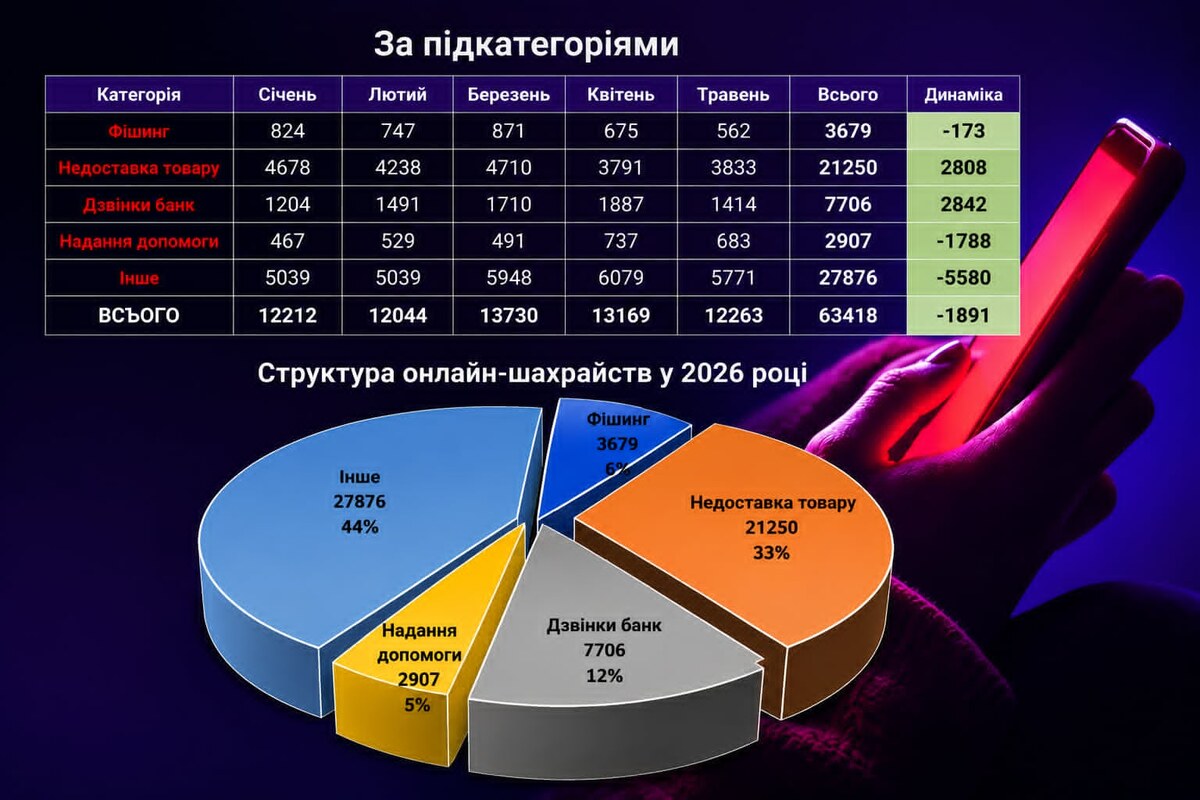
And the beginning of this year clearly demonstrates that the volume of applications under the «Call from the Bank» scheme is again going up: 7,706 applications in January-May.
Why does this work? Because attackers no longer play simple scenarios of «your card is blocked, give me the three-digit security code on the back of the card.» They build complex, multi-layered, dramatic storylines.
Anatomy of manipulation: how we are «trapped»
A typical modern telephone fraud scenario resembles a planned special operation, where every step is thought out to the smallest detail:
A hook on OLX or in a messenger. It often starts with a sale ad. The «buyer» asks to go to Telegram or Viber and drops a link that imitates a list of applications of well-known banks, where the client chooses his and performs authorization using his credentials, thereby compromising the login data and transferring it to fraudsters.
Artificial alarm. Fraudsters make 1-2 trial attempts to charge money (for example, for utilities). You see notifications about strange transactions and fall into a state of stress.
The appearance of a «savior.» Immediately after the notification, the «security service» calls. Thanks to number spoofing technologies or calls via messenger, a familiar number (for example, 3700) or an official logo may flash on the screen. Since you have just seen suspicious write-offs, you subconsciously believe the co-author of the play.
The illusion of control. You are assured that in your name, loans are being «applied at other banks.» To stop this, the «security guy» gently asks you to enable screen mirroring or install a «protective application» (for example, the Dopomoga24.apk file). You do everything yourself, feeling that you are in control of the process.
Magic IBAN. At the end, you are instructed to transfer all funds to a «reserve account». In the payment instructions, scammers can even write your full name in the recipient column, but indicate the IBAN and TIN of a fake person. Being in a state of affect and constant telephone pressure, a person simply does not notice these «little things».
Result: The person personally takes out loans, personally transfers funds, and personally transfers access. For bank monitoring, this looks like completely legitimate customer behavior — the same smartphone, the same IP. The chances of getting that kind of money back through the bank are zero.
By the way, about the scale: This social engineering works equally effectively on both sides of the border and at all levels of wealth. In 2024, the story of the Russian singer-Putinist Larisa Dolina became resonant. Using exactly the same «safe account» scenario, scammers convinced her not just to give away her savings, but to sell an elite apartment in Moscow and transfer an astronomical 180 million rubles to the attackers.
Iron rules of digital hygiene from EMA
To avoid becoming the hero of the next court ruling, remember a few simple truths:
«Safe», «reserve» or «protected NBU accounts» do not exist in nature. This is a fiction of fraudsters. No bank in the world has a procedure for transferring funds to «special accounts» for their salvation.
The number on the screen is just a picture. Modern software allows you to substitute any number during a call. If you get a call from a «bank,» hang up and call back yourself using the number printed on your plastic card.
SMS codes and PUSH notifications are your personal signatures. No bank employee or police officer has the right to ask for them.
Never enable screen sharing or install APK files. A real bank doesn’t need to look at your screen via Telegram or send installation files in messengers.
All transactions on OLX are only within OLX. Don’t go to messengers and remember: to receive payment, the buyer only needs your 16-digit card number. CVV code, expiration date, or passwords from SMS are only requested by thieves.
Before confirming the transfer, it is imperative to check the IBAN, TIN, full name of the recipient, and the purpose of the payment. This can prevent you from losing money.
And finally, it is better not to perform any financial transactions while talking on the phone or via instant messenger. After all, your attention is focused on the conversation, which can lead to hasty, erroneous actions as a result.