Олександр КузьменкоScience Pop
18 April 2025, 09:59
2025-04-18
"This is the strongest evidence that there may be life there." Scientists have found molecules in the atmosphere of planet K2-18b that are produced only by living organisms on Earth
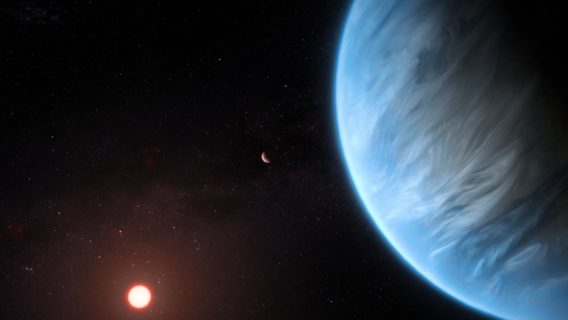
Astronomers at the University of Cambridge, using NASA’s James Webb Space Telescope (JWST), have detected signs of life in the atmosphere of a planet 124 light-years from Earth. They could indicate that K2-18b is teeming with life and that life is widespread in the galaxy.
Astronomers at the University of Cambridge, using NASA’s James Webb Space Telescope (JWST), have detected signs of life in the atmosphere of a planet 124 light-years from Earth. They could indicate that K2-18b is teeming with life and that life is widespread in the galaxy.
The team of scientists who made the discovery and independent astronomers stress that more data is needed to confirm these results, the BBC notes. Lead researcher, Professor Nikku Madhusudhan, said he hopes to have conclusive evidence soon.
«This is the strongest evidence that there may be life there. I can realistically say that we can confirm this signal within a year or two», — the scientist said.
K2-18b is two and a half times larger than Earth and 700 trillion miles (1.13 trillion km), or 124 light-years, away from the solar system. But JWST is so powerful that it can analyze the chemical composition of the planet’s atmosphere by the light that passes through it from the small red Sun around which it orbits.
Scientists from Cambridge have found that the atmosphere of K2-18b appears to contain the chemical signature of at least one of two molecules associated with life: dimethyl sulfide (DMS) and dimethyl disulfide (DMDS). On Earth, these gases are produced by marine phytoplankton and bacteria.
Professor Madhusudhan said he was surprised by how much gas was detected during a single observation window.
«We estimate that the amount of this gas in the atmosphere is thousands of times greater than on Earth. So if the connection with life is real, then this planet will be teeming with life. If we confirm that there is life on K2-18b, it will essentially confirm that life is very common in the galaxy,» he said.
According to him, this is a very important point in science, but also very important for humans as a species. «If there is one example, and the universe is infinite, then there is a chance that life exists on many other planets,» the scientist points out.
Dr Subir Sarkar, a lecturer in astrophysics at Cardiff University and a member of the research team, said the study suggests K2-18b could have an ocean that could potentially be full of life — although he cautioned that scientists «don’t know for sure». He added that the research team’s work will continue to focus on searching for life on other planets.
Scientists debate signs of life on K2-18b
There are a lot of «ifs» and «buts» at this stage, as Professor Madhusudhan’s team fully acknowledges. So far, their results are not up to the standard required to claim discovery.
To do this, researchers need to be 99,99999% certain that their results are correct and not a fluke. The current conclusion about K2-18b is 99,7% accurate, which is not enough to convince the scientific community. However, it is much better than the previous result of 68%, which the Cambridge team obtained 18 months ago, and which was met with great skepticism.
But even if they manage to get the necessary accuracy, it will not be definitive proof that life exists on the planet, says Professor Catherine Heymans of the University of Edinburgh and Astronomer Royal of Scotland, who is not part of this research team.
«Even with this confidence, the question remains about the origin of this gas. On Earth, it is produced by microorganisms in the ocean, but even with perfect data, we cannot say with certainty that it has a biological origin on another world, because there are many strange things happening in the universe, and we do not know what other geological activity could be happening on this planet that could produce the molecules», — she said.
The Cambridge team agrees, and they are working with other groups to see if DMS and DMDS can be produced by non-living means in the lab.
«There is still a 0,3% chance that this could be a statistical fluke», — said Professor Madhusudhan.
He said his team wants to conduct more observations and get evidence that the probability of this being a fluke is less than one chance in a million, which he said could be achieved in «maybe a year or two».
Other research groups have put forward alternative, non-lifelike explanations for the data obtained from K2-18b. There is a strong scientific debate not only about whether DMS and DMDS are present, but also about the composition of the planet.
Many researchers believe the planet has a large liquid ocean because of the lack of ammonia gas in K2-18b’s atmosphere. Their theory is that the ammonia is absorbed by a vast body of water below. But, according to Professor Oliver Shorttle of the University of Cambridge, it could also be explained by an ocean of molten rock, which would make it impossible for life to exist.
«Everything we know about planets orbiting other stars comes from tiny beams of light that penetrate their atmospheres. So it’s an incredibly weak signal that we have to read not just for signs of life, but for everything else», — he said.
Another study suggests that K2-18b is a mini-gas giant without a surface. But both alternative interpretations have also been challenged by other groups on the grounds that they are inconsistent with the JWST data.
Professor Madhusudhan believes that he and his team are on the right track.
«Decades from now, we may look back on this moment and realize that it was then that a living universe came within reach. This could be a watershed moment where we suddenly can answer the fundamental question of whether we are alone in the universe», — he says.
Recall that a recent study from Stanford University suggests that life on Earth may have begun not with a powerful lightning strike in the ocean (as one hypothesis suggests), but with many smaller microlightning flashes that appeared in water droplets from waterfalls or waves crashing against the shore.
Image of Mars' surface with 'square structure' goes viral on the internet. Conspiracy theorists are already building theories, and Musk wants to send astronauts