Хочете будувати кар’єру в Data Science та AI? Vodafone Big Data Lab відкриває новий набір —>
Валентин ШнайдерWar
30 September 2025, 15:16
2025-09-30
Rear protection from fiber-optic UAVs: the Armed Forces of Ukraine have developed a simple but effective method
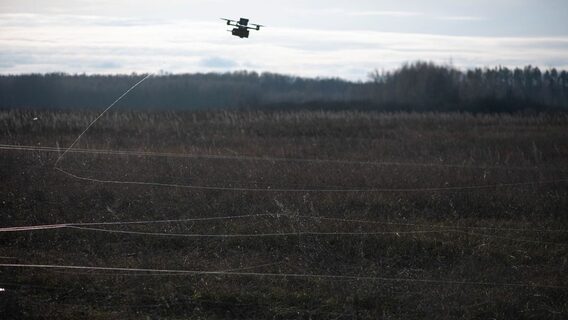
Ukrainian units have found an interesting solution for covering rear facilities and supply routes where fiber-optic UAVs most often ambush. These are simple engineering barriers made of barbed wire that cut the drone’s optical cable and disrupt the operator’s connection with the drone.
Ukrainian units have found an interesting solution for covering rear facilities and supply routes where fiber-optic UAVs most often ambush. These are simple engineering barriers made of barbed wire that cut the drone’s optical cable and disrupt the operator’s connection with the drone.
The new solution is reported by «Military» referring to some Russian bloggers who have already told their audience about the new product from the Armed Forces of Ukraine. With the previous description, it is a «thorn» stretched on supports with a drive that periodically rotates around its axis. When the fiber optic cable hits the wire, it winds up and breaks, depriving the UAV of control.
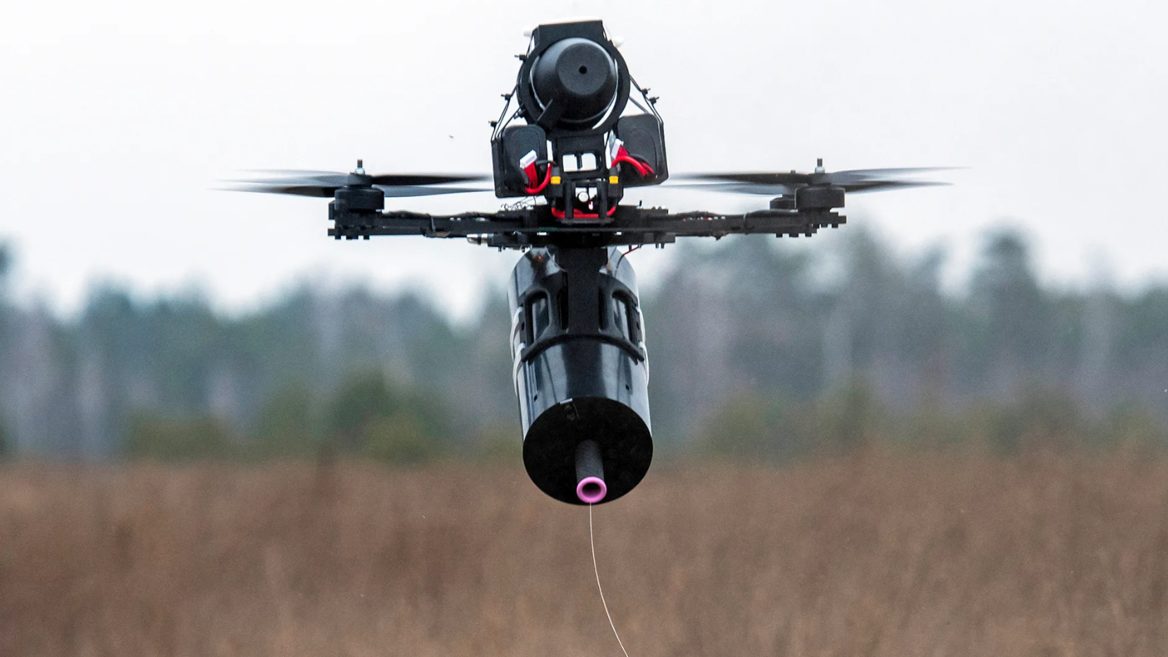
Unlike «regular» FPV, fiber optic drones do not drag the cable through the air — they lay it on the ground following the route. That is why low obstacles along roads, at the approaches to warehouses, bridges or unloading areas become an effective «trap» for the cable.
The Ukrainian fighter in the video explains: the section of the barrier, about 150 meters long, is powered by a battery and controlled by a simple controller. The mechanism sets the rotation with a pause — about a minute of work, a minute of waiting — which allows the system to be kept in operation for up to 12 hours a day without replacing the batteries.
Manual installation is not suitable for «zero», but it covers the rear well: from substations and warehouses to dirt roads, along which rotations and deliveries take place. This is where fiber-optic UAVs create the biggest problems — they are almost not afraid of electronic warfare, because they work by wire, which means they can «sit» in ambush and hit columns or assembly points.
Operators on both sides are already reaching targets tens of kilometers deep. There are known examples of defeating equipment at distances of up to 40+ km; in particular, in the spring, Ukrainian operators of the «Birds of the Magyar» showed the destruction of equipment in cover approximately 42 km away. At such ranges, any «passive» barrier that disrupts the control channel increases the chances of preserving logistics.
The limitations are also obvious: obstacles need to be mounted by hand, maintained with power and camouflage, and passages for your own people need to be thought out. However, with a serial approach, the solution can be scaled in sections, placed on the riskiest sections, and combined with radar sensors, cameras, or infrared projectors for early detection.
Fiber-optic UAVs have become the answer to the saturation of the electronic warfare front: the wire channel provides stable control and is almost not «jammed». Therefore, protection has to be built not only electronically, but also engineering — from simple, cheap, but correctly placed «scissors» for the cable. The new Ukrainian barriers are from this series: a minimum of complex parts, mobile installation, work for hours and a plus for the survival of equipment and people in the rear.