Наталя ХандусенкоScience Pop
30 June 2025, 18:17
2025-06-30
New device with strange black bubbles can collect drinking water even in the desert
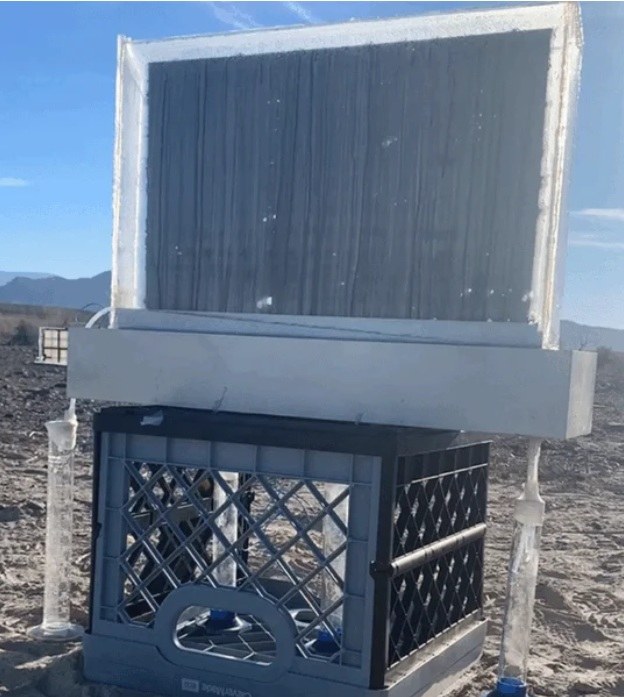
Engineers at the Massachusetts Institute of Technology have created an atmospheric water harvester that works without a power source. It has already been tested in one of the driest places on Earth, Death Valley in California.
Engineers at the Massachusetts Institute of Technology have created an atmospheric water harvester that works without a power source. It has already been tested in one of the driest places on Earth, Death Valley in California.
Today, 4.5 billion people in the world no longer have a constant supply of clean drinking water. This device could be a solution for water supply in such regions.
Until now, the possibilities of harvesting atmospheric water have been limited by the very low rate of its extraction (a few milliliters per day) and the high level of contamination from the materials used for this, from salt to lithium.
In Death Valley, four surrounding mountain ranges push clouds upward, squeezing most of their moisture out before they hit the parched land beyond, making it a challenging testing ground for water harvesting.
But a hydrogel made from polyvinyl alcohol (PVA), lithium chloride (a salt that attracts water), glycerin, and black ink coped with this task, writes Science Alert.
Source: Science Alert
The team shaped this hydrogel into a bubble film shape to increase the surface area for water collection. They also ensured that its microstructure did not have pores large enough to allow the water-attracting salt to escape. The glycerin helped keep the salt inside the gel.
A gel panel sandwiched between glass panels with an outer polymer film that promotes cooling attracted up to 160 ml of water molecules overnight, when humidity was highest.
During the day, the water trapped in the gel heats up, evaporates from the gel, and condenses on the cooler glass surface. Gravity, acting on the vertical panel, along with a system of channels, collects the water.
"This is a test of the scalability of this water harvesting technology," the engineers say. "Now people can build it even bigger, or connect it in parallel panels to provide people with drinking water and achieve real impact."