Хочете будувати кар’єру в Data Science та AI? Vodafone Big Data Lab відкриває новий набір —>
Марія БровінськаWar
30 July 2026, 09:00
2026-07-30
"I would advise those IT professionals who are hesitating whether to move to Defense Tech to change their mindset." 7 questions for DefTech CEO: owner of SKIF NVK about industry problems, personnel and product evolution
Ukrainian Defense Tech is developing faster than ever. If earlier the cycle of creating a new technology was measured in years, now it is measured in weeks, and sometimes days. This changes not only products, but also the requirements for engineers, companies, and the entire industry.
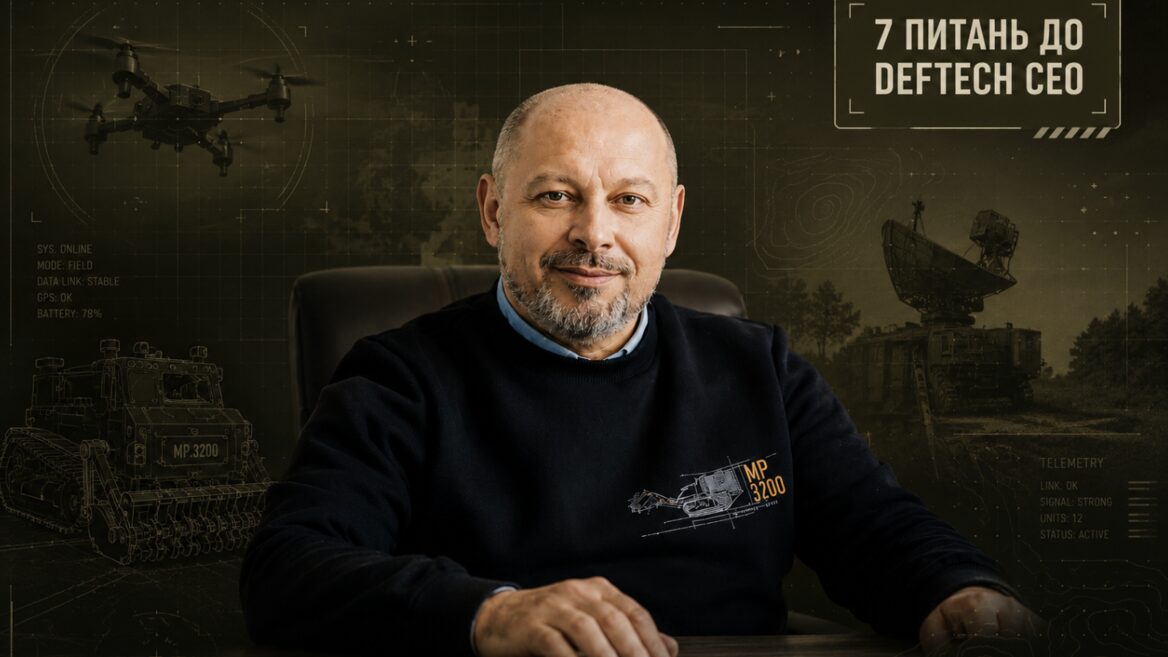
In the new issue of the column«7 Questions for DefTech CEO» dev.ua spoke with Yuriy Lavrenov, CEO of SKIF. He told why Ukrainian miltech lacks people, who overestimates technology today, that civilian IT often does not understand the defense industry, and what, in his opinion, the technological war of the coming years will be.
Ukrainian Defense Tech is developing faster than ever. If earlier the cycle of creating a new technology was measured in years, now it is measured in weeks, and sometimes days. This changes not only products, but also the requirements for engineers, companies, and the entire industry.
In the new issue of the column«7 Questions for DefTech CEO» dev.ua spoke with Yuriy Lavrenov, CEO of SKIF. He told why Ukrainian miltech lacks people, who overestimates technology today, that civilian IT often does not understand the defense industry, and what, in his opinion, the technological war of the coming years will be.
— What is the biggest problem facing Ukrainian Defense Tech today? What is the biggest concern for your company?
I wouldn’t call it a problem. This is the new reality of Ukrainian Defense Tech.
Modern warfare has become a constant technological confrontation. One side creates a new solution, the other almost immediately finds a way to counter it. As a result, the cycle of technological development has been reduced from years to weeks, and sometimes even days.
In fact, today a product can no longer be considered complete. It needs to be constantly adapted: software, electronics, sensors, algorithms, and methods of application need to be updated. The speed of adaptation has become the main competitive advantage of Ukrainian manufacturers.
The biggest challenge for our company is people. Historically, Ukraine has not had a large school of engineers specifically for the defense industry, so we actually train such specialists within the company and teach them to work at the pace of modern warfare.
— What technology is most overrated today? And what, on the contrary, is underrated?
In my opinion, individual technologies are often overrated. In fact, almost none of them, by themselves, provide a battlefield advantage. True advantage arises when sensors, communications, software, artificial intelligence, mechanics, and electronics are properly combined.
It is not a separate component that is decisive, but the ability to integrate different technologies into a single system. At the same time, systems engineering and the speed of integration of new solutions remain underestimated. Today, they determine the effectiveness of any modern product.
— Who is the hardest person to find on the market today? How do you solve the personnel issue?
The biggest challenge for us is people. Some specialists left Ukraine because of the war, but the reason for the shortage is much deeper. For many years, there was practically no large Defense Tech industry in Ukraine, so the market simply did not have time to form a sufficient number of specialized engineers.
We are looking for specialists in electronics, programming, mechanics, and production. But the main thing is to quickly integrate them into the company’s work.
Today, it’s not enough to simply find an engineer. You need to onboard them as quickly as possible and train them to work in an environment where technology is changing almost continuously.
What is the most valuable skill for an engineer in Defense Tech today?
The most valuable thing today is systems thinking and the ability to learn quickly. Modern Defense Tech works on a modular principle. Almost no one creates a product from scratch. An engineer must be able to combine ready-made technologies, integrate new solutions and adapt them to new challenges.
Therefore, today it is more important not to have perfect knowledge of one specific technology, but to be able to quickly combine dozens of different components into a single effective system.
— What do civilian IT people most often misunderstand about Defense Tech?
Many people perceive Defense Tech as just another IT industry. In fact, it is an environment where programmers, electronics engineers, designers, production engineers, communications specialists, and those who analyze real combat experience work together.
In addition, the pace of development is completely different. An idea that emerged today can be tested today or tomorrow. This is fundamentally different from the classic multi-year product development cycles.
— What will war be like in two or three years from a technological point of view?
It seems to me that war is increasingly moving from the plane of numbers to the plane of technology and economics. Today, it is not enough to create an effective system. It must be economically justified, quickly produced, easily scalable and constantly improved. Therefore, the war of the future will evaluate technologies not only by their combat capabilities, but also by the ratio of effectiveness and cost.
The winner will not be the most expensive solution, but the one that provides maximum results at minimal cost and can quickly adapt to new conditions.
— What would you say to IT professionals who are hesitant about moving to Defense Tech?
First of all, I would advise you to change your mindset. While previously you could work on a product for years, today you need to learn how to create solutions that can be tested almost immediately after the idea appears.
Defense Tech is also a completely different level of responsibility. Here, an engineer works not just on a product or customer requirements. He works on solutions that could affect people’s lives.
And one more piece of advice — invest in fundamental knowledge. Physics, mathematics, electronics, chemistry, and systems thinking are no less important today than knowledge of a specific programming language or framework. They are the ones that allow you to quickly create new technologies that modern Defense Tech needs.
Ukrainian Defense Tech today is probably the best environment in the world for the development of an engineer. Nowhere else do technologies go from idea to real application so quickly.
«Military companies today are like Ukrainian IT companies 15 years ago.» 7 questions for the CEO of Frontline Robotics — about the future of war, FPV, the shortage of engineers and more
«The biggest problem, as well as the biggest opportunity, of the deftech industry is the existence of Russia.» 7 questions for the CEO of HIMERA about technology, the talent shortage, AI and the future of war
«We once believed in drones. Now we have to believe in missiles.» BlueBird Tech co-founder on the new stage of Ukrainian miltech, dependence on China and the shortage of engineers — 7 questions for the CEO
«The hardest thing is finding an engineer who can translate a problem into a technical solution.» 7 questions for the CEO of XTI Engineering, which creates demining equipment
Головна проблема в тому, що довірившись системі, айтішник чи інженер може через тиждень бути переведеним в штурмовики.
І це не якісь вигадки. Людей вже похоронили. А держава тепер шукає «нових спеціалістів». Ну-ну.
Головна проблема в тому, що довірившись системі, айтішник чи інженер може через тиждень бути переведеним в штурмовики.
І це не якісь вигадки. Людей вже похоронили. А держава тепер шукає «нових спеціалістів». Ну-ну.









Це все супер, але дефтех не дає конкурентних зарплат, і це головна проблема, бо якісний інженер скоріше піде на х2 зарплатні працювати на штати.
Головна проблема в тому, що довірившись системі, айтішник чи інженер може через тиждень бути переведеним в штурмовики.
І це не якісь вигадки. Людей вже похоронили. А держава тепер шукає «нових спеціалістів». Ну-ну.
Головна проблема в тому, що довірившись системі, айтішник чи інженер може через тиждень бути переведеним в штурмовики.
І це не якісь вигадки. Людей вже похоронили. А держава тепер шукає «нових спеціалістів». Ну-ну.