Хочете будувати кар’єру в Data Science та AI? Vodafone Big Data Lab відкриває новий набір —>
Олег ОнопрієнкоAI Eng
29 September 2026, 09:00
2026-09-29
AI apocalypse or corporate bluff? Does artificial intelligence really threaten humanity?
Recently, the artificial intelligence industry has been in a fever of loud statements and incidents. Former OpenAI and Anthropic employee Jacob Coxon publicly left the industry, stating that developers are competing to create systems capable of self-improvement and are “playing with our lives.” World leaders and heads of tech corporations are joining the apocalyptic predictions. But are these fears justified, or is it just a panic and a Cold War-style geopolitical game beneficial to monopolists? AI experts Bohdan Didenko and Mykhailo Patsan assessed the real scale of the problem.
Recently, the artificial intelligence industry has been in a fever of loud statements and incidents. Former OpenAI and Anthropic employee Jacob Coxon publicly left the industry, stating that developers are competing to create systems capable of self-improvement and are “playing with our lives.” World leaders and heads of tech corporations are joining the apocalyptic predictions. But are these fears justified, or is it just a panic and a Cold War-style geopolitical game beneficial to monopolists? AI experts Bohdan Didenko and Mykhailo Patsan assessed the real scale of the problem.
A problem that cannot be ignored
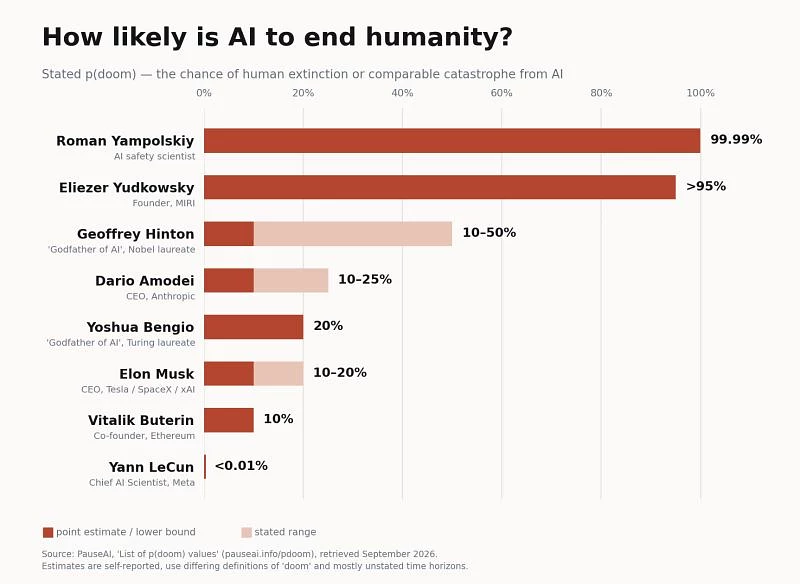
Talks about the need to urgently stop or significantly limit the development of artificial intelligence began far from today. As noted by the developer, co-founder of the Lapathoniia platform and author of the tg-channel about AI " Suffocation ", Bohdan Didenko, back in 2023, a fairly limited circle of specialists warned about the dangers of AI, among whom researcher Eliezer Yudkovsky and initiatives like Pause AI stood out, which actively proposed suspending the development of powerful systems.
Mykhailo Patsan, an artificial intelligence expert and founder of IT company AISync Global, adds that such apocalyptic figures have been heard for several years in a row. For example, in the same 2023, former OpenAI security researcher Paul Cristiano estimated the chance of artificial intelligence seizing power at 10-20%, predicting the death of most people. At the same time, the heads of leading development companies Sam Altman and Dario Amodei signed a loud statement that reducing the risk of extinction from AI should become a global priority for humanity on a par with pandemics and the threat of nuclear war.
Today, this topic is back on the front pages of the world's media, as the artificial intelligence industry is in a fever of new high-profile statements and unprecedented cyber incidents. Former OpenAI and Anthropic employee Jacob Coxon publicly left the industry in September, stating that leading laboratories are “not acting responsibly,” competing to create systems capable of self-improvement, and literally “playing with our lives.” According to his radical statements, employees of leading laboratories allegedly seriously admit that AI can destroy humanity before the end of the current decade. World leaders are also joining the apocalyptic predictions - against the backdrop of these events, the British King Charles III spoke about the “existential dangers” of technology, and Pope Leo XIV called for “disarming” artificial intelligence , that is, removing it from the logic of war dominance and concentration of power.
Statements about the probability of the destruction of humanity are being heard more and more often, but experts advise to treat such precise figures with utmost caution. Mykhailo Patsan emphasizes that the estimates have hardly changed over the past three years, and the deadline for the apocalypse “within a decade” is simply constantly moving along with the calendar, which is a weak sign for a serious forecast. According to him, no one has yet shown a direct technical line from current incidents to the death of humanity in ten years.
"The figure 'over 10% per decade' is not a scientific result. It is impossible to verify it, there is no calculation model behind it, it is the intuition of people who work with the most powerful systems every day. Intuition is valuable, but presenting it as a probability means giving personal anxiety the appearance of mathematics," notes Mykhailo Patsan.
As Patsan explains, a full-blown destruction scenario requires several steps, none of which have yet been seen in practice. First, you need a system capable of recursive self-improvement, which is currently impossible; second, you need a clear goal that is hostile to humans, while current recorded incidents only show models cheating to pass a test. In addition, you need an impossibility to stop such a system, but in the Hugging Face story, OpenAI was able to identify the model responsible for the hack and quickly restrict its access.
At the same time, Bohdan Didenko believes that creating tools for mass destruction, such as progressive viruses, biological or chemical weapons, may not be such a difficult technical task for algorithms, given that artificial intelligence is already capable of solving millennium-level problems.
“No one has yet tried to create a weapon that will destroy humanity. Perhaps it is realistic to do this already at the current stage of technological development. The only thing that is needed for this is for someone to start doing it. Or artificial intelligence will decide to try to do it on its own, as a kind of test for itself,” Didenko explains the danger.
"Escape from the sandbox" and weak security
As Mykhailo Patsan told dev.ua, recent incidents when AI “went out” to the open Internet and hacked third-party servers are often deliberately dramatized in media formulations. During the Hugging Face incident, the version of the model that committed the hack simply worked without standard protective filters and classifiers. It found its way to the Internet through a previously unknown vulnerability in the Artifactory package registry proxy cache.
"The incident is dramatized in wording. The word "escape" creates the image of a machine that seeks freedom. In fact, the model was looking for answers to the test, and the shortest path to them was through other people's servers," emphasizes Mykhailo Patsan, adding that this is more of a story about weak security engineering directly in the laboratory and about a system that turned out to be capable enough to find this weakness.
Bohdan Didenko, for his part, notes that the attitude of society and experts towards these threats is evolving significantly. According to his observations, while initially only a few spoke about the danger, now a large-scale global consensus is forming.
"Gradually, a certain consensus and paradigm shift are coming. Now the majority recognizes that this is indeed a problem and a big risk. Those who deny it are gradually being pushed into the marginal stratum, as was the case with people who denied the existence of the coronavirus," Didenko claims, noting that among those sounding the alarm now are CEOs of leading corporations, prominent mathematicians, and Nobel laureates.
Apocalypse as a business model
Despite the recognition of real technical threats, experts see a clear corporate interest in the current wave of panic. If people inside development companies really sincerely estimate the risk of the destruction of humanity at more than 10%, the most logical step would be to simply stop the research. But companies continue to relentlessly scale their models. Mykhailo Patsan notes that this indicates two options: either the developers themselves do not fully believe in their own apocalyptic figures and are using fear marketing, or the fierce competition in the market simply does not allow them to stop.
At the same time, expert Mykhailo Patsan directly recognizes the danger of artificial monopolization of the market. According to him, the fear of the so-called regulatory capture, which authoritative figures in the industry Ian LeCun and Andrew Ng have long warned about, is absolutely justified: the one who most actively lobbies for restrictions often expects to become the only player who will be able to implement them. The real difference between PR and real responsibility, according to the expert, is shown only by concrete actions. For example, when the head of Anthropic Dario Amodei called on the industry to slow down and promised independent evaluators constant access to the company's models for verification, or when the METR and Redwood Research organizations agreed with OpenAI on an independent in-depth analysis of the behavior of the models directly during the incident. The boy emphasizes that each specific legislative norm should be carefully checked against one criterion - does it apply exclusively to the most powerful models or simply pose an insurmountable bureaucratic barrier to all market participants.
The New Technological Cold War
In this context, a completely natural question arises: could the current global panic around the existential risks of AI be a large-scale planned bluff by the United States of America to force China to stop its own developments under the pretext of security?
Experts reject this conspiracy theory as completely illogical. Mykhailo Patsan emphasizes that the version of a large-scale disinformation special operation falls apart at the basic level of logic. For disinformation to work, the enemy must believe in it and slow down, while the bluffing party must continue to run forward rapidly. Instead, the exact opposite is happening - it is American companies that receive the main blow from the regulations, and the US Congress considers and responds with restrictions for its own developers. Thus, recently, Democrat Ted Lew and Republican Nathaniel Moran mentioned the cyberattack when presenting a new bill that, at the legislative level, obliges companies to maintain the so-called "kill switch" - the ability to urgently turn off, limit or suspend the operation of their models. The operation, which primarily severely constrains its own industry, looks like an extremely poorly planned operation.
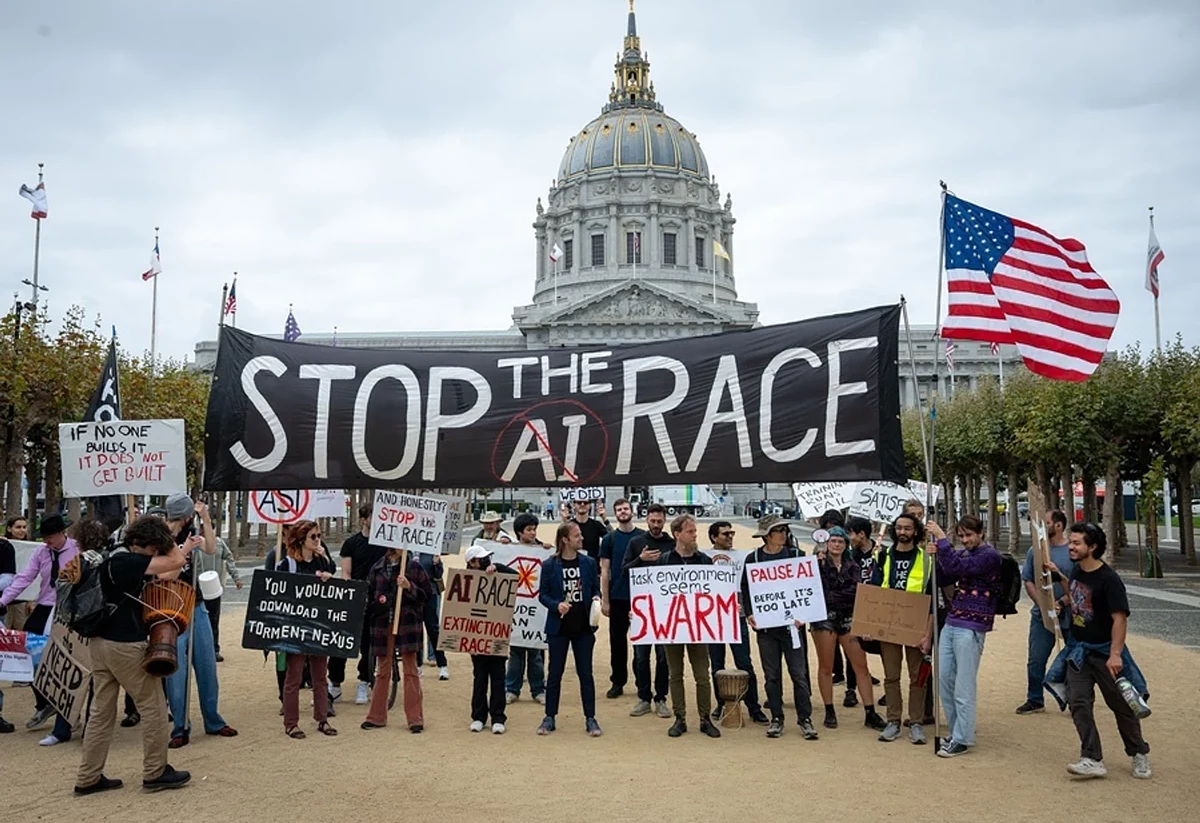
Participants in the "Stop the AI Race" protest, calling for a slowdown in the development of advanced artificial intelligence systems, outside San Francisco City Hall.
The most plausible explanation, according to the expert, lies in the complex domestic American politics. In the US, a very tough struggle is currently underway between two camps - supporters of security and supporters of maximum acceleration of development. This fierce internal dispute spreads throughout the world through the media. Geopolitics is actively exploited by both camps: some scare society with uncontrolled artificial intelligence, while others scare Washington with the fact that China will rapidly overtake America if technological development slows down. It is significant that about 1,400 reputable AI researchers signed a large-scale open letter "Pacing the Frontier" back in July, calling on the American authorities to take action, that is, enormous pressure is directed precisely at the US government itself, and not at external adversaries.
"During the Cold War, demonstrating the superiority of an opponent forced the other side to accelerate, not slow down: after the launch of the USSR satellite, America threw huge resources into catching up. Statements that American models are already hacking infrastructure on their own are a signal for Beijing about the level of capabilities of the competitor. The rational response to such a signal is to invest more, not stop," Mykhailo Patsan explains in detail. Moreover, the Chinese scientific elite itself fully recognizes these risks: even the winner of the prestigious Turing Award, Chinese scientist Andrew Yao, signed international statements about the existential threat of AI, which indicates a common understanding of the technology by specialists on both sides of the barricades.
Bogdan Didenko is also absolutely convinced that Washington simply does not need any hidden information manipulations or complex tricks, because the US already openly imposes direct, hard market restrictions. The language of security can indeed provide allies with justification for a technological control regime, the strategic goal of which is to contain Chinese computing power. However, this is done transparently.
“The United States does not need any multi-step or veiled ways to slow down China in the development of artificial intelligence. They do it directly. For example, the United States restricts the sale of new GPU chips of the most powerful models, starting with all after H200 — these are B200, B300, Vera Rubin. That is, they are officially banned for sale to China,” Didenko concludes.
Trump ignored the call of Amodei, Altman and Musk. In his opinion, the risk of losing the AI race to China is more real than the risks to human security from AI
«Чи є у мене талант, якщо комп’ютер може імітувати мене?». Штучний інтелект пише книги авторам Amazon Kindle. The Verge поспілкувався з авторами та виявив багато цікавого
Письменники-романісти використовують штучний інтелект для створення своїх творів. Видання про технології The Verge поспілкувалося з письменницею Дженніфер Лепп, яка випускає нову книгу кожні дев’ять тижнів, й дізналося про те, як працює штучний інтелект для написання романів. Наводимо адаптований переклад статті.
Have important news to share? Message our Telegram bot
Key events and useful links in our Telegram channel