Хочете будувати кар’єру в Data Science та AI? Vodafone Big Data Lab відкриває новий набір —>
Марія БровінськаStartup
14 August 2026, 08:39
2026-08-14
“AI wrote me a product, but I won’t let it wake you up at three in the morning”: Ukrainian engineer created AnyPager in two months
Ukrainian engineer Stanislav Cherednychenko created AnyPager himself, an emergency notification service that should wake up developers during critical incidents. The first commit in the repository appeared on May 7, 2026, and on August 9, the application was submitted for review in the App Store. During this time, one developer created the backend, iOS and Android clients, Wear OS support, CLI for five platforms, a web dashboard, billing via Stripe, and documentation.
He did a lot of the work with Claude Code and AI agents. He estimates that the direct development costs were about $150. But there is an important caveat: artificial intelligence helped create the product, but the product itself works without AI.
«AI built AnyPager, but AI won’t wake you up — that’s what queue, retry, and if do,» explains the founder of dev.ua.
Ukrainian engineer Stanislav Cherednychenko created AnyPager himself, an emergency notification service that should wake up developers during critical incidents. The first commit in the repository appeared on May 7, 2026, and on August 9, the application was submitted for review in the App Store. During this time, one developer created the backend, iOS and Android clients, Wear OS support, CLI for five platforms, a web dashboard, billing via Stripe, and documentation.
He did a lot of the work with Claude Code and AI agents. He estimates that the direct development costs were about $150. But there is an important caveat: artificial intelligence helped create the product, but the product itself works without AI.
«AI built AnyPager, but AI won’t wake you up — that’s what queue, retry, and if do,» explains the founder of dev.ua.
One person, but almost 20 years in IT
Cherednychenko has been working in IT since 2007. He started as a student at the DNUJT in Dnipro and during this time he managed to work with web development, backend, frontend, mobile applications, DevOps, Terraform, Kubernetes, and PostgreSQL.
Separately, he worked on embedded systems, Arduino, and 3D printing.
This background, he says, explains why he was able to work independently with several technology stacks at once.
AI agents greatly speed up work where the developer already knows what the correct result is. But if a human is unable to evaluate the result, the speed of code generation alone does little.
«My background is that verification function,» he says.
Pager between Telegram and PagerDuty
The idea for AnyPager arose from a specific problem. When a small team is responsible for production, they have to choose between a homemade webhook in Telegram or Slack and corporate platforms like PagerDuty.
«There is a huge void between the shell script and the corporate command center,» says Cherednychenko.
He says PagerDuty costs about $21–41 per person per month, and it can take weeks to fully set up a solution. AnyPager is trying to bridge that gap.
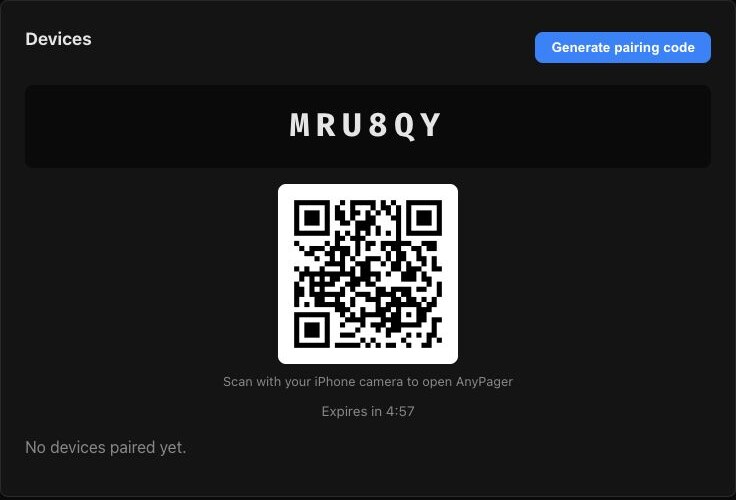
The service converts a single HTTP event into a push notification that should break through even silent mode.
But its task is not just to send a message. AnyPager must answer three questions: who owns the incident, did anyone see it, and what to do if no one reacts.
After pressing Acknowledge, the escalation stops.
«Webhook can send messages. It doesn’t know who is on-call, who has taken the alert to work, and when to wake up the next person,» explains the founder.
The product’s target audience is small teams with 2–20 responders: indie developers, small SaaS companies, and agencies that support production for clients.
The product is aimed directly at the global market. It is English-language, payment is via Stripe, and distribution is via the App Store and CLI.
There has been no public release yet — the iOS app is under review in the App Store. Currently, AnyPager is being tested by five small teams, so the founder doesn’t call them a full-fledged user base yet.
Two months of development — and several stacks
Cherednychenko created AnyPager himself, in parallel with his main job as an engineer at Techery.
Development was largely done with the help of Claude Code. The founder’s own functions were architecture, defining product boundaries, reviews, and deciding what the team, i.e. himself, would not do.
«I would have spent six months sculpting it myself — and, to be honest, I probably wouldn’t have finished it. In the fourth month, a solo project dies from fatigue, not from technical reasons,» he says.
According to him, the main advantage of AI agents is not just the speed of writing code: «The speed here is not that the code is typed faster. It is that the switching cost disappears.»
A developer doesn’t need to waste hours returning to the context of each technology: he can work with Rust in the morning, Swift in the afternoon, and Kotlin in the evening, delegating a significant part of the implementation to agents.
In total, AnyPager’s code base is about 26,000 lines. Approximately 20,000 are written in Rust, 3,200 in Kotlin, 1,800 in Swift, and the rest is for the web dashboard and documentation.
In a few months, the backend, iOS, Android, and Wear OS clients, CLI for five platforms, web dashboard, Stripe billing, and documentation were created.
The most interesting experiment is to rewrite the backend in Rust
Initially, the AnyPager backend was written in TypeScript. In July, Cherednichenko decided to completely rewrite it in Rust.
The replacement took place directly in production, without a separate staging rehearsal. It took several days. The key tool was a black-box test suite: it raises a real worker and tests it over HTTP just like the client does.
The tests actually became a specification for the new implementation: if the external behavior has not changed, the backend is considered to have been rewritten correctly.
This is where, according to the founder, AI does not eliminate engineering work. «Agents provide speed, but you can only use them where you have something to check the result,» he says.
«I don’t judge what I don’t understand»
Using AI agents does not mean that Cherednychenko accepts the code they write without checking. The project uses the Rust compiler, clippy with zero tolerance for warnings, formatting, and automatic tests in CI.
The founder also has a personal rule: «I don’t measure what I don’t understand. If I can’t explain why this piece is needed, it doesn’t go to the market.»
He even believes that AI-assisted development has made him more strict about quality, not the other way around.
The logic is simple: if code can be generated very quickly, the main limitation becomes not the speed of writing, but the quality of testing.
Why is there no AI in AnyPager?
At first glance, this may seem like a paradox: AI was actively used to create a product, but there are no AI features in the product itself.
For Cherednychenko, this is a principled position. AnyPager works in a critical chain: it must deliver an alert, wake up the right person, and stop the escalation after its confirmation. Therefore, the founder does not want to use probabilistic logic here.
«AI incident grouping,» «intelligent noise suppression,» and other similar features may be useful for large enterprise platforms, but they fall short of AnyPager’s main promise — to reliably deliver critical alerts.
«There is no inspector on the pager at three in the morning,» he explains.
The most difficult thing about a product is not to push it.
The technological complexity of AnyPager, according to the founder, is not in sending a push. It is actually a single HTTP request to APNs.
The difficulty is in delivering it.reliably and on time, and also correctly handle the situation when two people press Acknowledge at the same time.
This uses idempotency keys, Cloudflare Queues with retries, a dead-letter queue, a backup cron every five minutes, and a separate daily Stripe subscription checker.
Any event entering the DLQ becomes a reason for verification. A separate metric is the proportion of valid pushes accepted by APNs. The founder’s goal is at least 99,9%.
Critical notifications use Apple Critical Alerts. This is a separate entitlement that Apple issues with appropriate justification. It allows critical notifications to pass through Do Not Disturb, Focus, and Silent mode.
That is, in an ideal scenario, AnyPager should really do what it was created for: wake a person up at three in the morning.
One POST request instead of a complex migration
Integration with the product should take a few minutes.
AnyPager is not a replacement for monitoring. Sentry, Grafana, Uptime Kuma, GitHub Actions, cron, and other systems that can send HTTP events can use it as an emergency notification channel.
The founder’s goal is to ensure that from registration to the first delivered alert,less than 15 minutes without his participation.
$1 per user
AnyPager’s monetization model is as simple as possible: $1 per participant per month or $10 per year.
A team of five people pays $5 per month or $50 per year. There is a 30-day trial without a credit card.
The price is intentionally much lower than corporate solutions.
«Price is not dumping, it is a distribution strategy: the product should be purchased without calling the salesperson and without agreeing on a budget,» says Cherednychenko.
He spent about $150 in direct funds on product development — on the Apple Developer Program, a domain, Cloudflare, and an email service.
There are no servers, and infrastructure costs, he said, amount to tens of dollars per month depending on actual consumption.
The startup did not attract any investments. It is a complete bootstrap.
«Raising money to this proof means scaling an assumption instead of a fact,» the founder explains.
Why now?
According to Cherednychenko, several favorable factors have developed for such a product.
Firstly, there are more small teams that independently support real production.
Secondly, infrastructure has become cheaper, while enterprise platforms have not become proportionally cheaper.
Third, edge runtimes allow one person to maintain a globally distributed service without their own servers.
And finally, there is a specific market window: Atlassian stopped selling new subscriptions to Opsgenie in June 2025, and the service itself should be unavailable from April 2027. For some small teams, this means the need to look for an alternative.
AnyPager wants to fill this gap — between a full-fledged enterprise platform and a homemade webhook.
«We don’t want to become just another platform»
Among the competitors, the founder names PagerDuty, Better Stack, and Opsgenie/Jira Service Management on the one hand, and Pushover and home-made webhook solutions on the other.
AnyPager’s positioning is in the middle: routing and accountability functionality close to professional pagers, but simplicity and price closer to simple push services.
At the same time, the founder consciously gives up many functions.
AnyPager has no monitoring, logs, status pages, SMS and phone calls, SSO/SCIM, or AI.
«One urgent cycle, executed exceptionally well,» is how he describes the product.
Not DAU, but the number of people who were actually «covered»
Since AnyPager has not yet been released publicly, there is no data on retention, DAU/MAU, or geography of downloads yet.
And the founder doesn’t find these metrics particularly useful for a pager.
«A good pager is one you rarely open,» he says.
Instead, Cherednychenko looks at the share of delivered pushes, time from registration to first alert, trial → paid conversion, and churn.
There is also its own metric — Monthly Protected Responders, that is, the number of living people who are actually protected by the pager. For the first year, he set a goal of 30 paid workspaces and 150 responders.
This, he said, should be proof of the viability of the model, not a ceiling for the product.
What’s next?
In two or three years, Cherednichenko wants to see AnyPager not as a platform, but as a tool that is installed in a new project as routinely as Sentry.
The nearest plans are Android and Wear OS, Apple Watch with Critical Alerts support, as well as a Slack app with the ability to press Ack directly in the channel.
At the same time, each new feature must pass its own criteria of necessity. For example, he is ready to actively develop the Android version if it blocks at least 30% of qualified lost trials or is needed by at least five teams.
That is, they do not plan to turn the product into another platform with dozens of features.
Вас також кусають комарі? Розповідаємо про пристрій від українських стартаперів, який може цьому зарадити
Як зауважив нещодавно один військовий, якой побажав залишитись невідомим, орки, може, й не поцілять, а комарі точно зʼїдять. І від них потерпають зараз багато українців.
Позбавитись від комарів назавжди ефективно й екологічно допоможе гаджет Mosqitter. Цей стартап заснували дві українки — Анастасія Романова та Ольга Дьячук.
Ми вирішили нагадати, що може Mosqitter, про принципи його роботи та особливості, на злобу дня.
(текст від 21 жовтня 2021 року)
Кнопка здоров'я. Українці розробили систему, яка рятує пацієнтів стаціонару від смерті. Вони - переможці IT Arena Lviv 2022
Медичний психолог, який переїхав в Україну з Москви в 2014 році, Іван Осадчий, придумав систему, яка допомагає медсестрі і пацієнтові не втратити один одного в стаціонарі. Його стартап knopka вже працює в декількох лікарнях понад три роки не лише в Україні, а й у Польщі.
Повторюємо історію стартапу-переможця IT Arena Lviv 2022. Текст від 28 вересня 2022 року.