Хочете будувати кар’єру в Data Science та AI? Vodafone Big Data Lab відкриває новий набір —>
Ігор Вишневський Startup
21 October 2025, 09:00
2025-10-21
How the Anima app detects depression levels by looking at the eyes and why, in addition to psychologists, it is useful for businesses and the military. dev.ua tested the app and spoke with the startup's COO
As the startup competition at this year’s IT Arena showed, the integration of technological solutions based on artificial intelligence into the field of psychology is more than timely. Especially in a warring country that is smoothly approaching the fourth anniversary of full-scale war and has been fighting the enemy on the battlefield for more than 11 years.
As the startup competition at this year’s IT Arena showed, the integration of technological solutions based on artificial intelligence into the field of psychology is more than timely. Especially in a warring country that is smoothly approaching the fourth anniversary of full-scale war and has been fighting the enemy on the battlefield for more than 11 years.
Not long ago, we wrote about how startup InTempo offers a way to overcome panic attacks and anxiety disorders through your favorite songs. But during IT Arena 2025, we also managed to talk to the Chief Operating Officer of startup Anima, who describes his solution as an «innovative AI platform for mental well-being.»
We have already written about Anima in the news, but this time the dev.ua journalist managed not only to talk to the startup’s COO Anastasia Pustilnyk, but also to test the application on himself.
About the Anima startup
Anima is a platform founded by entrepreneur Roman Gavrysh and neurophysiologist Sergey Danilov. The startup was formed on the basis of Beehiveor, a research center founded by Danilov. Since its creation in 2016, Beehiveor has accumulated a significant amount of data and expertise in the analysis of eye movement behavior, so Anima was based on a test that, through eye movement tracking, allows you to determine the level of stress, anxiety, or depression.
The test is conducted using a webcam that records eye movement and determines how much attention is shifted in relation to stimuli of different emotional valence. At the end of last year, Anima announced the launch of an office for military psychologists to enable them to use the startup’s solution in their work.
The Anima platform can be used not only by individual users and medical institutions, practicing psychologists, psychotherapists and psychoneurologists, but also by businesses — for their employees. After all, as noted on the Anima website with reference to a Deloitte study, companies lose an average of $2,000 per person per year due to problems with the mental health of employees.
What Anima says about the mental state of the journalist dev.ua
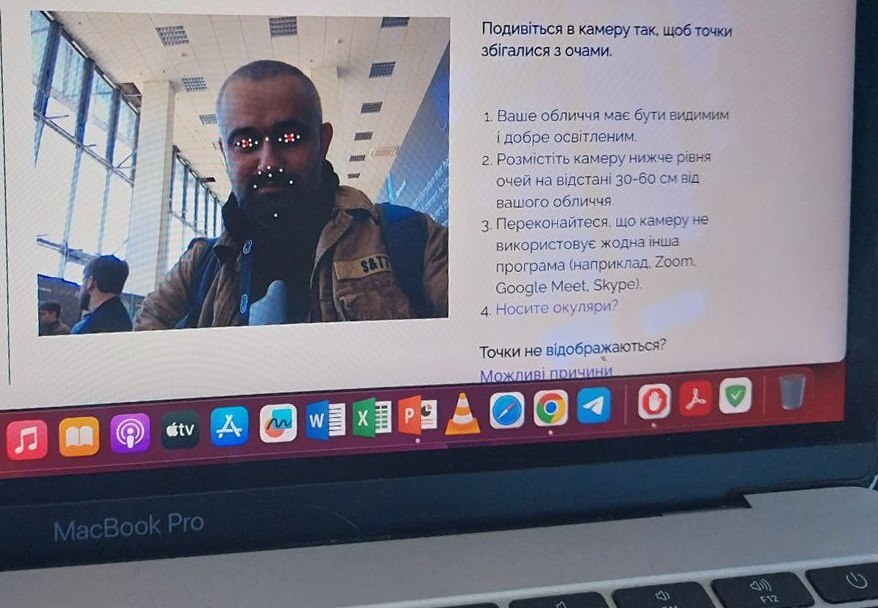
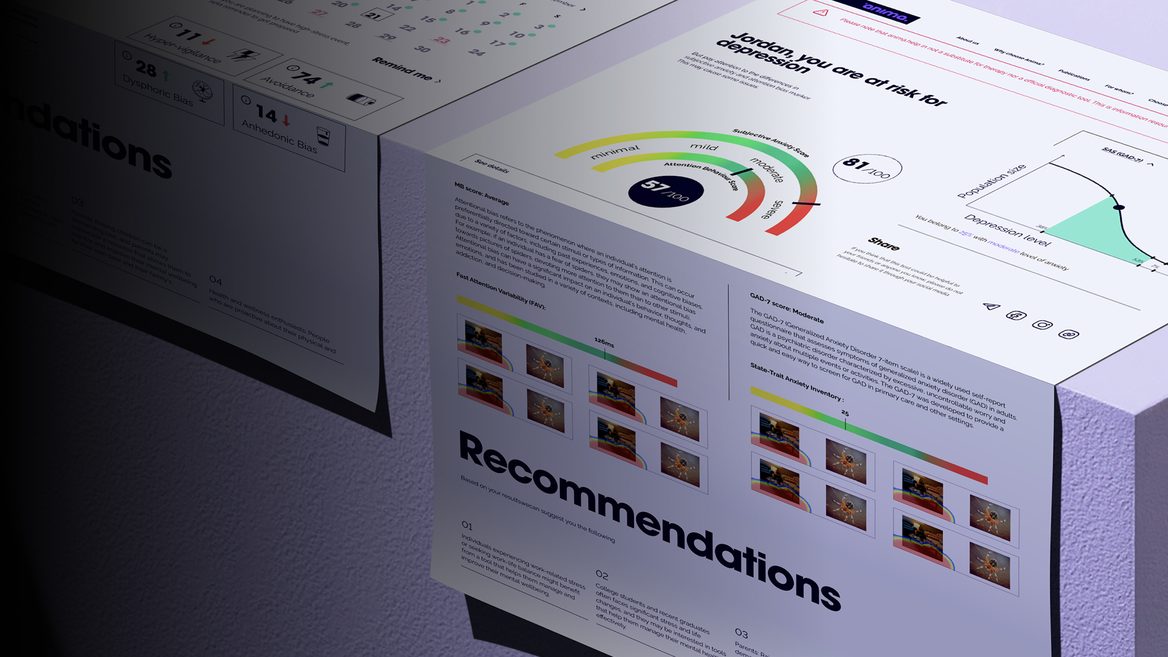
The first thing that happened when interacting with the Anima app: the face of the dev.ua journalist displayed on the laptop screen was covered with white and red dots — it means that the gadget’s camera has connected with his visual organs and is ready to «read» information about his psycho-emotional state from them. Although he looked a little more «cool» than in real life :)
Later, after a series of necessary mouse clicks, the next stage was the selection of paired images — two pictures on the screen at the same time, and these pairs of pictures replaced each other. The journalist could not follow any pattern in the selection of pictures, because they could simultaneously be images that conveyed some positive idea or event, and certain terrifying sights (of course, without any excessive cruelty). After all, it is difficult to imagine what pictures should be shown to Ukrainians in 2025 to truly throw them off balance, if the bloodiest videos with the death of occupiers on numerous social media channels cause them only a gentle smile.
«The first stage is calibration. Then you are shown various images — which have been worked out by a whole team of psychologists and, according to the theory of attention distortion, are selected in a certain combination. This is done so that we can then analyze various patterns and gather an overall picture of a particular indicator,» Anastasia Pustylnyk commented on my attempts to test Anima.
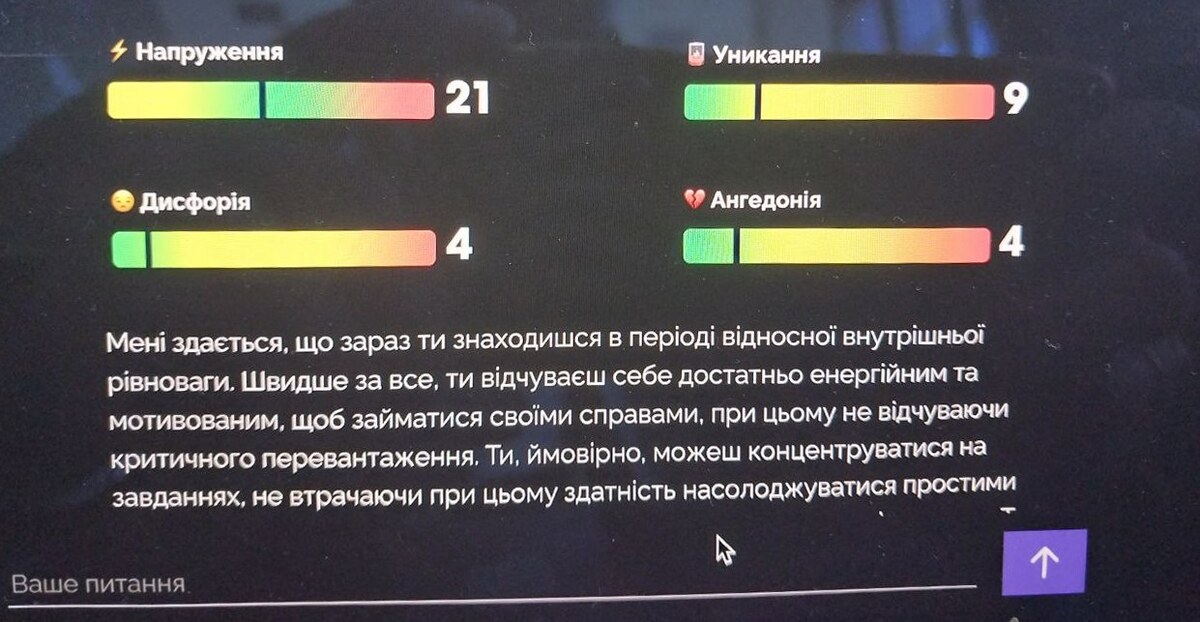
At the time of his stay at IT Arena 2025, the author of the material was truly inspired by the atmosphere of the event and was sincerely interested in what was happening, and also did not have any stressful feelings, so the application, after viewing photo galleries and completing a small survey, classified his condition as a conditional norm according to 4 indicators and issued its conclusion.
Defining Combat Readiness for the Military and Eating Disorders: How a Startup Expands Its User Base
After the test, the dev.ua journalist also asked the COO of Anima several questions about their product and the development of the startup.
— Anastasia, please give a brief description of the solution your startup offers. How exactly does technology determine a person’s mental state?
— We determine different mental states, such as stress, burnout, depression, anxiety, by eye movement. We track attention by eye movement when we show different stimuli-images. According to how a person looks at them, we can determine with very high accuracy, compared to a professional eye tracker, what level of various mental illnesses a person has.
The test consists of two parts. The first is an eyetracker part, where we show different images. The second is a small questionnaire. Then this data is processed by our trained system, which produces results in a chart for the four indicators that we measure: anhedonia, dysphoria, avoidance, and tension.
We give recommendations on how to deal with this. And with our AI, trained by neuropsychologists and psychologists, you can talk about what to do about it, get individual evidence-based recommendations, and generally talk about your results.
— I had to read a lot of news stories where people, on the contrary, deepened their psychological problems by communicating with AI chatbots. You’re talking about recommendations from an AI platform in a rather sensitive topic. How safe is that?
— This is generally a key story, why it is bad to communicate with the ChatGPT conditional chat about your problems — because it hallucinates. By tracking eye movement, we understand what state the person’s brain and psyche are in now. And, accordingly, our LLM can provide a personalized result based on this data.
That is, it doesn’t just address the abstract question «What happened? Tell me,» it receives input data and indicators, based on which it then interprets what to do. We trained our AI on these indicators with psychologists and neuroscientists. Moreover, one of our co-founders and Chief Science Officer is a doctor of neurology. Therefore, from a scientific point of view, everything is more than justified.
— With some indicators, what defines the application is clear. And what is, for example, avoidance?
— When avoidance increases, it indicates that our brain needs rest. Our psyche is overloaded and can no longer cope under such conditions.
If this rest does not occur, the level of dysphoria will increase. If it is very high, it indicates a depressive state. That is, it is advisable to make sure to stay in the green zone.
Another indicator is responsible for your attention and focus under stress, and, accordingly, anhedonia is an indicator of the lust for life. In fact, it is an antonym for the word «hedonism.» So, if anhedonia is elevated, it means that you do not get pleasure from what should usually bring you pleasure.
— And what figures about the users of your app can you draw general conclusions from?
— We conducted research on a large sample — I think it was 6,000 people. But in total we already had over 30,000 active users. That is, we see dynamics in large numbers.
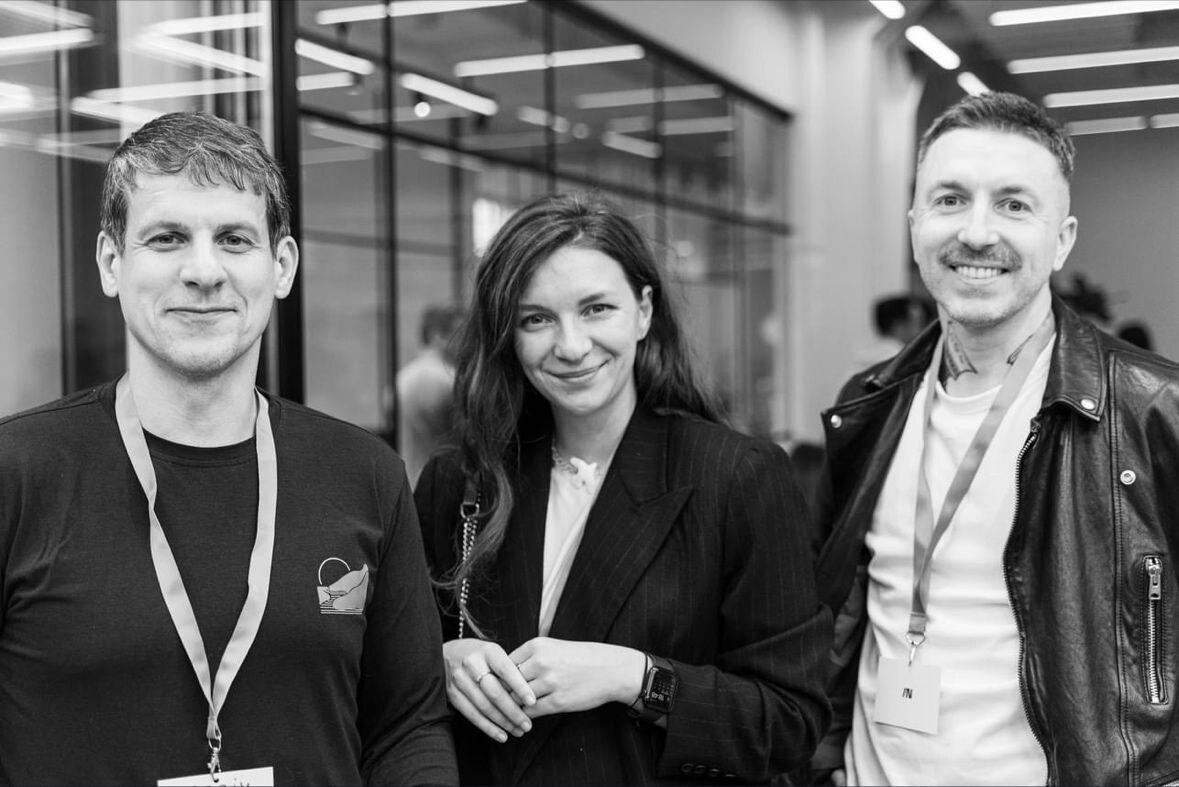
Anima startup co-founders Roman Gavrish and Serhiy Danilov with Chief Operating Officer Anastasia Pustylnyk. Photo from her LinkedIn
In general, I can say that Ukrainians, on average, tend to exaggerate the problems of their psychological state and catastrophize the situation. And women do this 25% more than men.
— If I am, conditionally, a regular user, and have already passed the test, then I probably won’t do it too often — because is there any point in checking my psychological state every day?
— No, on the contrary — because the idea is for people to track their dynamics. We even have a special calendar in the application where everyone can watch and track these processes. If, conditionally, one day you are in the red zone — then perhaps something just happened to you and this is some particularly difficult period. So you start looking at your positive and negative dynamics — conditionally, from the red you enter the yellow zone. You have been in the yellow zone for several days, and your brain tells you that something needs to be corrected, because it is desirable that we be in the green zone. But we cannot be in the green zone every day, because life is unpredictable, and various things happen that greatly affect our psycho-emotional state. These indicators should be checked at regular intervals — for example, once a week. Our application can be used as a kind of tonometer.
— How much does your app cost to users?
— If we are talking about a B2C story, then this option is available in the format of purchasing a single test or a monthly or annual subscription. If it is a monthly subscription, then its cost is 268 UAH per month. Currently, there is a significant discount when paying for an annual subscription — under such conditions, the cost will be only 134 UAH per month.
If we talk about the B2B product, then we have a solution for companies and businesses that purchase access and provide it to their employees. For companies, we set up a common dashboard where they see the average dynamics of their employees.
That is, they do not see individual indicators of a person, but are able to record the «general temperature» across different teams, departments, and so on.
For businesses, using our application is a preventive measure against burnout.
— Is your technological solution currently more in demand among civilian or military psychologists?
— Our product is used by psychotherapists as a screener before starting to work with a patient. This includes dozens of specialists.
We are also used by military psychologists — we have separate solutions for the military, we received a grant from Brave1 for this development. And we are used by military psychologists both in the fields and as a tracker of the rehabilitation process — for example, in «Lisovaya Polyana» or in Feofania.
Anastasia Pustylnyk after the VivaTech event, photo from her LinkedIn
We are also used by some military units, such as the 3rd OSHB, for slightly different purposes — we call it Combat Readiness.
With the help of our application, it is possible to check whether a fighter is currently «in resource» or «out of resource» to perform a particular task. Again, if, according to the indicators, the fighter’s results and his psychological stress are «in the red zone», he may be a threat to himself and his comrades.
— What new ideas do you plan to implement in your product in the near future?
— We are currently completing a certain stage of work, and I think in a few months we will present our product on PTSD and concussions. The technology is the same, but the data collection and processing of the results are a little different. In particular, for concussions there is a slightly specific format of how a person reacts to stimuli, how they look, there may also be specific head movements and so on.
Additionally, we are also currently completing clinical trials on eating disorders, with the goal of extending our solution to this population as well. It will simply be a slightly different questionnaire and different images.
A Ukrainian startup will determine the level of anxiety, depression, and stress resistance of military personnel using a neuroscientific tracker. How it works
«Ми не можемо дозволити путіну захопити Україну. Це божевілля». 20 тез Ілона Маска з великого інтерв’ю Business Insider
Мільярдер Ілон Маск дав відверте інтерв’ю виданню businessinsider.com, де торкнувся теми вторгнення рф в Україну, космічних подорожей та речей, що роблять людей особливими.
Наводимо тезисно адаптований переклад тексту.