Хочете будувати кар’єру в Data Science та AI? Vodafone Big Data Lab відкриває новий набір —>
Ігор Вишневський Історії
21 October 2026, 09:00
2026-10-21
Is motherhood a risk to the profession? Three stories of women in IT about returning from maternity leave and the accompanying challenges
In Ukrainian IT, returning from maternity leave is not always 100% guaranteed for many young mothers — unfortunately, it may turn out that there is simply nowhere to return due to the closure of a project or a reduction in position. Of course, a lot depends on the company and its social responsibility — and there are still more than enough positive examples. But constant budget cuts, staff optimization and fierce competition, in addition to the turbulence of wartime, have turned maternity leave for many IT workers into a zone of high professional risk.
In Ukrainian IT, returning from maternity leave is not always 100% guaranteed for many young mothers — unfortunately, it may turn out that there is simply nowhere to return due to the closure of a project or a reduction in position. Of course, a lot depends on the company and its social responsibility — and there are still more than enough positive examples. But constant budget cuts, staff optimization and fierce competition, in addition to the turbulence of wartime, have turned maternity leave for many IT workers into a zone of high professional risk.
When a specialist falls out of the operational routine even for six months, let alone a year or more, she often returns to a completely new landscape, where no one remembers her past achievements, and during this time the project may simply be closed. Moreover, technology advances so quickly that it is extremely difficult to keep up with them, and falling out of the profession for a year or more can mean falling out of it forever.
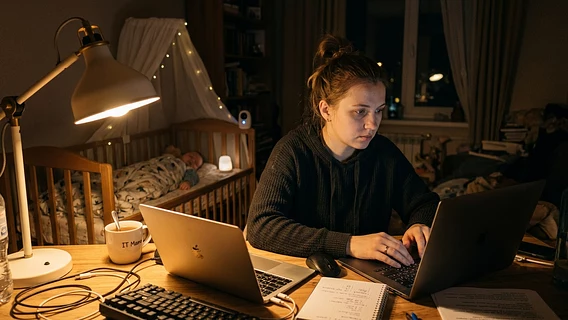
For young mothers, this creates a situation of double exhaustion. On the one hand, there is the 24-hour physical and emotional involvement in caring for a newborn child, poor sleep, which, in addition to the needs of their own baby, is significantly spoiled for many by Russian missiles and drones, as well as daily life complicated by blackouts. On the other hand, there is a constant background feeling of anxiety about one’s own professional status, which nevertheless forces one to look into seemingly irrelevant work chats, take up freelance work during the hours when the child is sleeping, or at least try to keep one’s finger on the pulse of new technologies so as not to lose one’s qualifications. Some, fearing for their own place, do not stay on maternity leave for long and return to work in IT, barely recovering from childbirth. Under such conditions, one cannot do without the help of a grandmother or a nanny.
Thus, young mothers working in IT have to find their own balance between legal realities, the demands of a tough market, and the basic need to be with their child. And everyone does it differently. We talked to three representatives of the IT sphere who are currently raising babies, and here is what they told us. Their experience and current life circumstances differ significantly, but the issue of a comfortable and employer-agreed exit from maternity leave plays a key role here.
“I wasn’t worried about being fired or having nowhere to go back to”
Miltech Partnership Manager at Mate academy Anastasia Shkirya publicly noted her employer’s policy regarding young mothers returning from maternity leave.
“Do you know what helped me enjoy the beginning of motherhood in peace? It was my company Mate academy, which created a clear policy while I was pregnant. I knew I was expected, and I had 4 months of paid maternity leave. Then, from the 5th month, I started working at a slow pace (4 days a week), and from the 6th I returned to my usual schedule. But all 4 months I didn’t worry that I would be fired or that I would have nowhere to go back,” she wrote on her LinkedIn page. At the same time, in her post, Anastasia drew attention to the fact that she knows many situations where the paid maternity leave for an employee is only two weeks.
In a conversation with dev.ua, Anastasia Shkirya told more about her motherhood and her return from maternity leave. According to her, she had another option — to take two additional unpaid months. “I could have returned to part-time work from the seventh month, and then to full-time employment,” the specialist says about another option offered by Mate academy, but which she did not choose. She does not know for sure whether Anastasia could have spent a year or more on maternity leave and kept her place, but one way or another, she did not want such a development of events.
Anastasia Shkirya with a baby
Anastasia admits that combining full-time work with motherhood is difficult for her, but not as much as it could be, because her husband is also actively involved in caring for the child. Moreover, Anastasia’s time and effort are required not only by work and a small child, but also by studying at a postgraduate school abroad, as well as learning Italian and Spanish. “I study in Italy, but I have a six-month internship in Spain, so we moved for a while,” shared the representative of Mate academy. Among other things, she previously had to overcome certain challenges with the child’s health, associated with a decrease in platelet levels, as well as problems with breastfeeding. And it was not easy to get through.
For a while, the husband’s mother and her own mother also helped with the care of the child. "I definitely wouldn’t have been able to pull it off on my own. Around the fourth month, the husband’s mother came, and it really helped us finally get some sleep. And in the seventh month, my mother also helped. But usually we still manage on our own, the two of us," the Mate academy representative stated.
However, what scared Anastasia the most was not all these difficulties, but the disappointing prospect of dropping out of an active professional life and self-development, reducing all her functionality exclusively to motherhood. At the moment, apparently, this does not threaten her yet.
“With a newborn baby in my arms, I need to urgently find a position for myself”
Another case of leaving maternity leave is not so optimistic. A 35-year-old IT project manager told dev.ua her story on condition of anonymity. She has been working in the industry for about 8 years, and during this time she went on maternity leave twice: if the first time there were no issues with her former employer (it was Sigma Software), then the second employer “washed its hands”, putting the IT worker in a very difficult situation — and not only because of money.
"I am abroad and my residence permit here is tied to my job. I need to exchange this permit, so in fact, with a newborn baby in my arms, I need to look for a position very quickly, at some urgent pace, run to interviews and go through this "gloom" from the very beginning. Despite the fact that I have worked with this company for more than three years. Unfortunately, they told me — we understand everything, but we can’t help in anything," — shared the unpleasant situation of the IT worker, for whom the maternity leave ended not only with happy motherhood.
She clarified that she is currently in Poland and does not have refugee status or temporary protection in EU countries, but instead has a residence permit. “Now I need to look for a new job in a very bad market, where hiring is very bad,” the IT worker stated.
She did not want to give the name of this company, only noting that it is an outsourcer with approximately 500 employees in different countries. “I had a Polish sole proprietorship all this time, and the company I worked for was only formally Ukrainian. Because it has a foreign entity and they do not position themselves as Ukrainian,” the project manager noted.
The specialist recalls that she started working with this employer when her first daughter was still small — she was one and a half years old and didn’t even go to kindergarten. Then the IT specialist started working part-time on an hourly basis, and the employer was happy with that. Then she got involved in the work fully and with high intensity.
“After just a few months of part-time work, I almost immediately switched to full-time work, and for the next few years I worked quite intensively. As a project manager, I had several projects in parallel, and several teams. I warned them about my maternity leave well in advance. We did a knowledge transfer to another manager, I transferred all my projects. I said again that I didn’t plan to be away for very long and wanted to return to them first part-time, and then full-time when the child was five or six months old. They said: “Okay, we’ll look at the projects,” the specialist recounted the circumstances.
But just a few months after giving birth, when the specialist contacted her employer to plan her gradual return to work, she was told that there were currently no projects for her and, most likely, there would be none by December.
At the same time, according to the manager, work, like projects, actually exists — the company simply distributes the workload in such a way that fewer people handle a larger number of projects.
“I communicate with my colleagues from this job. And the other managers who remained working, including those I worked with, do not have the impression that there is no work,” says the IT worker, who is currently actively looking for a job, because it creates a very high level of stress for her family.
“The issue is not only about money, it is about legalizing our stay in another country. Including — I have two small children who are legalized here because of me,” she reminds.
Against this background, the story with her first “maternity” employer — Sigma Software — looks completely different, but it only needs to be mentioned. “I never felt any discrimination based on the fact that I have a small child. The company has always been very calm about the need for a flexible schedule — so that work gets done. Everyone was very friendly oriented. I know that they care about their employees, because everyone who went on maternity leave from there always returned. Of course, they also cannot always guarantee a specific date when they will find you a project, but if you are in contact with them, warn them in advance, and were a full-time employee, then something is found,” recalls the project manager, who is now, unfortunately, in completely different circumstances.
“Not being able to work now, I won’t jump on this train anymore”
Marina works as a QA engineer and is raising an 8-month-old daughter. Not so long ago, she returned to work after a seven-month absence due to childbirth and maternity leave. At the same time, she has no complaints about her employer — only gratitude and mutual understanding. At the same time, the tester says that the market is so difficult, and the productivity that has arisen thanks to AI tools speeds up work processes so much that staying on maternity leave is a risk of becoming uncompetitive very quickly.
“The employer did not put forward any conditions to go to work as soon as possible. On the contrary, the phrases were: "When you are ready, then come back, we are waiting for you." Therefore, there was no pressure. But everything is changing very rapidly in the industry itself. I was absent for seven months. During this time, there were no critical changes in the processes, but a cardinal change in productivity is very noticeable,” says Marina.
Even in these seven months, she claims, the pace of work, task completion, and all processes has increased significantly.
“Now management has completely different expectations regarding results and the time it takes to achieve them. Code development has accelerated thanks to AI, the speed of development has increased enormously, and expectations that the result will be much faster have also increased. The guys in the team do not write the code themselves, I, as a tester, work behind the guys, and accordingly, I also need to adapt to new processes,” says Marina.
She claims that the entire professional community unanimously says that the number of jobs is decreasing significantly and will continue to decrease, because artificial intelligence will take over a lot of “manual work.” Therefore, you need to be ready for this now.
“It wasn’t my employer who motivated me to come to work, but rather the changes in the industry,” says Marina.
Under these conditions, Marina decided to seek the services of a nanny who would take care of the child full-time, five days a week. Of course, this is a significant expense for the family budget, and Marina is essentially giving a large part of her salary to the nanny for the opportunity to work in IT. But the specialist sees no other option at the moment.
"These are significant expenses. I don’t have a top position to feel comfortable paying another person a monthly salary. But not being able to work now, in two years, when, conditionally, the child will be able to go to kindergarten, I won’t jump on this train," Marina explained her situation.
The specialist added that very rapid changes are taking place now, so she cannot predict what will happen in the industry even in a year.
"And I want to keep both my place and my field of activity, because I like what I do, and I went to this for a long time, studied a lot, and invested a lot of resources and effort. So I really don’t want to lose what I’ve gained," says Marina.
This situation is not unique to her team — according to the tester, their product manager also came back from maternity leave quite quickly. “We have a total of 20 people in the product and technical team, and two people who came back from maternity leave quickly. I know that there are people who can organize their working day with children without hiring a nanny. There are such cases, but it very much depends on the working conditions of both the woman and the man. We have a situation where we both have to be in touch all the time. And it can always be that we cannot replace each other with the child. Therefore, there needs to be a person who will take care of the child all the time,” added Marina.
We also asked Ukrainian IT companies a number of questions about what financial and social guarantees they provide for pregnant employees and young mothers, do they pay additional material assistance upon the birth of a child, what happens to a specialist’s contract if she decides to take a long maternity leave, and how is the issue resolved if the specialist’s project is closed or the team changes during her maternity leave?
We also asked whether IT companies have soft adaptation programs after returning from maternity leave and what the policy is regarding urgent sick leave or forced breaks in work due to a child’s illness. And even whether the company’s policies provide for the possibility of taking maternity leave for men. So read about all this soon in a separate text.
"If it weren’t for maternity leave, I would have simply gone on unpaid leave for six months or quit." 5 examples of IT professionals who talked about work and maternity leave