Хочете будувати кар’єру в Data Science та AI? Vodafone Big Data Lab відкриває новий набір —>
Олег ОнопрієнкоAI Eng
13 November 2025, 09:00
2025-11-13
"Digital" is no longer trendy, now the state must be "agentive". How the Ministry of Digital Affairs plans to make AI the basis of the state and why there are still more questions than answers
During the week, the Ministry of Digital Affairs presented drafts of several directions of the state strategy on artificial intelligence. Ambitions border on fantasy: by 2030, 90% of Ukrainians should have skills in using AI, children will be taught this from kindergarten, and AI itself will become one of the key factors in winning the war. We tried to figure out what is behind these plans and why the piece of pie that the Ministry of Digital Affairs wants to bite off may be in its throat.
During the week, the Ministry of Digital Affairs presented drafts of several directions of the state strategy on artificial intelligence. Ambitions border on fantasy: by 2030, 90% of Ukrainians should have skills in using AI, children will be taught this from kindergarten, and AI itself will become one of the key factors in winning the war. We tried to figure out what is behind these plans and why the piece of pie that the Ministry of Digital Affairs wants to bite off may be in its throat.
What is an agent state?
Let's start with the main thing, at the WINWIN Summit, Mykhailo Fedorov announced the transition of the state from the already familiar digitalization to agent-based. To this end, for six months, the Ministry of Digital Affairs, together with foreign partners, developed a roadmap with clear KPIs that must be achieved by 2030 and enter the top three world leaders in the implementation of AI, as has been repeatedly reported before.
"We are now at the stage where we are transforming the concept from a Digital state to an Agentic state. We are already the first country to launch agent services. And this is just the beginning," said the head of the Ministry of Digital Affairs from the WINWIN Summit stage.
But what is this agentive state and how does it differ from a digital one? According to Fedorov, in digitalization, the emphasis is on digitizing certain stages of the value-providing process, while in agentization, the emphasis is on rethinking value itself through the use of artificial intelligence. To simplify Fedorov’s explanation, a digital state simply makes old services convenient and online, while an agentive state creates new ways to help people with the help of AI so that the state itself understands what they need.
What does the Ministry of Digital Affairs' strategy on AI look like?
Danylo Tsvek, Head of the Center for Development and Implementation of AI Solutions at the Ministry of Digital Affairs, noted that the implementation of the strategy is based on three fundamental pillars:
widespread implementation of AI in key areas for the state,
creating high-quality and accessible basic AI
development of "activators" - data, human capital and infrastructure.
Despite the fact that the authors of the strategy announced the introduction of AI in all areas, the focus is now primarily on defense and education. Everything is clear with the defense direction, while Ukraine is engaged in an existential war with Russia, which has given impetus to the development of innovations, including AI solutions.
“Today, attention is focused on defense. And this is not only because it is a key challenge for Ukraine, but also because the amount of talent and resources are concentrated there. The obvious short-term goal is to maintain Ukraine's global leadership in the field of defense artificial intelligence,” said Luukas Ilves, Advisor to the Minister for AI.
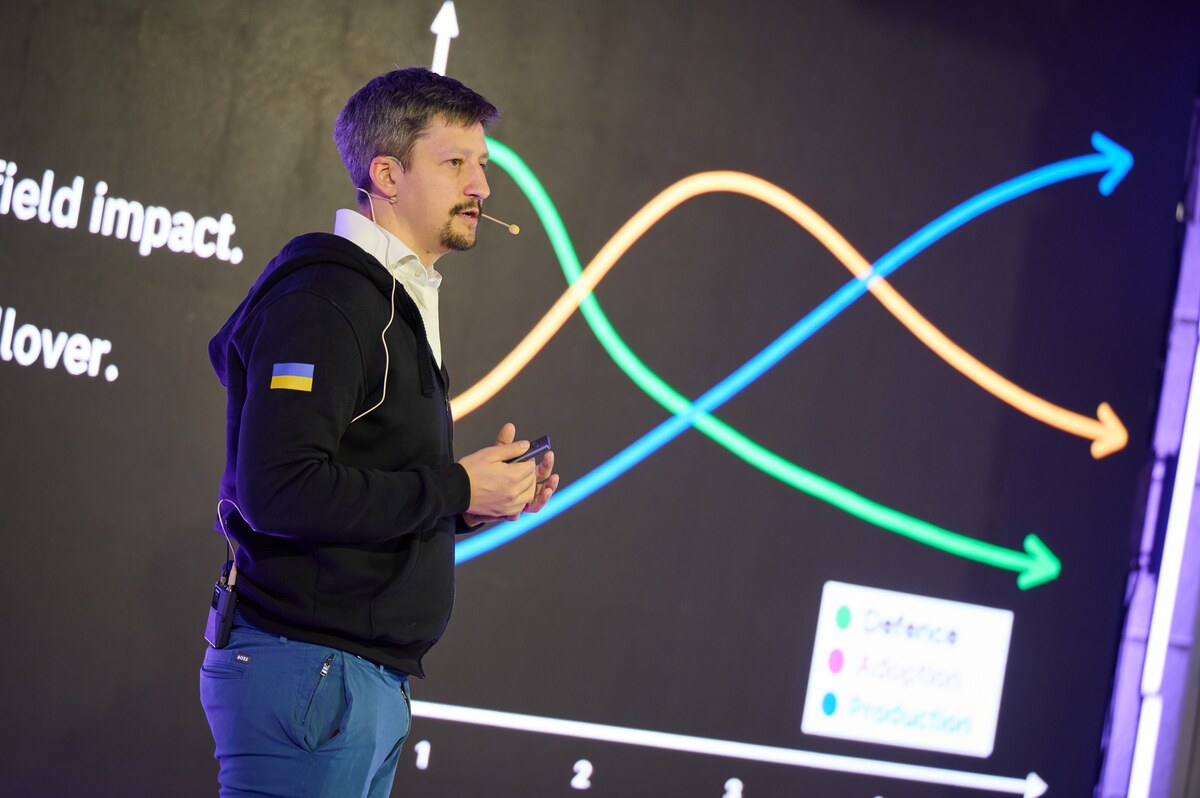
Lukas Ilves during the WINWIN Summit
The authors did not explain how Ukraine will maintain this leadership, but limited themselves to general words about the mobilization of resources and how Ukraine will then help allies with its expertise. Emphasizing the importance of defense, the speaker devoted more time to the issues of the ethical use of AI on the battlefield, because someone in the Netherlands does not like videos from fpv drones.
Admittedly, the laconicism of the representatives of the Ministry of Digital Affairs can be explained by the sensitivity of the topic, so as not to say too much for the omnipresent ears of the enemy, but the next key sector that the Ministry of Digital Affairs has singled out also leaves many questions unanswered.
"It is very difficult to say now what the future of education will be like in 10 years. Today we can only begin the process of transforming education into something that is driven by artificial intelligence," said the Minister's advisor on AI.
The results of a study of the level of digital literacy of Ukrainians commissioned by the Ministry of Digital Affairs indicate that 75.6% of adolescents aged 10-17 use AI for decision-making (this is almost 25% more than among the adult population). Abuse in education, academic dishonesty and a decrease in the level of critical thinking are of greatest concern to teachers when it comes to the use of AI by children. That is, the uncontrolled use of AI by children in education is already present, there are specific problems, and the results of NMT are deteriorating every year. Indeed, it is difficult to say what the future of education will be in 10 years.
If such answers are heard in more than 40 minutes of detailed panel discussion (or rather, speech) on the issue of two key areas, what can we say about other equally important areas, such as energy, medicine, and the agricultural sector? The following quote from Mr. Ilves partially answers this question.
“We are experimenting with the use of artificial intelligence wherever possible. And in the process, we will identify areas where, in our opinion, automation is not needed. We do not need artificial intelligence everywhere. The only way to find out is to try it,” added Luukas Ilves.
Ukrainian answer ChatGPT. How Kyivstar and the Ministry of Digital Economy will build a national LLM for Ukraine: insights and international AI experience VEON
One manifestation of such experiments is the recommendation to create a position of “Chief AI Data Officer” in each ministry, who would be responsible for integrating AI into the core of each ministry. Apparently, Mr. Luukas was not informed that AI should reduce the number of civil servants, not the other way around.
What indicators does the Ministry of Digital Economy plan to achieve?
The Ministry has set ambitious KPIs by 2030:
75% of the private sector should use AI.
90% of the population regularly use AI in their lives and work.
Staff: from 5,000 to 50,000 ML specialists.
Education: at least 4 million AI certificates.
100% of services in "Diya" are through AI agents.
Sovereign infrastructure: up to 200 million GPU hours for researchers.
At least 500 Ukrainian AI companies on the global market.
Is it realistic? Regarding the first point, the Ministry of Digital Affairs said that they will act here by analogy with "Diya.Business", when communities will be created to promote AI in the private sector by providing preferences.
The fact that 90% of the population will use AI will likely not be the merit of the Ministry of Digital Affairs, but rather the banal spread and improvement of the technology.
The first agent service that Mr. Fedorov mentioned is the AI assistant in "Diya" . So far, the virtual assistant has managed to provide 23% of income certificates on the first day of work. Recently, the AI CTO of the Ministry of Digital Affairs Dmytro Ovcharenko stated in one of the technology podcasts that to achieve 100% results, the AI assistant must process from 42,000 to 70,000 requests from citizens in "Diya" every month, or 120,000 per year.
As of April 2025, there are 243 companies in Ukraine developing AI solutions (+34 over the last 4 years). Doubling the figure will be difficult, but realistic, and this, in turn, will create a need for the necessary personnel.
Regarding infrastructure, Luukas Ilves himself said that the figure of 200 GPU hours is a bit of a shot in the dark (the original phrase We've set a goal of 200 million GPU hours, that is a bit of a shot in the dark). Despite this, he said that according to the strategy, by the end of the decade Ukraine will become a hub for 20-30% of computing power for all AI, and big tech companies will build their data centers here.
Instead of a conclusion
The Ministry has somewhat reassured itself by stating that this is only a draft version of the strategy. A revised public vision is now being prepared with further public discussions.
And for now, we have ambitious goals: an agent state, hundreds of AI companies, and a place among the three world leaders. But for the goals to become a reality, we need not only a good presentation, but also specific steps on how this strategy will be implemented.
Diya.AI currently works on Gemini, but the Ministry of Digital Affairs is preparing a transition to its own Ukrainian model: what will change and how data is protected