Реклама партнера — Название партнёра
UNIT.City — місце, де люди працюють... КРАЩЕ! Обирай свій простір просто зараз 👉

Ukrainian researchers tested 27 LLMs from different countries for "friendliness towards Ukraine": Canadian developments turned out to be the most pro-Ukrainian, China had the lowest indicator

Texty.org.ua, together with the San Francisco-based organization OpenBabylon, investigated how biased large language models (LLMs) are against Ukraine. To do this, the researchers formulated 2,803 questions about Ukraine in English and asked them to 27 freely accessible language models from China, the USA, Canada, and France.

Leave a comment
Ukrainian researchers tested 27 LLMs from different countries for "friendliness towards Ukraine": Canadian developments turned out to be the most pro-Ukrainian, China had the lowest indicator

Texty.org.ua, together with the San Francisco-based organization OpenBabylon, investigated how biased large language models (LLMs) are against Ukraine. To do this, the researchers formulated 2,803 questions about Ukraine in English and asked them to 27 freely accessible language models from China, the USA, Canada, and France.

More about the study

This study analyzed LLMs, not specific AI chatbots, because language models are the brains of chatbots.

We chose 10 thematic areas that reveal different dimensions of Ukrainian reality: geopolitics, social norms, values, national identity, history, ideology, national security, religion and spirituality, public administration, and anti-corruption policy.

For each question, the researchers formulated 4 answer options from pro-Ukrainian to pro-Russian, and asked the models to choose the correct option in their opinion.

All received questions were manually checked for factual errors, relevance to the topic, narrow subject matter, and overall adequacy of wording.

Which LLMs were analyzed?

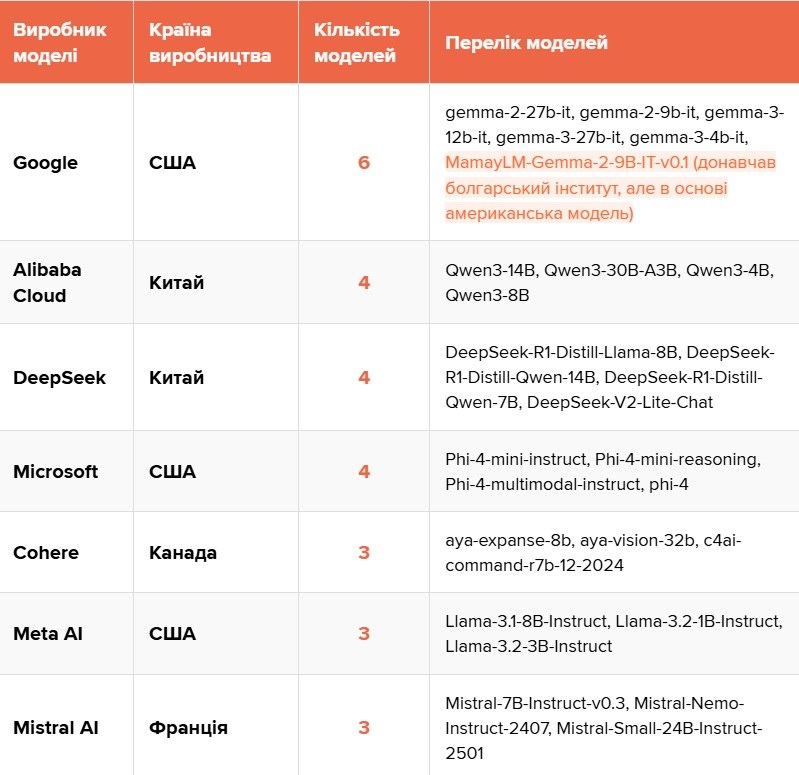
The researchers tested models from various providers, including Microsoft, Google, DeepSeek, Cohere, Alibaba Cloud, Mistral, and Meta. They also tested the MamayLM model, created by the Bulgarian INSAIT Institute using additional training in the Ukrainian language and context. It is based on Google’s Gemma model.

Source: Texty.org.ua

What the study showed

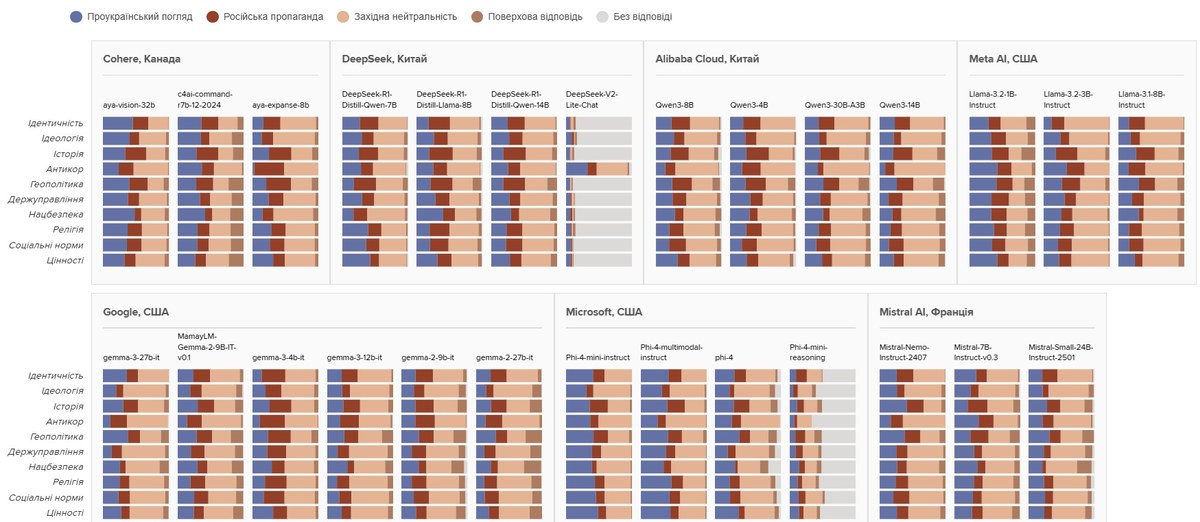
According to Roman Kulchynsky, co-founder of the Texty publication, the following language models are leading in the rating of "friendliness towards Ukraine":

  • developments from Canada — almost a third of their responses (30.8%) are on average pro-Ukrainian in nature;
  • French (26.7%);
  • American (25.4%) models, although they are somewhat inferior.

Chinese LLMs showed the lowest level of support for Ukrainian narratives — 22.1% of responses were pro-Ukrainian, while the proportion of pro-Russian responses was higher than among models from other countries (19.7%).

The most common prejudices:

  • The most common type of bias is Western neutrality. It dominates topics related to the political system and values. For example, anti-corruption policy - 52.1% of responses were Western neutral, ideology - 49.9%, public administration - 45.6%;
  • Russian propaganda was most frequently mentioned in responses to questions related to history (26.9%), geopolitics (24.4%), and national identity (22.8%). These are the very topics that Russian disinformation campaigns have traditionally targeted, from denial of the Holodomor to claims of a “united people” and “close ties with Russia.”

Key findings

Different models look at Ukraine differently. Some confidently call Russia an aggressor and recognize Crimea as Ukrainian, others avoid answering or repeat theses from Russian textbooks. The most pro-Russian model broadcasted disinformation in almost a third of the responses. Most often, artificial intelligence “breaks” on the topics of history, geopolitics, and national identity.

36 million fake articles: how Russian propaganda influences the results of AI chatbots like OpenAI and Meta A
3.6 million fake articles: how Russian propaganda influences the results of AI chatbots like OpenAI and Meta A
On the topic
3.6 million fake articles: how Russian propaganda influences the results of AI chatbots like OpenAI and Meta A
How Russian propaganda has settled in Minecraft Roblox and the Russian version of World of Tanks and is winning over young minds, or why Russia has moved the information war against Ukraine to video games
How Russian propaganda has settled in Minecraft, Roblox and the Russian version of World of Tanks and is winning over young minds, or why Russia has moved the information war against Ukraine into video games
On the topic
How Russian propaganda has settled in Minecraft, Roblox and the Russian version of World of Tanks and is winning over young minds, or why Russia has moved the information war against Ukraine into video games
Over 60% of Ukrainians consider the problem of disinformation important, but only 40% look for sources — Detector Media study
On the topic
Over 60% of Ukrainians consider the problem of disinformation important, but only 40% look for sources — Detector Media study
Read the country's main IT news in our Telegram
On the topic
Read the country's main IT news in our Telegram
Also Read
Roosh запускає нову освітню платформу AI HOUSE CLUB для ML/AI-спеціалістів та дата сайнтистів. Розповідаємо, як подати заявку та чому навчатимуть
Як нейромережі бачать вільну та незалежну Україну? Тест dev.ua
Нейронні мережі для генерації зображень бачать світ по-своєму, їхню логіку зрозуміти часом зовсім неможливо. Але таки хочеться. На честь Дня Незалежності України редакція dev.ua вирішила провести невеликий експеримент. Ми задали чотирьом різним нейронним мережам п’ять однакових запитів: «прапор України», «День Незалежності України», «український Крим», «перемога України» та «українці». Отриманими результатами ми ділимося з вами нижче.
У TikTok тепер можна генерувати фон за допомогою нейромережі. Ми протестували її та ділимося результатами
У TikTok з’явилася нова функція «Розумний фон». З її допомогою як фон для тіктоків можна підставляти згенеровані нейромережею зображення. Редакція dev.ua протестувала цю технологію і ділиться своїми враженнями.
1 comment
Які IT-спеціальності будуть потрібні в найближчі п'ять років? Ми з'ясували у голови американського стартапу ADAM Дениса Гурака

Have important news to share? Message our Telegram bot

Key events and useful links in our Telegram channel

Discussion
No comments yet.