Олег ОнопрієнкоІсторії
21 August 2025, 09:00
2025-08-21
Instead of relaxing on the ocean shore, there are soldering irons in hand and workshops. How Ukrainian IT professionals gathered a community of like-minded people in Portugal who help assemble FPV drones
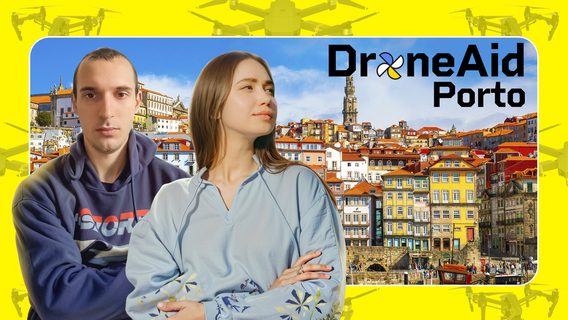
It would seem like a futile task to assemble FPV drones for the needs of the Defense Forces in sunny Portugal, but a union of Ukrainian IT workers has banded together to attract local residents to help Ukraine. And all this despite the Russians' attempts to sabotage the volunteers' activities. The founder and communications officer of DroneAid Porto told dev.ua about the peculiarities of fundraising in Portugal, what amounts locals donate and how DroneAid manages to attract new supporters.
It would seem like a futile task to assemble FPV drones for the needs of the Defense Forces in sunny Portugal, but a union of Ukrainian IT workers has banded together to attract local residents to help Ukraine. And all this despite the Russians' attempts to sabotage the volunteers' activities. The founder and communications officer of DroneAid Porto told dev.ua about the peculiarities of fundraising in Portugal, what amounts locals donate and how DroneAid manages to attract new supporters.
DroneAid Porto is part of a large volunteer initiative DroneAid Collective, launched by Ukrainians in the Netherlands. This project operates on a franchise model, expanding to different cities and countries. The main goal is to raise funds for drone components, which are assembled in workshops and transferred to the Defense Forces. The Portuguese branch also aims to build a community of caring people - through education and curiosity about technology, to involve expats and local Portuguese, to constantly remind about the full-scale war in Ukraine and to involve them in helping.
About the speakers
Anton is the leader of the DroneAid Porto volunteer project. His main activity is as a programmer, mainly a frontend developer. Anton relocated to Portugal before the full-scale invasion. After 2022, Anton switched to Defense Military and began working with defense technologies, in particular with embedded systems, hardware and software.
Karina is a communications officer at DroneAid Porto and also works as an Employer Brand Manager at a Ukrainian IT company. Karina arrived in Porto after a full-scale invasion. There she found like-minded IT people who wanted to help the Defense Forces not only with donations, but also with their hands.
— What does Drone Aid Collective do?
Anton: In general, we are part of a large initiative DronAid Collective, it was started in the Netherlands by Ukrainians. This volunteer project has expanded to the whole of Europe, because we realized that FPV drones are very important for our defense forces. This is something that we can close on our own, collect locally in cities where there are Ukrainian volunteers and caring locals and send them on to our defenders.
Karina: In the Netherlands, the whole initiative started two years ago. Co-founder Jana survived the Bucha, and thanks to her input and the other co-founders, it has reached this level of franchising.
— How did you become part of the Drone Aid Collective?
Anton: About a year ago, I started doing defense hackathons in Europe. I met a team from Munich at one of them, and learned about Drone Aid Collective. At that time, there were literally two centers: the original Drone Aid in the Netherlands and the Munich one. It seemed to me that it would be really cool to combine volunteering and drone assembly. Since then, a center has been launched in Porto, Portugal. DroneAids have since opened in Lisbon, Poland, Lithuania, and German cities. Currently, Drone Aid Collective has about 10 centers in different cities in Europe. DroneAid continues to grow thanks to active Ukrainians who form project teams in their cities.
— How many people did you have at the start and how many people are currently working in the team?
Anton: I think there were three of us right at the beginning, but for the first drone workshop we gathered about 10 IT people. For the second workshop we quickly recruited another 10 people to the team. We divided who was responsible for what: who was responsible for organizational issues, who was responsible for assembling the drones, for technical details, for shipping, for communication with the military.
Karina: We have a core team — these are the most active people who work on a volunteer basis. We do not receive any income from donations, we invest our time, our resources, including financial ones, to support the project. The team consists mainly of IT people, so we bring our own “IT” order a little and literally in early August we started strategizing to simply organize the chaotic volunteer process.
— Have local residents joined your team?
Karina: The main part is still Ukrainians. There are some Ukrainians who have been living in Portugal for a long time, they help us reach out to Portuguese communities, because they know Portuguese well. We also try to build a community, because the goal of the project consists of two parts: the first is directly fundraising, assembling drones and sending them. And it's cool that we do this through training, the atmosphere at the workshops is very pleasant.
And secondly, it is to build communities of people who care about Ukraine, preferably expats and Portuguese, so that the Ukrainian issue is constantly among them and they can see the results of their donations.
— How many FPV drones do you collect on average each month and how many in total?
Anton: Now we have reached a pace where we make about 16 drones per month, on average we hold a workshop once every two weeks. At the strategic session we decided to increase this goal. To do this, we need more mentors and, of course, donations for the purchase of FPV kits. So far, a total of 119 drones have been collected at the workshops, 107 of which have already been sent to Ukraine.
— Where do you get your components from: are they mostly Chinese spare parts, local elements?
Anton: FPV stores are common in Europe, it's a hobby story. But the prices there are more expensive than in China, somewhere around 30-40%. We buy through partners — Pilotics or Partizan, which are located in the Czech Republic and are part of the Social Drone initiative. The Czechs also have their own developments, they make drone frames themselves in the Czech Republic, and some more complex components, such as video transmitters, cameras — are ordered from China. Orders are placed in large batches, so it's possible to save money on this. Depending on the scheme you work with them under, you can get hit with the European customs tax, which is 23% VAT.
Tell us more about the tax.
Anton: The tax logic is this: if we register the purchase as a commercial resale, the rate can be 0%. And if we look like an end consumer, then customs automatically charges 23% VAT at the moment the goods enter the Eurozone. Therefore, we try to correctly show that the end user is Ukraine, and Europe is only a transit. This allows us to reduce the tax burden.
We don't sell drones or components — we buy everything with funds from fundraising campaigns and give it to the front lines for free in the form of assembled drones. That is, in fact, there is no commerce here.
— Are any additional licenses or permits required under local law for your activities?
Anton: As long as these are non-commercial volumes, up to a hundred drones per month, it won't trigger anyone much. There have been no questions in Portugal so far, and the embassy has also informed us that everything we do complies with the law.
From the point of view of legalization for the bank, there is already a question here, because we need to somehow convince that we are making a product that does not have the ultimate goal of being a military or dual-purpose tool. Experience shows that some banks are ready to take on some of the risks and they are okay with our type of volunteer activity. Other banks are not okay with anything Ukrainian volunteer. Therefore, the situation is very different.
For now, we use “people’s” funds on Monobank, or we refer to the Dutch DroneAid, which has a registered photo studio where you can show the use of collected drones. Local residents understand that it is better to donate via PayPal, crypto, or cash, because for them, if we are not an official charity, it does not count towards tax write-offs. In Portugal, there is a regulation: if you are on the “white list” of charities, then 1% of your taxes can be redirected to this organization.
Karina: The reality of Portugal is that citizens also use cash a lot. There are certain restrictions on the amount - if I'm not mistaken, any transaction over 3,000 euros in cash is impossible by law. But small amounts - 20, 50, 100, 270 euros - are often given in cash.
— What is the largest one-time donation you have received?
Anton: In a global sense, DroneAid Collective received a one-time donation of 15,000 euros from a NATO official at one of the defense hackathons that our initiative helped organize. It was a very significant event.
Karina: Unfortunately, there haven't been any such donations for Porto yet. They mostly donate for a complete drone (270 for just the FPV kit or 350 euros with a battery). We did a fundraising campaign for 20 drones for Azov, where we raised 8,377 euros (the goal was 7,800).
— You wrote that some of the funds were donated by parishioners of the local church. How does the local community generally react to your activities?
Karina: There is a part of very conscious and active people who understand who the enemy is, and that supporting Ukraine is not only about our security, but also about peace in Europe as a whole. We try to explain in simple words why we are raising money for drones: that this is a tool that saves lives, helps our military to be safe and perform tasks more effectively. Of course, not everyone immediately realizes the scale of the war, because it seems that it will never affect them. But in general, the community reacts favorably: some help financially, some spread information or simply show interest.
There is a hypothesis that the further a country is from Russia, the less it feels a direct military threat, and this correlates with the figures of financial assistance to Ukraine. According to this hypothesis, Portugal is not the best place to conduct fundraising for the Armed Forces of Ukraine among the local population.
Karina: We had a hypothesis that we would be supported mainly by Ukrainians. When we met with colleagues from the Netherlands, they shared their approach. In the Netherlands, people are more solvent, they can drop a donation and not come to the workshop, that is, simply support financially. In Portugal, the income level is much lower. But the project is growing, we are gradually attracting Portuguese people, and our hypothesis is not confirmed. Ukrainians support us most financially, and local Portuguese support us more “PR”, they really like to exchange experiences and talk about us.
— How does a day go for a Drone Aid Porto employee?
Karina: My day and Anton's day will be radically different. I am responsible for communications. I wake up, check requests, look at the communications plan, then sit down for my main job at the IT company. Every Monday we have team calls. We also sometimes do public drone flights, because they must be tested after workshops and before being sent to defenders. Sometimes I organize these events. Sometimes I visit workshops to film and chat with participants, and also eat delicious borscht, which Anton's mother prepares.
Anton: For a technical person, it looks like this: six days of quiet work, and the seventh is a workshop where you need to talk to people and teach them how to assemble a drone. Most of our "techies" are IT specialists, they are not required to write code or work on complex circuits. It is more about live communication, changing activities and socialization. From time to time, R&D projects also appear: for example, testing a new drone model, working with fiber optics or testing a new repeater.
For non-technical specialists, there is enough operational work: ordering and testing drones, monitoring donations, communicating with local residents and organizations, participating in events. There is really a lot of work, and it is very diverse.
At the same time, the foundation of DroneAid is its technical mentors. They come once a week to share knowledge and engage in volunteer work.
— You mentioned an unpleasant episode with the local Russian community. Can you tell us more about what happened?
Karina: If the Russians are on fire, it means we are doing everything right. Any volunteer activity in support of Ukraine provokes discussions in fake forums. When they found out about the existence of DroneAid in Portugal, they published photos from our workshops and wrote threats.
Anton: They even tried to create narratives that Ukrainians allegedly have “underground factories” or “use child labor,” although these fabrications were later refuted on local television. After that incident, we abandoned any communication on Telegram and switched to closed and more secure communication formats.
— How do you combine your main job and work at DroneAid?
Karina: It's hard. Sometimes there are too many operational moments. I am very grateful to the team, because we share responsibility. I don't use working hours for volunteer activities, I devote my free time. Offline helps me a lot: meetings, strategy sessions. Communication with the team of volunteers helps me not to get so tired. Also, we decided that we would look for more people for small tasks, so that one person doesn't have to pull everything, but so that the project survives longer and we don't burn out.
Anton: It seems to me that it’s just like two jobs. The only saving grace is that DroneAid is constantly visited by interesting people: someone tinkers with drones, someone knows how the locals work. At my main job, my project manager and front-end team volunteer, so everyone understands what I do and is very supportive. Working hours are for work, and outside of work, I have a second job at DroneAid.
— How are drones transferred to Ukraine?
Anton: Each DroneAid branch has its own system of cooperation with the military. Usually, drones are transferred through trusted partners in Ukraine and go directly to the units.
— Does the Embassy of Ukraine in Portugal help your activities?
Karina: The embassy informs, advises, and supports. For example, they allow us to speak at rallies on the anniversary of the invasion or Independence Day. We do not actively lobby the Portuguese authorities. When we were looking for premises, we contacted local administrations. They were happy to meet, but were not ready to take responsibility for the fact that these could be “military” drones. However, they do not interfere, which we regard as support.
— Has the Ukrainian IT community in Portugal increased during the full-scale invasion?
Anton: It feels like people here are migrating between Canada, Portugal, and Spain. There are those who travel to Ukraine and back. But overall, it seems to me that the IT community is gradually growing.
Karina: We started to connect more. Thanks to DroneAid, I met new people with whom I managed to make friends and unite around a common cause. I often say that "Porto doesn't let go." It's a city with its own rhythm: it's about peace, a glass of vigneron and sunsets on the ocean. This lifestyle doesn't suit everyone, some try to go to more dynamic places. But it's interesting that many eventually return.
"The game gave an understanding of what you will have to work with in reality." Interview with an artilleryman of the Armed Forces of Ukraine about gamification in the Defense Forces
"2025 has become the year of the NRC, but to meet the need on the front line, 40,000 robots are needed." Interview with the co-founder of Tencore, the largest manufacturer of ground robotic systems in Ukraine