Хочете будувати кар’єру в Data Science та AI? Vodafone Big Data Lab відкриває новий набір —>
Марія БровінськаWeapon
22 October 2026, 08:08
2026-10-22
Protection from FPV drones: DroneAid volunteers develop DRONOLAW complex that intercepts drones with nets
The international volunteer initiative DroneAid is developing the DRONOLAW active defense system, designed to intercept FPV drones using special nets. The system should detect air targets at a distance of up to 100 meters and neutralize them at a distance of 10–20 meters. Currently, the developers are preparing the system for testing at a military training ground in Ukraine.
The international volunteer initiative DroneAid is developing the DRONOLAW active defense system, designed to intercept FPV drones using special nets. The system should detect air targets at a distance of up to 100 meters and neutralize them at a distance of 10–20 meters. Currently, the developers are preparing the system for testing at a military training ground in Ukraine.
DroneAid representative Vadym Vasylenko told Military about this during the Future Forces Forum in Prague, Czech Republic.
How DRONOLAW works
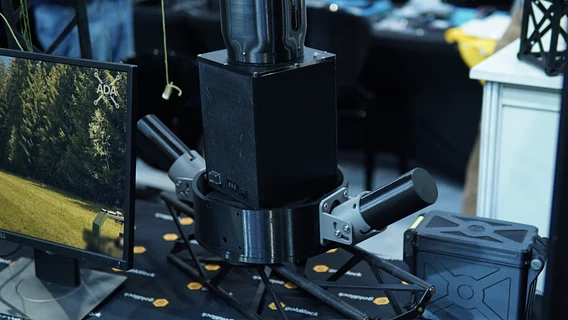
The DRONOLAW design consists of a central target detection unit and a rotating drum with launch containers. The upper part of the complex houses an optical module with a thermal imaging camera, and below is a ring platform with inclined mortars from which nets are fired.
The complex scans the space 360 degrees in five seconds. This should provide all-round protection of equipment or positions from air threats. The declared target detection range reaches 100 meters.
To intercept a drone, the system fires a net at a distance of approximately 10–20 meters. It is intended to entangle the propellers of the FPV drone, preventing it from continuing its flight.
Thanks to the thermal imaging camera, the complex can detect targets day and night. The developers expect to use it against conventional radio-controlled drones, as well as fiber-optic FPV drones.
Another feature of DRONOLAW is optical stabilization. It should allow the system to be installed on armored vehicles, cars, and ground robotic systems (GRS), while maintaining image quality while moving.
Why did the developers choose a thermal imager?
According to Vadym Vasylenko, the emergence of fiber-optic FPV drones was one of the factors that prompted the team to create DRONOLAW. Electronic warfare (EW) is ineffective against such drones, so the developers were looking for a way to physically intercept targets.
The team tested various detection technologies, from acoustic sensors and conventional cameras to thermal imaging, lidar, and radar. Ultimately, a thermal camera was the optimal solution, according to a DroneAid representative.
"We tested various detection systems: from sound to conventional cameras, thermal imaging cameras, lidars and radars, and decided that the most optimal option was a thermal imaging camera," Vasylenko said.
A year and a half of development and future testing in Ukraine
Work on DRONOLAW has been going on for about a year and a half. The first tests of the complex were carried out in Germany. Now the team is preparing the system for testing at a military training ground in Ukraine.
The developers have identified a specific criterion by which they will assess the readiness of the complex for use on the front line: the system must intercept at least 70% of targets during testing.
This indicator will become a guideline for moving to the next stage. At the same time, we are currently talking about development and preparation for testing: there is no data on the results of Ukrainian field tests in the Military News material yet.
DRONOLAW is intended to be a means of physical protection against FPV drones, particularly those against which traditional electronic suppression does not work. Whether the complex will be able to provide the claimed level of interception in military applications will be shown by further tests.
23 школи дронів, які допоможуть навчитись керувати безпілотником. Куди звернутись, щоби стати оператором БПЛА
Про важливість безпілотників та, відповідно, операторів вже говорять дуже багато та скрізь. Військові чекають, що штати БпЛА в бригадах мають розширити, особливо після оголошення створення «Сил безпілотних систем».
До переліку із зібраних нами закладів, які навчають операторів БПЛА, додалась ще одна 23-тя в цьому списку школа. Додаємо школу операторів USMT та оновлюємо інформацію по іншим закладам.
Якщо ви знаєте, хто ще навчає пілотів для безпілотників, пишіть на пошту [email protected].
(оновлений текст від 22 липня 2022)
На український ударний дрон PUNISHER зібрали понад 1,3 млн грн. Що може гроза командних центрів ворога
Дмитро Томчук повідомив, що найлегші та найменші ударні дрони PUNISHER, які не мають аналогів у світі, тепер коштують $70 000. Виробник додав у комплекс ще одного безпілотника, і тепер їх там два. Дмитро пише, що Юлія Черешня та Павло Харузов зібрали на комплекс більше 1,3 млн грн.
Раніше він розповів журналісту dev.ua, що вміють ці «пташки», та чому саме вони можуть переламати хід війни на користь України.
(текст від 1 червня 2022 року)
США в черговому пакеті допомоги надасть Україні дрони Switchblade 600. Подробиці про ці та інші «пташки», якими користуються українські захисники
Серед списку допомоги, яку пропонує Пентагон, є дрони-камікадзе Switchblade 600, які офіційний Київ просив передати раніше.
Контракт на дослідження та розробку для 10 дронів SwitchBlade 600 виробника Aerovironment, очікується протягом наступних 30 днів, заявила прес-секретар Пентагона Джессіка Максвелл в електронному листі до News Defense.
Ми зібрали список дронів, які використовують українці проти ворога, в тому числі і подробиці про Switchblade 600.
(текст від 17 травня 2022)