Хочете будувати кар’єру в Data Science та AI? Vodafone Big Data Lab відкриває новий набір —>
Наталя ХандусенкоGadgets
30 October 2026, 15:04
2026-10-30
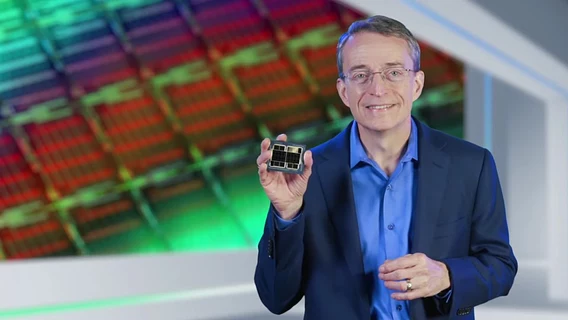
Former Intel President Pat Gelsinger is investing in a breakthrough RAM technology to solve the memory market crisis. What is Z2RAM and how is it unique?
Former Intel CEO Pat Gelsinger has backed a revolutionary new RAM technology that should overcome the global crisis and chip shortage in the long term.
Former Intel CEO Pat Gelsinger has backed a revolutionary new RAM technology that should overcome the global crisis and chip shortage in the long term.
The market for RAM and storage devices is currently in a deep crisis, which has led to high prices for components for all consumer electronics. Leading manufacturers, including Samsung and SK Hynix, note that the situation is unlikely to improve in the next few years. Against this background, Nagare Labs, a startup created by scientists from the Georgia Institute of Technology, has attracted $5 million in investment from the venture fund Playground Global (where Gelsinger is a general partner) and has come out of secrecy, Neowin reports .
What is Z2RAM and how is it unique?
The development of a startup called Z2RAM aims to combine the best properties of three key memory types:
speed of SRAM used in processor cache);
DRAM density (system random access memory);
NAND Flash scalability (SSDs) with 3D layer stacking capability.
Unlike classic DRAM, which requires a transistor and a capacitor to store one bit of information, Z2RAM uses two transistors. This eliminates the need for a separate physical capacitor and makes reading data "non-destructive" (the memory does not need to be constantly rewritten after each read).
By using oxide semiconductors and 3D hybrid interconnects, Nagare Labs promises to increase data storage density by more than 5 times compared to standard SRAM. For example, in the area where 64 MB of SRAM was previously located, Z2RAM will allow up to 320 MB to be stored.
Salvation for AI accelerators
The main target market for Z2RAM is the field of artificial intelligence and AI accelerators, where bandwidth and memory have become major bottlenecks. According to experts, the use of Z2RAM can potentially reduce the number of chips needed to process large language models by a factor of 5 or more.
Challenges and time to market
Despite Pat Gelsinger's optimism, the technology is still in the early stages of lab prototypes. The startup faces a number of challenging engineering challenges:
ensuring the reliability of oxide semiconductors;
the lack of a single industry interface standard for integrating such memory with accelerators;
searching for an R&D factory to go beyond the university laboratory.
The company plans to create the first working samples within 4 years, and mass commercial production may begin only in 10 years. Therefore, the development of Z2RAM is aimed at the future of AI infrastructure and will not be able to solve the current shortage of consumer RAM in the coming years.