Хочете будувати кар’єру в Data Science та AI? Vodafone Big Data Lab відкриває новий набір —>
Марія БровінськаThat's Life
28 January 2026, 09:00
2026-01-28
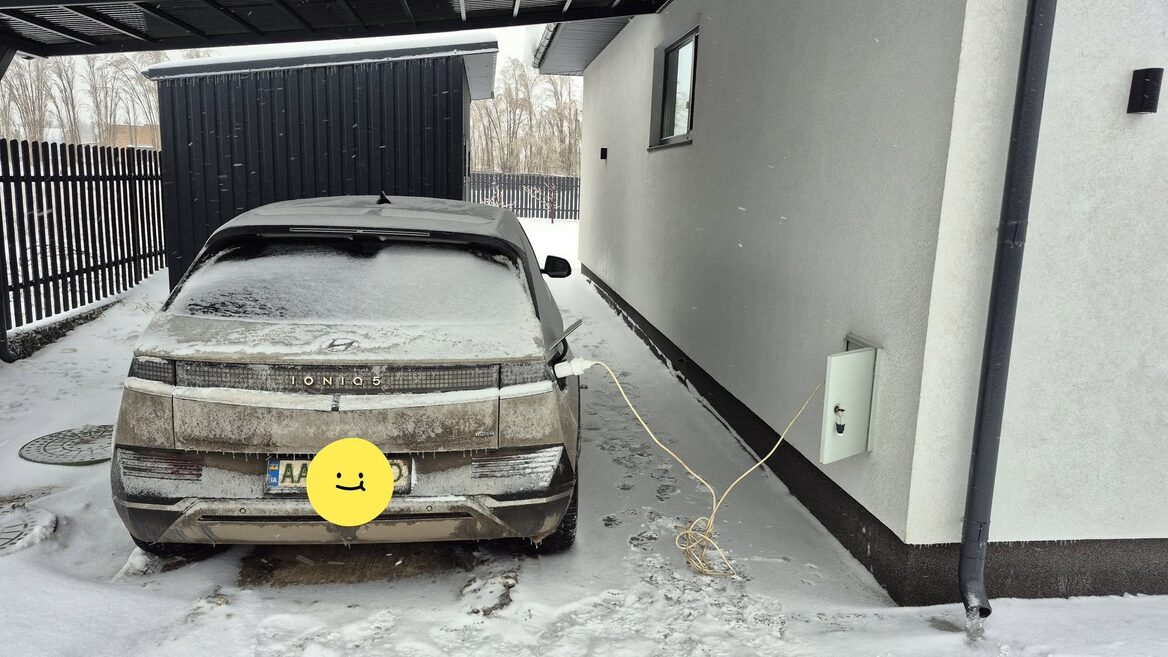
"Holy shit, I'm ready to throw this damn car away and take a minibus." Due to blackouts, it's difficult for electric car drivers to charge conveniently, and charging prices have increased significantly. Does an electric motor currently have a price advantage over an internal combustion engine?
«It’s a drag, because it’s the last working day before the New Year. The car’s battery is running low quickly, there’s 15 percent left. We look for a charger, we drive to OceanPlaza, the map shows as many as dscsv of free ports there. But the parking lot resembles a madhouse with cars crawling in different directions, trying to find somewhere to settle in. We run away, drive towards Respublica, where I know a good charger. There are 11 km left on the road, which means 5 kilometers in the cold. In this stress, we find a free charger on the map, reach it, park it and go to warm up. We exhale. Then suddenly, an hour later, I see in the app that the car has stopped charging. It turns out that the area has been turned off, the charger has also gone out. We have to drive further to look for a new one. We drive again, again the same 11 km, we stop near Respublica. I insert the gun, pay money for the app. And here this area is already dying. Damn, I’m ready to abandon this damn car and go to Vasylkiv by minibus. We find another charging point, a kilometer away. We go there. Industrial zone, garages. We get stuck in a snowdrift. We push ourselves out. We arrive. This is some kind of critical infrastructure structure and the charging works! I’m also charging this application, for the third time.» This is part of a post by journalist and now military serviceman Stanislav Yasynskyi, who a few days ago recalled how on New Year’s Eve he tried to charge his electric car, moving from location to location, because the light was disappearing.
«It’s a drag, because it’s the last working day before the New Year. The car’s battery is running low quickly, there’s 15 percent left. We look for a charger, we drive to OceanPlaza, the map shows as many as dscsv of free ports there. But the parking lot resembles a madhouse with cars crawling in different directions, trying to find somewhere to settle in. We run away, drive towards Respublica, where I know a good charger. There are 11 km left on the road, which means 5 kilometers in the cold. In this stress, we find a free charger on the map, reach it, park it and go to warm up. We exhale. Then suddenly, an hour later, I see in the app that the car has stopped charging. It turns out that the area has been turned off, the charger has also gone out. We have to drive further to look for a new one. We drive again, again the same 11 km, we stop near Respublica. I insert the gun, pay money for the app. And here this area is already dying. Damn, I’m ready to abandon this damn car and go to Vasylkiv by minibus. We find another charging point, a kilometer away. We go there. Industrial zone, garages. We get stuck in a snowdrift. We push ourselves out. We arrive. This is some kind of critical infrastructure structure and the charging works! I’m also charging this application, for the third time.» This is part of a post by journalist and now military serviceman Stanislav Yasynskyi, who a few days ago recalled how on New Year’s Eve he tried to charge his electric car, moving from location to location, because the light was disappearing.
Its history in modern conditions is far from an exception, because the blackouts caused by Russian shelling have deprived owners of cars with electric motors of the opportunity to plan anything. Moreover, for more than a week now, drivers have been complaining about the significant increase in the cost of charging electric cars, which almost eliminates the savings of using environmentally friendly cars. dev.ua talked to operators of the market for electrical equipment for charging and manufacturers of stations, and found out how they support stations during blackouts, whether the demand for their services has changed, why the cost of charging has increased, and what owners of electric cars can expect in the near future.
Impact of blackouts
According to market operators, as of today, more than 245,000 electric vehicles have been registered in Ukraine, while the number of unique users of public charging stations during one month is about 30,000–40,000 people. That is, approximately 15% of electric vehicle owners regularly use public charging infrastructure. This indicates that the situation is not critical, and most owners have alternative charging options. However, blackouts make adjustments.
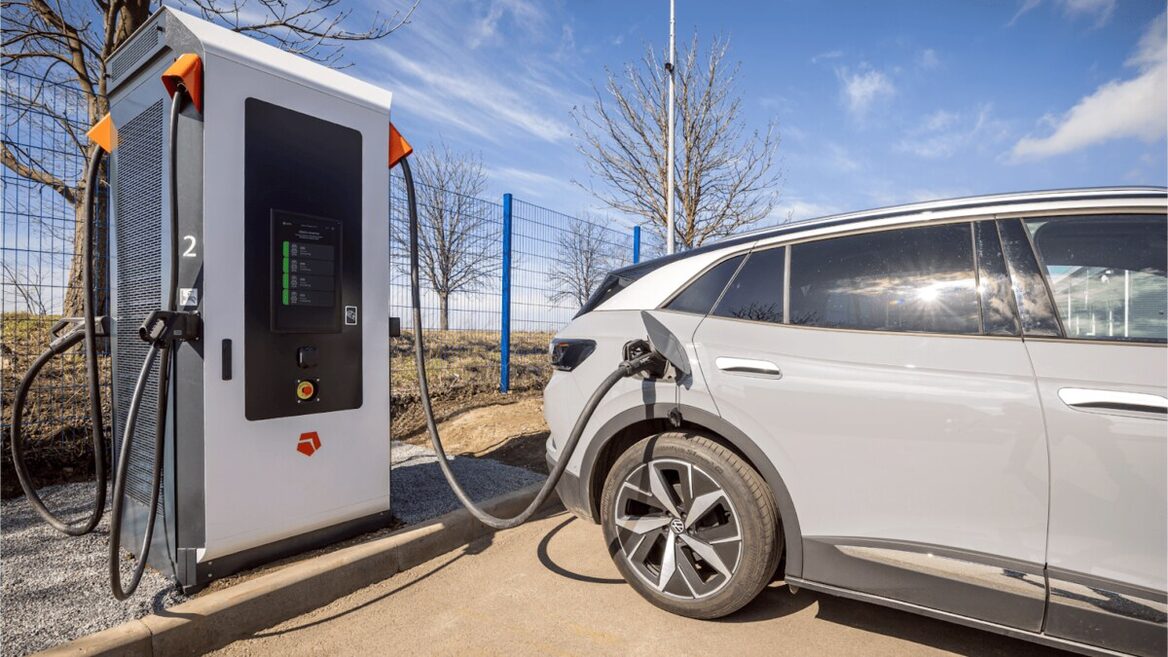
As dev.ua was informed by IONITY, one of the largest projects for the placement and management of a network of charging stations for electric vehicles in Ukraine, the demand for access to public charging stations has now significantly increased. «Since the beginning of January, we have recorded an increase in demand for public charging stations, primarily in large cities. This is due to prolonged emergency and emergency power outages, due to which some owners of electric vehicles temporarily lost the opportunity to charge at home,» the company noted. At the same time, this growth, according to the operator’s conclusions, was not in the nature of a sharp or uncontrolled jump — the dynamics were uneven and depended on the region and the stability of the power supply. The vast majority of network locations, IONITY reported, continue to operate: «In isolated cases, temporary pauses are possible due to lack of power or restrictions from network operators, but there is no mass decommissioning of stations.»
This trend is confirmed by Serhiy Velchev, CEO and founder of ECOFACTOR, a platform and equipment manufacturer, not an operator of charging stations: «Yes, we have recorded a significant redistribution of the load. During the massive attacks, some locations were disconnected from the power supply, and all demand was concentrated on the stations that continued to operate. This created an increased load on the available infrastructure.» According to him, the situation confirmed the critical dependence of the charging infrastructure on the stability of the central power grid — and the need to develop autonomous solutions.
How operators power stations during blackouts
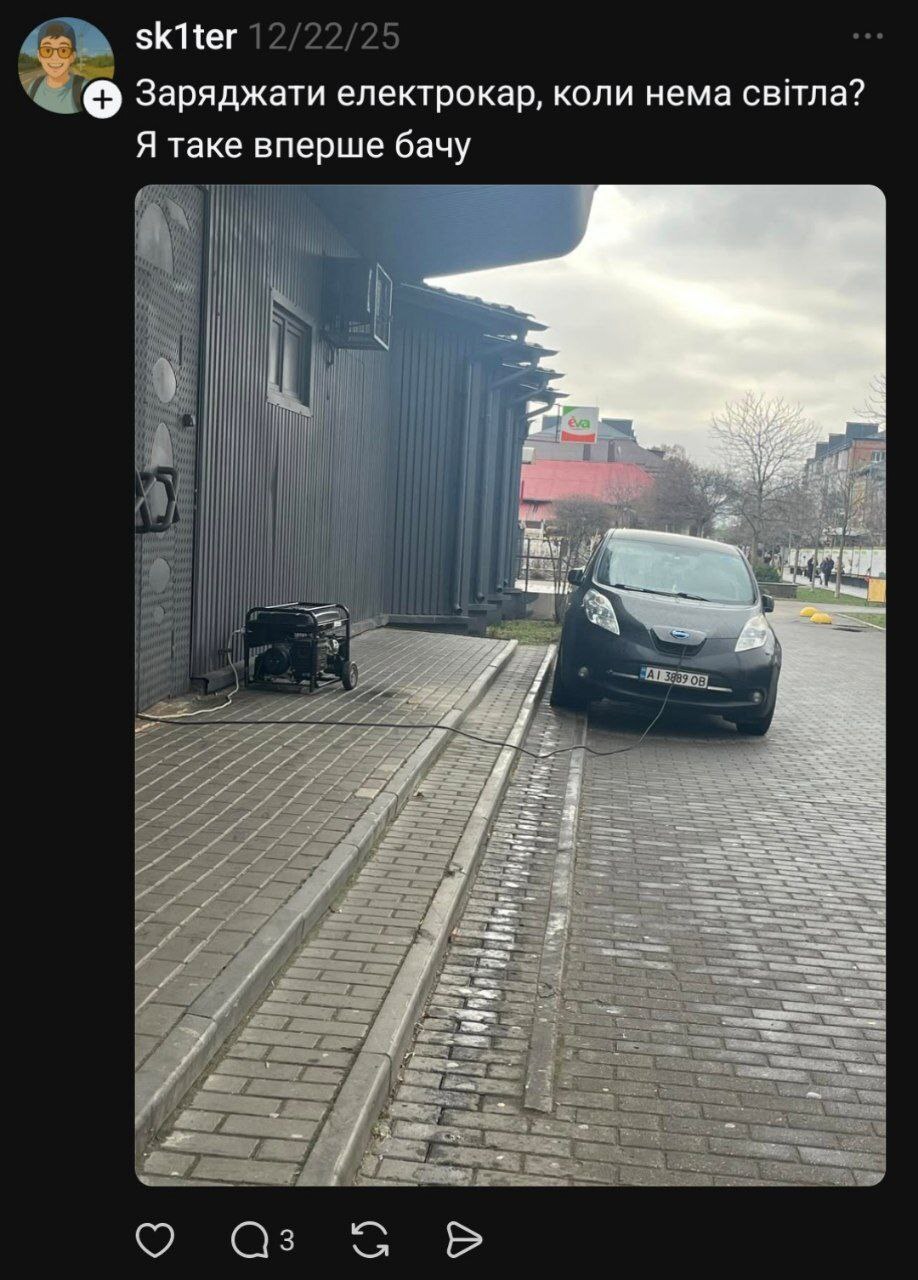
To ensure the operation of charging stations during power outages, operators have to use alternative energy sources. This is not always possible, so some charging stations do not work during blackouts. Generator power can also be used to keep the stations operational (if, for example, the charging point is located near a building with a powerful generator).
But this also happens:
Meanwhile, ECOFACTOR is developing a project for non-volatile hubs. This is a comprehensive solution that includes its own generation (solar panels, mini-wind turbines or other sources), energy storage systems (batteries for storage and buffering), and charging stations integrated into a single autonomous system. «Such a hub can operate independently of the central grid or in hybrid mode — using the grid when it is available and its own generation during outages. This is not only about business stability — it is about the resilience of critical infrastructure in wartime,» says Serhiy Velchev.
Prices up
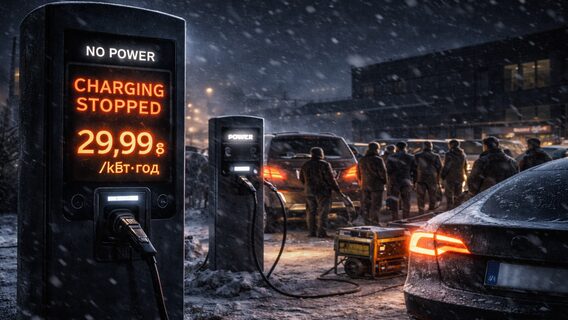
Operators do not hide: tariffs for using charging stations have increased significantly. Prices at charging stations across Ukraine have increased by more than a third, says Velchev from ECOFACTOR. According to his calculations, approximately 28% of stations have increased the price by more than 30%, and 4% of stations have more than doubled. In particular, currently at TOKA at AC stations the average tariff is 20.49 UAH per kWh, DC 24.49 UAH per kWh, at ECOFACTOR charging stations slow charging (AC, up to 22 kW) costs 16–22 UAH per kWh, fast charging (DC, 50–150 kW) — 18–32 UAH per kWh. At IONITY, the cost of charging reached 29.99 UAH per kWh.
At the new tariff of 29.99 UAH/kWh, a full battery charge of 60–70 kWh can cost almost as much as refueling a small gasoline car. To understand what the tariff of 29.99 UAH/kWh means, it is worth calculating not the «cost of charging», but the price of one kilometer. According to Auto24 experts, the cost of a tank for various electric cars will be from 1,200 to 2,300 UAH at a tariff of 29.99 UAH. Public charging of an electric car in Ukraine costs approximately 4.5–5.7 UAH per kilometer, depending on the model and driving conditions. And this is comparable to the cost of 1 km of driving in a gasoline car and more expensive than driving on a diesel engine.
How much does it cost to charge an electric car at a rate of 29.99 UAH/kWh (data from Auto24)
Model
Battery, kWh
Consumption, kWh/100 km
Cost of 100 km, UAH
Cost of 1 km, UAH
«Full tank» (0–100%), UAH
Nissan Pathfinder (40)
40
17
510
5.10
1,200
Tesla Model 3 RWD (~60)
60
15
450
4.50
1,800
VW ID.4 (77)
77
19
570
5.70
2,310
Hyundai Kona Electric (64)
64
16
480
4.80
1,920
Renault Zoe (52)
52
16
480
4.80
1,560
Kia EV6 (77)
77
19
570
5.70
2,310
It will be more expensive at DC high-speed stations — part of the energy goes into losses and heating the battery.
Why are prices rising?
The root cause of the increase in the cost of the tariff is a sharp increase in the commercial tariff for electricity, say TOKA, one of the largest market operators. «In addition, the National Commission for the Regulation of Energy and Utilities of Ukraine adopted a decision to increase the maximum prices, which directly affected the cost of charging at public stations,» the company explained to dev. ua.
In turn, Serhiy Velchev specifies: the increase in charging prices began on January 17, 2026 — after the entry into force of the NEURC Resolution No. 70, which increased the maximum prices (price caps) on the wholesale electricity market to 15,000 UAH/MWh. This state decision directly affected the cost of electricity for commercial consumers.
The price of charging is not only electricity. «It is formed from several components: commercial tariff, location rental, taxes, equipment cost, as well as its maintenance and service. When one of these components changes significantly, this is inevitably reflected in the final price,» TOKA notes.
It is noted here that during an active charging session, the cost does not change, even if the tariff is updated. That is, the client completes the charging at the same price at which it was started.
According to Velchev, charging station operators are a business that buys electricity at commercial rates. When the input price increases, they are forced to revise the final tariffs so as not to work in the red. «I emphasize once again: ECOFACTOR does not set tariffs — the station owners do that. The cost of kWh is not our income. We only reflect the prices that the operators set for their locations,» says the CEO and founder of ECOFACTOR.
In turn, IONITY notes that charging network operators purchase electricity as commercial consumers, and not at fixed household tariffs. At the same time, electricity bills are formed ex post facto — at the end of the month. «This means that the charging service is actually provided without accurate knowledge of the final purchase price of electricity at the time of its sale, which makes the operators' operating model risky in conditions of sharp market fluctuations,» IONITY notes.
The company clarified that it conducted a detailed financial analysis and set tariffs at a level that allows avoiding significant losses and ensuring stable network operation, without setting excessive margins.
Will tariffs continue to increase?
The operator assures that as soon as it receives confirmed information on the actual cost of electricity, tariffs are revised downwards. «Currently, we are making efforts to record the cost of electricity for the period January-February in order to clearly and transparently determine the actual cost of the service. This will allow us to make informed tariff decisions and promptly adjust prices for end users in the event of a decrease in the market cost of electricity,» the company noted.
IONICA expects that electricity prices and, accordingly, electric vehicle charging tariffs will definitely decrease. A number of objective market factors are already forming for this, including:
increasing competition in the electricity market;
improving weather conditions and reducing seasonal load;
restoration of damaged elements of power grids, which will lead to a reduction in the volume of imported electricity;
increasing solar electricity generation and its share in the overall energy balance.
«As these factors are implemented and the market stabilizes, we will promptly review tariffs downwards,» the company promises.
TOKA also promises to review tariffs: «We are closely monitoring the market situation and will definitely review tariffs as soon as conditions stabilize.»
What should electric car owners do during blackouts?
In the current conditions, electric car owners have to adjust their usual car usage scenarios. Operators and market participants interviewed by dev.ua advise following a few basic rules that will help reduce the risks of being left without charging at the worst possible moment:
Charge at home or at work if possible. Private or corporate charging points remain the most predictable option during periods of unstable power supply.
Do not plan trips with a charge level below 20%. In winter, during frosts and blackouts, the actual range can be significantly reduced.
Check if the location has backup power. Having a generator or off-grid power systems greatly increases the chances that the charging station will work during outages.
Have several charging network operator apps installed. This allows you to find alternative points more quickly if the planned location is unavailable.
Avoid fast DC stations unless absolutely necessary. They are more expensive, have higher energy losses, and are more dependent on grid stability.
Experts note that in times of war and energy instability, an electric vehicle requires more planning than in peacetime, and this is becoming a new reality for Ukrainian drivers.
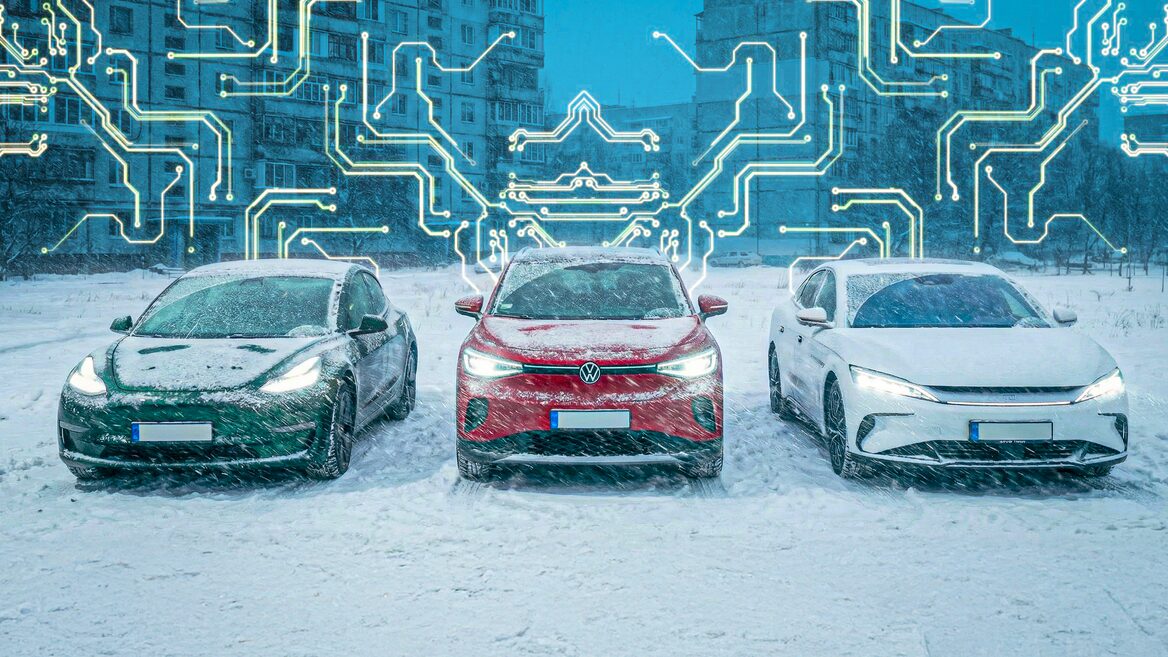
Electric cars in winter — a problem or a solution during blackouts? Real experiences of owners and expert advice on frost, charging and survival without electricity
«Without an electric car, those 45 hours without light would be much bleaker.» Ukrainian developer shows how an electric car can power a house during blackouts