Хочете будувати кар’єру в Data Science та AI? Vodafone Big Data Lab відкриває новий набір —>
Олег ОнопрієнкоІсторії
10 August 2026, 09:00
2026-08-10
From homemade floorboards to five tons of products for the front. As the head of design at Kyivstar, he deployed his own 3D farm
The hum of dozens of coolers merges into one continuous monotonous noise that does not stop for a minute. In this room, despite the abnormal Ukrainian heat, parts that are vitally needed on the front line are continuously being created: from discharge systems to mine shafts. This relentless process is managed by Yuriy Sakhno, the head of the design department at Kyivstar, who in his free time from his main job has become a printer and founder of a powerful volunteer 3D farm.
We tell you how Yuriy's 3D farm works, which grew from a small hobby into a charitable cause that makes a difference on the front lines.
The hum of dozens of coolers merges into one continuous monotonous noise that does not stop for a minute. In this room, despite the abnormal Ukrainian heat, parts that are vitally needed on the front line are continuously being created: from discharge systems to mine shafts. This relentless process is managed by Yuriy Sakhno, the head of the design department at Kyivstar, who in his free time from his main job has become a printer and founder of a powerful volunteer 3D farm.
We tell you how Yuriy's 3D farm works, which grew from a small hobby into a charitable cause that makes a difference on the front lines.
From 20 kilograms to tons of plastic in two years
Yuriy's passion for 3D printing began long before the full-scale invasion. Since 2019, he has been printing trinkets for himself and his family on an old printer. In order not to lug a bunch of boxes onto a plane while traveling with his wife and eight-year-old daughter, he redrawn and printed compact board games himself.
With the beginning of the Great War, Yuriy saw printed periscopes on the Internet, but he did not know how to join the process. The local forces of the Ukrainian Armed Forces then refused his help. The situation changed only in the fall of 2023, when he came across the volunteer community "DrukArmiya". Realizing that his printer would not be able to handle military tasks, the designer ordered a new modern printer, and in May 2024 he got to work.
Yuriy says that at first, newcomers to DrukArmia are entrusted with simple test tasks, for example, machine caps, so that the curators can assess the quality. But Yuriy Sakhno bypassed this stage, writing directly to the management. Then there was a funny overestimation of his own strength.
"I wrote directly to Yevhen Volnov: 'I know how to print, I printed 20 kilograms of plastic.' At that time, over all these years since 2019, it honestly seemed to me that this was a lot. Now it sounds funny, because today I understand that in just one day I can print more than 30 kilograms here. And in general, I have already crossed the five-ton mark. But then, in addition, I worked with capricious ABS plastic, so I was immediately transferred from beginners to a group with complex tasks," Yuriy recalls with a smile.
The birth of the "3D-bimba" and a quest to find the room
The first printer was at home, but due to severe power outages, Yuri had to move it to another room. There, a colleague saw his work. He became interested, bought himself one, and Yuri taught him. Later, another employee joined in. They jokingly called their team of three devices “3D-bimba.”
Automatic parts reset system
When Yuriy set up a system for automatically dumping finished parts, the printers started working around the clock, burning up to 45 kilograms of plastic per month. This resulted in 12–15 thousand hryvnia in expenses. While looking for donated materials, he met a volunteer, Volodymyr, who was ordering large quantities of remote-controlled mines for the 25th brigade.
"Volodya arrived, saw our premises, and I recklessly said: 'I can put 10 printers here.' He said: 'I'll take your word for it!', gave me money, and I bought a fourth printer. Then, with my own money, a fifth. That's how it all started and I got to the eighth," says the founder of the farm.
But the real challenge was finding a new, larger space. State-owned companies, housing offices, research institutes, and businesses demanded crazy rent and electricity bills with all sorts of “tricks.” The math was relentless: eight printers consume over 860 kW per month, and at least 36,000 hryvnias is needed just for plastic.
"I told them: 'Listen, I only have money for plastic for the military, so what do you want me to give you a 'tenth'?" Everyone refused. In the end, there were people who took pity and let us in on friendly terms," Yuriy notes.
OLX hunting and engineering tricks
When I wake up at night from explosions, I lie down and the first thing I do is check my phone to see if the cameras are working properly...
As the farm expanded, the purchasing strategy changed. Instead of new printers for 15,000 hryvnias, Yuriy started looking for used ones on OLX for 4–8,000. They were often sold by people who bought equipment to help the Armed Forces of Ukraine, but simply couldn’t cope with the complex settings, gave up after the first month and put the devices up for sale as almost new.
"There was a person from whom I bought a printer for 8,000. We talked during the transfer, he found out that I had a volunteer 3D farm. Then he returned 4,000 to my card and also gave me about three kilograms of plastic as a gift," Yuriy shares.
Almost finished printing
But buying a printer is only half the battle. Ordinary desktop devices are not designed for continuous conveyor printing. Yuri had to become an inventor. European manufacturers could not even imagine the tasks that Ukrainian volunteers set for their equipment.
“Europeans print some vases one by one. They don’t have the task of dumping the products. I have already developed and installed about the 15th version of a special “dump” on the print head. The part is held on the table only by heat. After printing is complete, the fans turn on, the table cools down, the printer lowers the head and simply knocks the part into the basket. Then it prints the next one.”
I also had to write my own code. PETG plastic, popular among volunteers, is so sticky that when constantly printing in one spot, it leaves a microscopic mark. Over time, the parts simply stick tightly to the table. Yuriy wrote a script that shifts the new model by 1–2 millimeters after each cycle.
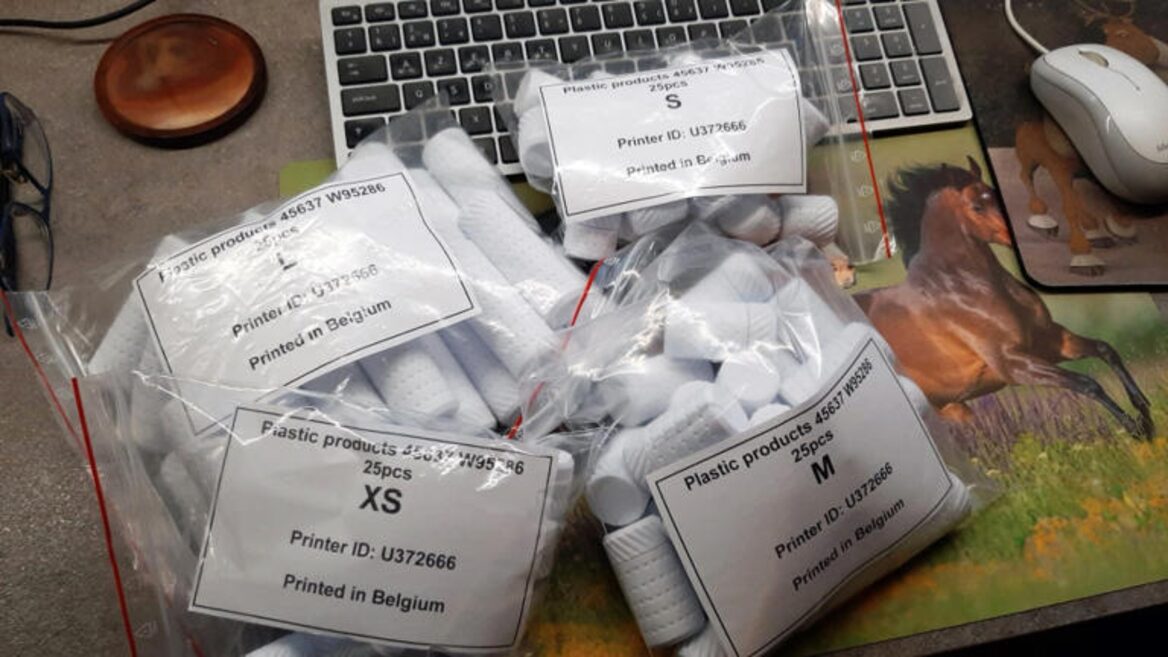
Some of the finished products that will soon be sent to our defenders
Hardware intervention was also necessary. The factory camera mount did not allow for proper control of the print, so Yuriy moved the cameras back. Now he monitors the farm remotely from his smartphone, which has given rise to a new nervous habit.
"When I wake up at night from explosions, I lie down and the first thing I do is check my phone to see if the printers are working properly, if a part is stuck. I scrolled through all 40 pieces, checked if everything was OK, and only then I was like, 'Well, let's see what's gone where'."
The part that Yuriy calls the “cup” drank the most blood. Due to the complex overhangs and small contact area with the table, it did not want to be printed in automatic mode. If you make a weak fit, the part falls off while working. If you press harder, the printer cannot knock it down and breaks it. It took weeks of experiments to select the ideal parameters.
Printers for rent, monetization and inclusion
Our HR technologies are such that as soon as they hear about military personnel, they immediately add them to the stop list.
Maintaining 47 printers requires considerable funds. Understanding how marketing works, Yuriy refused anonymous fees. He communicates openly, under his own name .
"I'm often asked: 'It's dangerous, you're shining your face.' This is a conscious risk. And what is the probability that a missile or ballistics will hit your house? In principle, it's the same as mine. But I'm glad that I'm doing this."
The idea of systemic monetization was suggested by a colleague, Yulia Kotlyar, who mentioned the sensational news about an IT guy from DTEK who founded a startup that rents out chickens with a subscription for eggs . She suggested that Yuri do the same with printers. This is how the “nameplate” option appeared: the donor transfers 4,500 hryvnias (this is the cost of 15 kg of plastic — the average monthly consumption of one printer), receives guardian status and regular photo reports of finished products.
One of the printers with the cartridge plate
Both Ukrainians and foreigners are helping. During the severe blackouts, Pole Stefan financed the purchase of powerful batteries for 1,200 euros. After Yuriy's letters to European manufacturers, the Latvian 3D studio UEP 3D Creative donated 100 kg of plastic. But Yuriy doesn't just raise funds, he builds a community. Yuriy specially sent printed reset systems to one of his regular sponsors, a disabled person named Maksym, via Nova Poshta so that he could put them at home and physically feel his involvement in the cause.
Yuriy is helped directly on the farm by several volunteers. This is a young guy Andriy, who comes for a few hours to fix the equipment, and a 50-year-old demobilized veteran.
"He has a problem finding a job. Our HR technologies are such that as soon as they hear about military personnel, they immediately add them to the stop list. Although you would never tell from this person that he was in the war, unless instead of "yes" he says "plus". I suggested teaching him 3D printing so that it would help him find himself and a new job. So now he comes here and helps the farm a lot," says Yuriy.
The future of 3D printing
In three to five years, half of schoolchildren will have a 3D printer at home, just like a regular inkjet printer now.
Today, more than 90 active orders are open in the DrukArmy system. The front's needs are not decreasing - orders are being placed for batches of 10,000 and even 500,000 pieces. It would seem that an industrial automatic injection molding machine would handle this faster and cheaper, but war dictates its own rules.
“The problem is that a mold for a thermoforming machine costs $10,000. So you make a batch, the military tests it and says: “No, it’s too long, let’s make it smaller.” That’s it. You need $10,000 again for a new mold. And with a 3D printer, I can simply change the model in the program and literally adjust to the needs of the soldiers on the fly,” the designer explains the economy of war.
Yuriy conveys his confidence in the prospects of this craft not only to his colleagues, but also to the younger generation when he conducts career guidance lectures. The technology, which is now literally saving lives, will soon become an integral part of everyday life.
"I tell the children that a 3D printer is a profession that will not be replaced by artificial intelligence in the near future. The technology is still very imperfect and requires human experience: disassembling, assembling, configuring. It is now at the level of a craft. But in three to five years, half of the class will have a 3D printer at home, just like a regular inkjet printer now. Marketing teaches us to be individual, and 3D printing is the perfect tool. This technology will definitely find its niche."
You can support Yuri's 3D farm by donating to his collection in mono or Privat . All funds will go towards the purchase of plastic.
At a college in the Lviv region, future IT professionals and engineers will master a 3D printer that prints with cement mixture. The authorities call it unique