Хочете будувати кар’єру в Data Science та AI? Vodafone Big Data Lab відкриває новий набір —>
Ігор Вишневський Startup
28 October 2026, 09:00
2026-10-28
How to get ChatGPT and Gemini to promote your brand? The co-founder of the startup Rankin AI and large agencies explained why the search for goods and services is going to AI and what to do about it
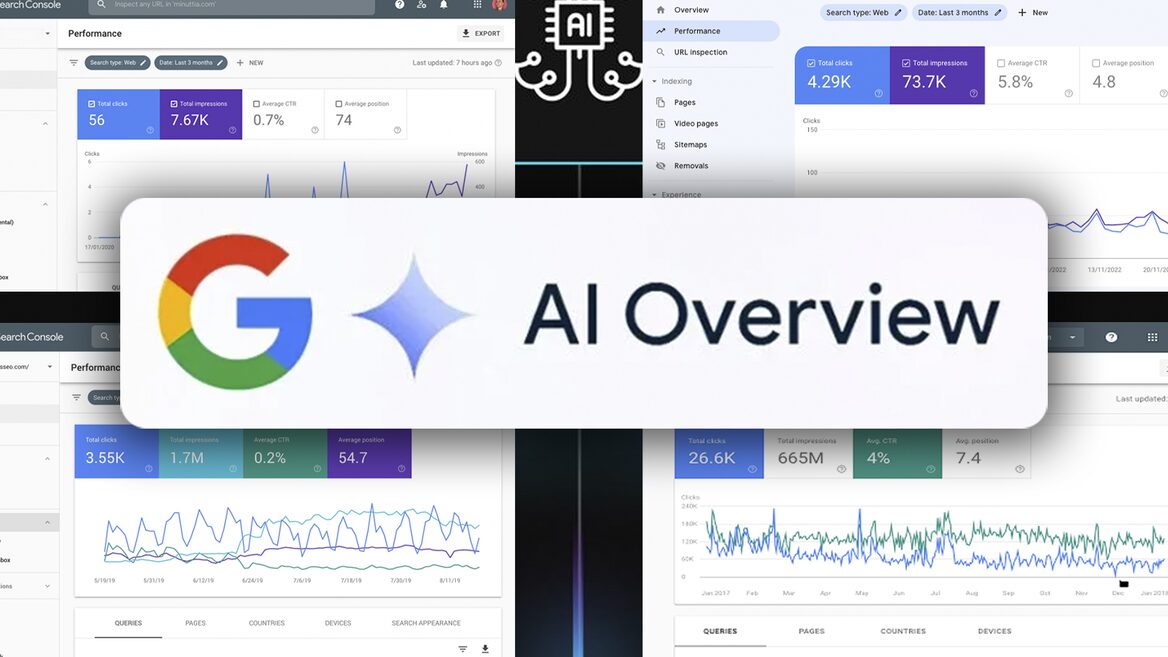
Googling has long been no longer the only way to find the information, product or service you need: today, users are increasingly asking AI about it. Thus, the traditional input of queries into a search engine is partially replaced by an interactive dialogue with artificial intelligence. Moreover, even Google has accustomed us to the so-called Zero-Click Search, because information for a search query appears in the AI overview at the top of Google’s search results. Therefore, a significant part of users are satisfied with this, without going to any external site.
While for years the battle was fought solely to get into the top 10 of Google results through SEO tools, today consumers are increasingly looking for answers and recommendations in ChatGPT, Gemini, Perplexity or another AI tool. That is why GEO — Generative Engine Optimization — is emerging at the forefront of digital marketing alongside traditional SEO.
For brands, this means a new reality: to remain visible in the search space, you need to become part of the answers generated by artificial intelligence. How exactly can you do this? The answer to this question, among others, is offered by Ukrainian startup Rankin AI, which is making its way in the conditions of huge competition in the GEO market.
To talk about the work of the Rankin AI startup and assess its prospects, we spoke with co-founder Nazar Dzyadyk.
We also received comments from those market players — Netpeak, Inweb, Promodo and Lanet CLICK — who have traditionally been engaged in SEO and have now also entered the GEO niche. We were interested in how much demand the GEO service is in compared to traditional SEO, and whether this forces clients who are ready to “invest” in GEO to cut SEO budgets; how difficult it was to enter this fairly new niche and whether the above-mentioned companies use any specific software tools for GEO. This was told to us by Head of Product SEO Department at Netpeak Olena Voskoboynik, COO Inweb Vladislav Naumov, SEO Team Lead at Promodo Vladislav Trishkin and Project Manager Lanet CLICK Nadiya Fetisova.
How startup RankinAI is helping brands become visible in the AI era
Nazar Dzyadyk, co-founder of the startup Rankin AI, which shone brightly at the IT Arena pitching this year and reached the finals, admits that there are a lot of competitors in the GEO market, including among startups.
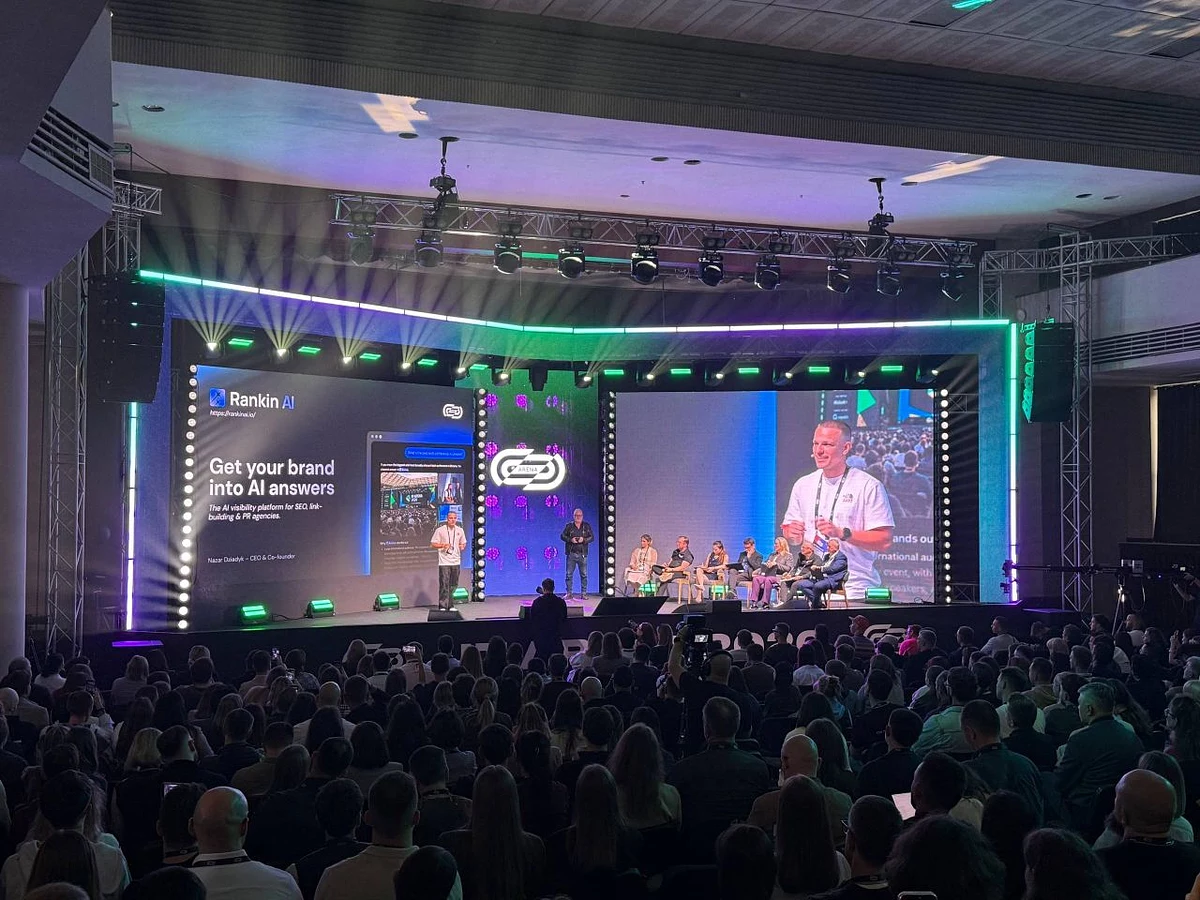
Pitching of the RankinAI startup at IT Arena, photo from LinkedIn by Nazar Dzyadyk
“Some competitors have already raised rounds of hundreds of millions. Others are already worth more than one billion. This is true, but again, what is the positive part of this? This confirms that the market exists. This is necessary. And there will be enough room for many more players who will offer both GEO services and some related services,” he notes in an interview with dev.ua.
Nazar Dziadik is also the co-founder of Growth Kitchen, a SaaS marketing agency that provides SEO services to its clients. Thus, the RankinAI startup was born on a solid foundation. As co-founders of RankinAI, CEO Nazar Dziadik was joined by two other co-founders: CTO Mykhailo Katruk, who is responsible for the technical part of the product, and Sasha Reminny, a well-known investor, serial technopreneur, and author of the YouTube channel “Startup Kitchen”.
“We at Growth Kitchen are engaged in SEO and saw that SEO was starting to lose clicks. We were losing traffic. Clients were losing money. So we realized that we needed to go into AI-visibility,” — Nazar Dzyadyk briefly explains the prerequisites for the emergence of the RankinAI startup.
Nazar claims that not all businesses are using AI optimization yet, but this is temporary, because AI search, in his opinion, will completely dominate in some time. Under such conditions, as the CEO of RankinAI says, we need to look a few steps (and years) ahead and already predict how the situation will develop in the near future.
“The time will come when everyone will be sitting only in AI, everything will be only in AI, potentially even all entertainment will be through AI. And then, as they say, the cancer on the mountain will whistle. But what are we doing? We are not stupid either, so we are not sitting still, and we are not doing exactly the same thing that our competitors are doing now. Not so long ago, we made a mini-pivot in a certain direction. I don’t want to spread this too much in public, but I will say this — we are changing the “battlefield” to where our competitors are not yet,” says the startuper, adding that they are currently looking for a solution that will allow them to “dominate the market in a year or two.”
Currently, the startup RankinAI works with brand visibility in the most popular and mass AI products — ChatGPT, Gemini, Perplexity, Microsoft Copilot, and Google AI Overview.
“We don’t work with Claude that actively, because Claude is used mainly by people from the tech sector who are at an advanced level with AI. It’s not as mass a product as the conventional ChatGPT. But if someone needs Claude, we can add it,” says Nazar Dzyadyk.
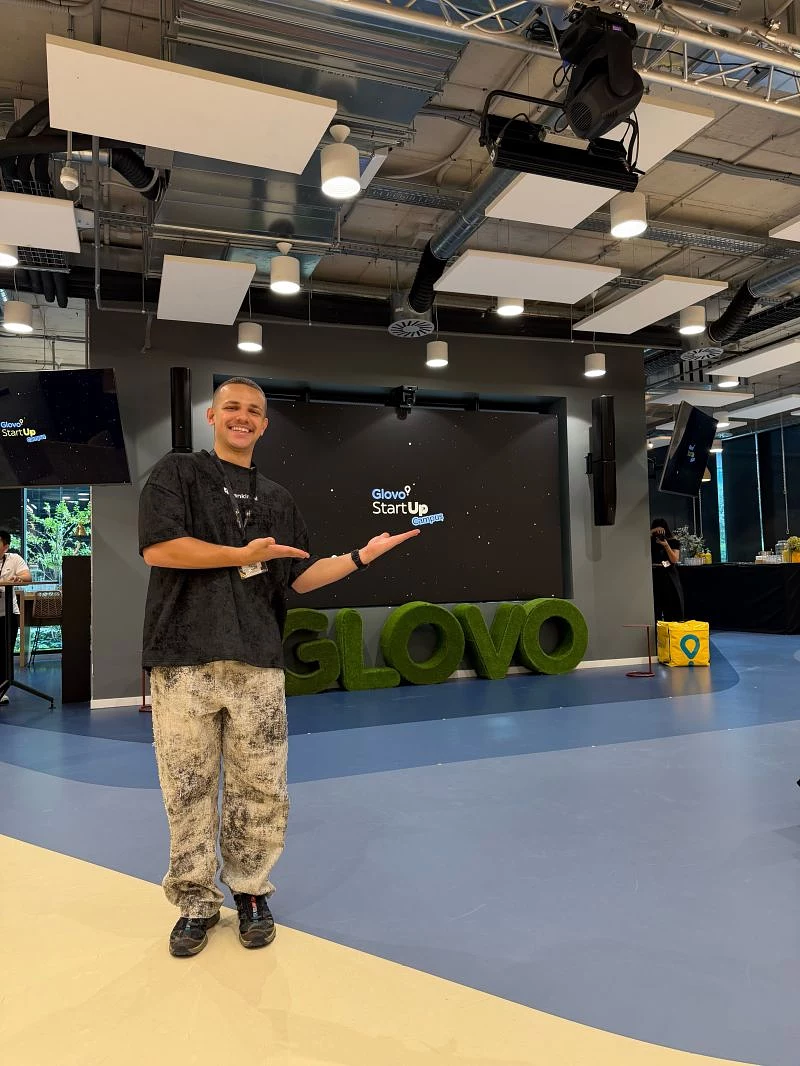
Nazar Dzyadyk at Glovo Startup Campus 2026, photo from his LinkedIn
The startup admits that the basic principles of SEO and GEO are now common, but there are also significant differences. The first of them is that for GEO there is no conventional workbench or some kind of console where you can "track" the results.
“If in SEO you have Google Search Console, where you can go in and look at the numbers, then in AI there is no such thing,” states Dziadik.
As he says, to start “tracking” results by GEO, you need to “set up” your brand, “set up” certain requests from users, the statistics of which you want to study, and only then start collecting information. “Only within a certain period, in our case it will take three to seven days, you will receive insights and you can start working with those insights,” the startuper explained.
Dziadik is confident that AI currently takes most of the results from Google, but it’s only a matter of time before AI starts prioritizing those sites that Google doesn’t prioritize.
“Google is a smart machine, but it has its own problems, which I think AI will fix. By the way, what is interesting is that simple Google Search has different algorithms from Google AI Overview. That is, if in Google Search you can be in first place for a certain query, then in AI Overview it can be replaced by a completely different brand,” he comments.
By the way, Nazar admits that no one currently has a complete understanding of how certain LLM algorithms prioritize brands, except, in fact, the developers of the LLMs themselves.
“Do we understand 100% what and how much it affects? No. Are there any guidelines from the same LLMs? None!”, states the CEO of RankinAI.
Thus, RankinAI’s product performs reverse engineering to understand what specifically influenced the AI response and how. Thanks to this, the startup’s clients can already receive practical advice on their own actions to increase brand visibility in the AI model’s responses.
Nazar explained that RankinAI currently offers separate rates for brands (from $39 to $199 per month) and separate rates for marketing agencies (from $199 to $1,194 per month), which, in turn, work with many brands. RankinAI also offers an annual payment option at a lower price and a free trial period.
“Now our main target is SEO agencies or marketing agencies. Why? We are interested in them bringing more brands and using our solution more actively. Why is it more difficult to work with individual brands? Because it requires a conditional SEO specialist and for this, some knowledge and understanding of basic principles are needed. Not all businesses, especially small ones, have such SEO specialists. That is why we are starting with agencies, but theoretically, some local pizzeria could also use our software,” Nazar Dzyadyk told a dev.ua journalist.
In turn, the startup RankinAI advises SEO agencies on the use of its software, conducts appropriate onboarding, and helps build a work strategy.
“Our main value for the agency is that if you are engaged in purely SEO, then SEO will somehow shine in GEO over time. And if you don’t shine now, then after a while your services will be irrelevant,” says Dzyadyk.
As for the team, the team from the Growth Kitchen agency is primarily involved in the functioning and development of the startup, and its co-founders set an ambitious goal — $1 million ARR.
“Actually, I like to set very ambitious goals, so the nearest goal is $1 million ARR. Well, relatively ambitious is $83,000 per month. For this, we need 420 agencies with a $199 tariff plan. Now we already have three agencies, so we are on track,” Nazar says half-jokingly about the seriousness of these plans.
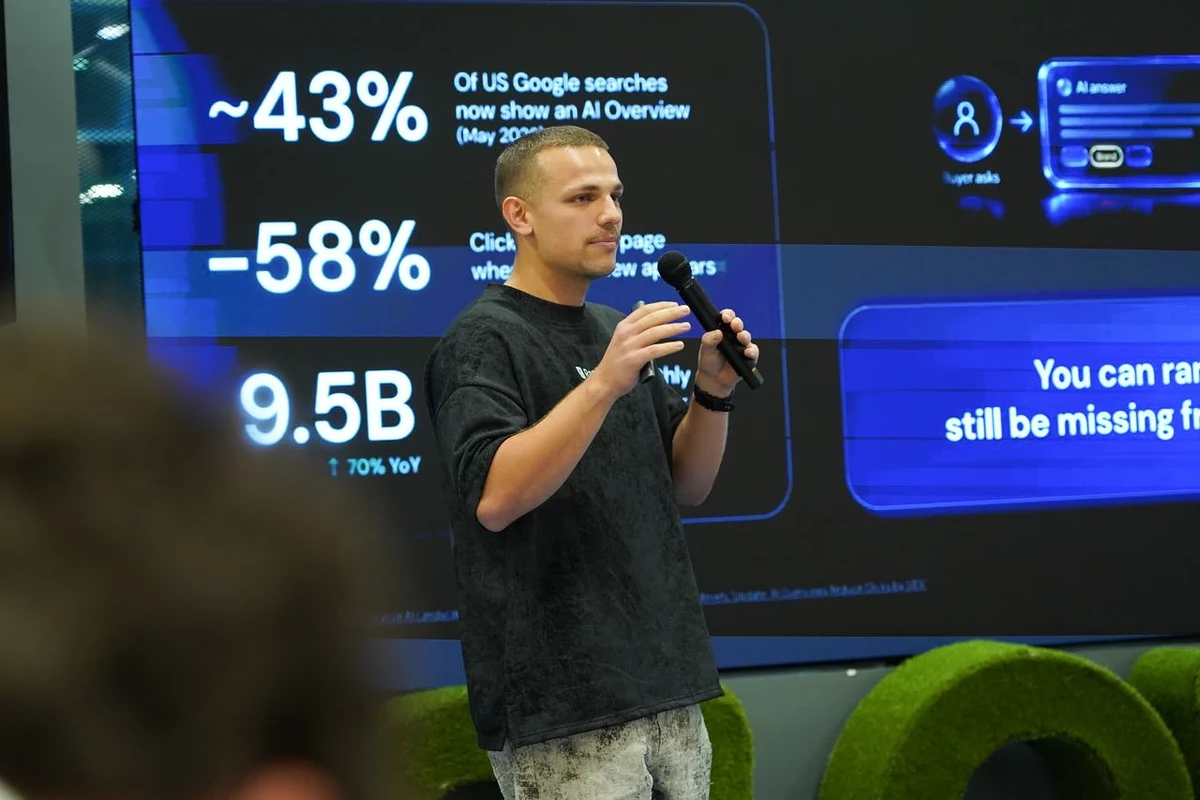
Nazar Dzyadyk presents his startup at Glovo Startup Campus 2026
To this end, RankinAI plans to invest significantly in its own advertising, as well as maximize networking and present the startup at various technology events. At the same time, Nazar once again hinted that he and his co-founders want to “shoot” where the field for competition is not so significant yet.
“There are already solutions on the market that position themselves more for Enterprise. They have a whole sales team, a bunch of investors, and a bunch of connections. So a very logical conclusion suggests itself — is it necessary to compete on a battlefield where you simply have less strength? This is a known loss. Therefore, we choose a battlefield where we will win,” he assured.
How popular is the GEO service: what Netpeak, Inweb, Promodo and Lanet say CLICK
According to Inweb COO Vladislav Naumov, the demand for GEO is currently growing very rapidly. “SEO is still the leader in terms of volume, but GEO has already moved beyond the experimental stage. The share of traffic from AI sources is growing every quarter,” he says.
According to him, companies look at AI assistants not only as a sales channel, but also in the context of business reputation. “It is important for a business that AI knows about it at all, has up-to-date information and correctly describes its advantages. If this is not done, the model will form an idea of the brand from what it finds. And it is not a fact that this picture will be accurate and truthful,” adds Naumov.
He calls the fact that GEO requirements are increasingly appearing in tenders a telling signal.
Olena Voskoboynik, Head of Product SEO Department at Netpeak, says that there is demand for GEO, but, according to their data, about 5–10% of clients order this service separately from SEO.
Head of Product SEO Department at Netpeak Olena Voskoboynik
“More often, we are talking about comprehensive promotion, when part of the budget for organic search is directed to work with brand visibility in AI responses. Medium and large businesses are most interested in this, for which it is important to quickly respond to market changes and not give in to competitors. Such companies are ready to experiment with new areas of promotion,” says Voskoboynik.
She added that Netpeak is testing approaches and offering GEO to those clients for whom they see potential in such work.
At the same time, in her opinion, the economic feasibility of a separate GEO service remains questionable, because in many cases it does not pay off or gives tangible results only for certain types of businesses. “That is why we most often combine SEO and GEO,” states the Head of Product SEO Department.
According to Nadiya Fetisova, Project Manager of Lanet CLICK, their company sees a growing interest in GEO from potential clients, and this area is actively discussed in the market. “More and more companies are interested in how their brand is presented in the responses of ChatGPT, Copilot, Gemini, Perplexity and other AI systems. At the same time, GEO does not currently replace traditional SEO. The share of traffic from AI platforms remains relatively small and strongly depends on the niche. In addition, the market is still forming approaches to assessing the effectiveness and measuring the results of GEO,” the specialist says.
As Project Manager Lanet CLICK says, for now they view GEO primarily as a promising direction and a logical addition to SEO, not an alternative to it.
Promodo agency says they are currently receiving a lot of requests for GEO, both from big brands and new companies and startups. “Everyone understands where search and users are going, and they want to get into LLM recommendations faster than their competitors,” says SEO Team Lead at Promodo Vladislav Trishkin.
In his opinion, GEO is work that needs to be started now in order to get more and more leads from the most promising channel. At the same time, according to him, SEO has “got a second wind” since the beginning of the LLM era, because without high-quality SEO settings, it is ineffective to engage in GEO.
Are SEO budgets being cut for the sake of GEO?
Olena Voskoboynik from Netpeak does not yet see GEO replacing traditional SEO: on the contrary, queries are more often related to comprehensive promotion.
“If a client contacts us about SEO, we can no longer ignore the brand’s visibility in AI responses. Therefore, we include relevant tasks in the proposal and explain how this direction complements traditional promotion,” explains the Head of Product SEO Department.
At the beginning of GEO’s development, she said, the situation was different: clients were interested in the service, but often did not understand how to evaluate its results. “We prepared commercial offers, but mostly received rejections: the business was not ready to pay for an area whose effectiveness is difficult to measure. Now the approach is gradually changing. Clients come with more complex requests and are more attentive to working with visibility in AI,” she shared.
SEO Team Lead at Promodo Vladislav Trishkin says that a typical request from a client today sounds like this: “I want to receive leads from both organic and LLM.” So, according to him, clients are usually not ready to cut SEO budgets because brands are interested in both areas.
“Especially since there is still much more traffic and leads from organics than from LLM. Therefore, the most effective approach is not to reduce current SEO budgets, but to start investing in GEO at the same time: this captures additional leads and works on the channel’s potential,” the specialist explains.
If the budget is strictly limited, then, according to Trishkin, an SEO specialist must determine the criticality of individual vectors and tasks and choose those that will give the greatest effect both in SEO and GEO.
Inweb COO Vladislav Naumov denies that clients are reducing SEO spending for the sake of GEO. According to him, they have only had one such case at their agency, and he calls it an exception.
COO Inweb Vladislav Naumov, photo from Liga.net
“The reason is simple: now there are significantly more sales and applications from Google than from AI. Therefore, brands are not replacing SEO with GEO, but adding GEO to SEO. At the same time, I am sure that the situation will change. So far, relatively few people are searching for goods and services through AI, but their number is growing rapidly,” he predicts.
Naumov says that he himself almost never uses search engines, but searches for everything through AI. “I compare prices and specifications. When I need to buy something that I don’t really understand, AI also helps me choose a product that is right for me. I think that more and more people will gradually do this. So in the future, redistribution of budgets is possible. But SEO and GEO are closely related: you will still have to optimize websites. Whatever they call it, that’s another question,” he notes.
Vladislav Naumov has been working in this field for over 15 years, but claims that even at the beginning of his career as an SEO specialist, he heard predictions that SEO was about to die, and there would be no need to optimize websites anymore. “But these predictions never came true. I think SEO will outlive us,” concluded the Inweb representative.
Project Manager Lanet CLICK Nadiya Fetisova confirms the conclusions of her colleagues — in most cases, brands consider GEO as a complement to SEO. “These areas are closely interconnected, because high-quality SEO remains the foundation for brand visibility both in search engines and in AI-answers,” she notes.
Fetisova believes that if a company has a sufficient budget and understands the value of both channels, it will invest in both SEO and GEO in parallel. At the same time, with a limited budget, some clients may postpone the launch of GEO or test it on a smaller scale.
“We do not consider GEO to be a replacement for SEO. On the contrary, an effective promotion strategy today increasingly involves a combination of both directions,” emphasizes Project Manager Lanet CLICK.
How difficult was it to enter a new niche?
Vladislav Trishkin, SEO Team Lead at Promodo, believes that the main difficulty is the very high dynamics of changes and development of LLM models. He calls measurability the second problem.
“In classic SEO, there are positions, GSC, traffic — you can show dynamics. In AI answers, the result is unstable: the same prompt gives different answers depending on the region, chat history, and model version,” he explains.
SEO Team Lead at Promodo Vladislav Trishkin
Trishkin also shared that the lack of open information about real user prompts also complicates the promotion. “There was very little information at the start, so everything had to be tested and measured on the company’s own websites,” he notes.
Nadiya Fetisova from Lanet CLICK says that their team adapted to the new direction quite quickly, as many of GEO’s principles are based on the expertise that SEO specialists already have: working with content, site structure, source authority, and technical optimization.
“The main difficulties are not so much related to the implementation of GEO, but to the peculiarities of AI search. Unlike classic SEO, there are no established standards for measuring effectiveness here, and the algorithms of large language models change very quickly,” she agrees with her previous colleague.
According to CLICK Project Manager Lanet, from a client perspective, an additional challenge is explaining the value of GEO, its differences from SEO, and setting realistic expectations for results.
Olena Voskoboynyk, Head of Product SEO Department at Netpeak, admits that at the beginning there was a lack of understanding of how language models work and what can be influenced.
“Therefore, I conducted research on the operation of LLM systems, studied the experience of English-speaking markets and the offers of international agencies, and also looked for answers to what exactly the business needed… At that time, there were still few open materials on this topic. Communication with the market also helped me understand what customers were most interested in: how to influence AI responses using content and what approaches in SEO need to be reviewed,” shared Olena Voskoboynyk.
As a result, thanks to her experience in SEO, it wasn’t that difficult to understand the basic principles of GEO. It was much harder, she says, to turn this knowledge into a service with measurable results.
“In traditional SEO, there are indicators by which you can track dynamics: positions, organic traffic, and other performance metrics. In GEO, we also track the presence of a brand in the answers, but by itself it does not yet show how much money this direction brought to the business. The brand is either mentioned in the answer or not, and the connection between such presence and sales is more difficult to establish,” concludes Voskoboynik.
According to her, this creates an additional barrier for business, because companies need to understand what they are spending money on and how to evaluate the result, and in GEO there are still no such established approaches to measuring effectiveness as in traditional SEO.
Inweb COO Vladislav Naumov shares the opinion of his colleagues. “It was not easy at the start, because there were practically no ready-made rules and proven approaches. We still did not fully understand the principles by which AI assistants choose sources for their answers, how to correctly measure results, and what actions to focus on,” the specialist shares.
At the same time, as Naumov says, it quickly became clear that SEO is not going anywhere, and a significant part of GEO work overlaps with traditional search engine optimization.
“The goal of SEO is to make a site respond to a user’s request better than a competitor’s site. AI systems, in fact, also rank sites, and their evaluation logic is quite similar. So the experience of the SEO team became the foundation for us,” he notes.
Among the main difficulties, he names the lack of frequency of requests. “In AI, people formulate questions differently, and there are no statistics on how many times something was asked. Therefore, the list of requests for tracking has to be compiled differently: from real customer questions and business tasks,” says Naumov.
Other difficulties include inconsistent results and the fact that GEO is not suitable for all clients in the same way, depending on the topic and niche. “For some niches, AI has already become a significant source of clients, for others it has not yet. Therefore, we honestly tell clients whether it makes sense to invest in this direction right now in their topic,” Naumov states.
Own and third-party tools for GEO
For GEO, as Project Manager Lanet CLICK Nadiya Fetisova says, they use a combination of classic SEO tools, their own analysis methods, and manual monitoring of results in various AI systems.
Nadiya Fetisova, Project Manager Lanet CLICK
“We separately monitor how artificial intelligence responds to targeted queries, whether it mentions the brand, which sources it cites, and which competitors it recommends. We also test new GEO platforms that appear on the market. The segment of tools for GEO is still actively forming, so it is currently difficult to single out one universal service that would completely cover all tasks.”
At the same time, Inweb, according to Vladyslav Naumov, works with its own tool.
“At first, we made a tool for ourselves. In it, we ran agency projects and saw how client visibility in AI was changing,” says Naumov.
As he says, Inweb later realized that such a tool was useful not only to them, so they released it as a separate product — VYDAI.
What he can do:
shows whether the site is mentioned by ChatGPT, Gemini, Claude, as well as AI Overviews and AI Mode on Google;
conducts a GEO audit: checks how understandable the site is for AI systems and suggests what needs to be fixed;
connects to Google Analytics to see how much traffic and targeted actions come from AI systems;
generates llms.txt on the site for language models.
“The main value of VYDAI is that we use it ourselves every day. Our promotion team works with it, and we add new features based on their feedback. So the product is developed based on real tasks, not assumptions,” says Naumov.
Head of Product SEO Department at Netpeak Olena Voskoboynik shared that they use both their own developments and partner solutions — in particular, they work with Serpstat to monitor brand visibility in language models.
“Their LLM Brand Monitor tool helps track presence in responses from major LLM systems. We use it in our work with clients and, together with partners, develop its capabilities,” says Olena Voskoboynyk.
As she says, Netpeak analyzed the market for such services: there are already quite a few of them, but they have appeared relatively recently, so choosing a solution you can trust is not easy.
“It is important for us not only to receive data, but also to participate in improving the tool, since monitoring requirements change along with the market. From our own developments, Netpeak has a solution for checking the presence of a brand in Google AI Overviews. It allows you to analyze links in answers, as well as the brand’s market share in this type of search results,” says Olena Voskoboynik.
She recalled that the company pays special attention to AI Overviews, as it is part of the Google ecosystem that already influences search behavior. “In our assessment, the impact of this format on the business is now more significant than the impact of the responses of individual LLM systems,” she concludes.
Promodo also has its own tool for GEO — Gelios. According to Vladislav Trishkin, they have their own AI development team, so the company mainly works with internal tools.
“These are dozens of different SEO tools for performing individual tasks and high-quality analytics on large volumes of data. For example, we are already actively using our own Gelios tool. It allows you to track how the visibility of a brand changes in different LLMs: for which queries it appears in the answers, in what context it is mentioned, which competitors are recommended nearby, and how this picture changes over time,” shared the SEO Team Lead at Promodo.
Prospects for RankinAI and other similar startups
All the experts we interviewed positively assess the prospects of Rankin AI or other solutions that are relevant in the GEO market.
“For many companies, AI search is becoming a separate channel that requires its own metrics. The more players appear on the market, the faster businesses realize that visibility in AI needs to be measured as systematically as positions in Google,” says Vladislav Naumov from Inweb.
In his opinion, the prospects in this category of solutions are good, because competition will only push everyone to make GEO products more useful.
According to Vladislav Trishkin, SEO Team Lead at Promodo, Rankin AI and similar solutions have great potential, and it will grow along with the number of LLM users.
“The main value of such tools for the client is not only monitoring current visibility and results, but also a high-quality action plan: what exactly to do to improve visibility in LLM. The niche is working, but very dense: there are “titans” here (like Ahrefs) that have already built AI visibility tracking into their platforms,” says the specialist.
Project Manager Lanet CLICK Nadiya Fetisova also assesses the prospects of Rankin AI and other similar solutions positively, because along with the growing popularity of AI search, the need for businesses to understand their presence in artificial intelligence responses is also growing.
According to Project Manager Lanet CLICK, the advantage of such solutions is not only in monitoring visibility, but also in the ability to receive practical recommendations on improving brand representation in AI search. “The prospects of such products will largely depend on the accuracy of data, the quality of analytics, and the ability to adapt to rapid changes in the generative search market,” she concludes.
Olena Voskoboynik, Head of Product SEO Department at Netpeak, believes that the demand for such services will develop along with GEO.
“However, the main problem with such solutions now is data accuracy. Many services receive information via API. However, the results of such requests may differ from what a person sees when they ask a question to ChatGPT or another language model on their own. Because of this, it is difficult for specialists to confirm to the client that the data in the service fully corresponds to the real output,” she voices the problem.
Olena Voskoboynik reminds that there are solutions that simulate the interaction of a real person with a language model, but their use is more expensive. Meanwhile, businesses are not ready to allocate significant budgets for GEO, so the economics of such services for clients may not converge.
“For Rankin AI and other similar startups, this means that there is demand for their product category, but to gain a foothold in the market, they need to solve the problem of measurement reliability,” says Olena Voskoboynik.
Bot invasion, advertising budget squeeze, and competitive wars. Why the effectiveness of Google advertising in the B2B segment is being questioned and is it really that bad?