Хочете будувати кар’єру в Data Science та AI? Vodafone Big Data Lab відкриває новий набір —>
Марія БровінськаWork
17 February 2025, 09:00
2025-02-17
IdeaSoft is entering the UAE market, where 40 Ukrainians are already working on projects for the state holding. How will such an expansion develop and who is being sought for the team: an interview with the CEO
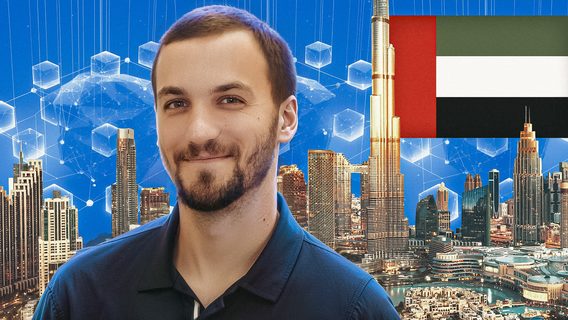
IdeaSoft, part of the Ukrainian-Swedish IT company Sigma Software Group, has entered the market of the United Arab Emirates. And although Ukrainian blockchain specialists have been cooperating with clients from there for a long time, the company’s current plans include multiple scaling and active involvement in projects related to the crypto market and blockchain in one of the most lucrative markets in the world. Within a year, 100 Ukrainian IT specialists will be working on projects in the OAE, while there are currently about 40 of them.
dev.ua spoke with IdeaSoft CEO Andriy Lazorenko about expansion plans and the future of the crypto industry in the world.
IdeaSoft, part of the Ukrainian-Swedish IT company Sigma Software Group, has entered the market of the United Arab Emirates. And although Ukrainian blockchain specialists have been cooperating with clients from there for a long time, the company’s current plans include multiple scaling and active involvement in projects related to the crypto market and blockchain in one of the most lucrative markets in the world. Within a year, 100 Ukrainian IT specialists will be working on projects in the OAE, while there are currently about 40 of them.
dev.ua spoke with IdeaSoft CEO Andriy Lazorenko about expansion plans and the future of the crypto industry in the world.
About the new market
— How long ago did the company enter the Emirates, with what products? Why was this particular direction chosen among many other markets? If I’m not mistaken, it’s the 5th after Ukraine, Poland, Portugal, and the Czech Republic?
Yes, IdeaSoft currently has offices in Ukraine, Poland, the Czech Republic, Portugal, and now we are entering the United Arab Emirates market, and it is in the UAE that we are currently placing people in our clients' offices.
In Poland and the Czech Republic, we operate in a coworking format, where we gather our employees in coworking spaces. In other countries, we have our own physical offices.
We do not yet have a local legal entity in the UAE, but entering the market involves expanding our physical presence by increasing our local team.
— How was the decision to enter this market made? How long did the process take, and what difficulties did you encounter during the entry process?
The United Arab Emirates market has been a consistent presence in our Profit and Loss Statement (P&L) for five years. During this time, we have implemented several commercial projects, but the key result is that we are now actively expanding our presence in the region.
A turning point in our development in the UAE was when we began serving several business verticals of a large state-owned holding group. This company has a capitalization of over half a trillion dollars and a staff of almost 100 thousand employees.
Due to a non-disclosure agreement (NDA), we cannot yet name this holding company, but we will be able to share details soon after completing a number of internal processes.
— Is there an office or other form of representation in the UAE? How many people work there? What do they specialize in?
We don’t have our own physical office in the United Arab Emirates yet, but we use the offices of our client, a holding company, and our employees work there. We have colleagues who fly there regularly, and we are also actively recruiting specialists directly in the UAE to have a team on site.
We currently have approximately 40 employees there, all Ukrainians, 80% of them are technical specialists, 20% are non-technical. But the company is growing rapidly. Our goal is to exceed 100 employees by the end of 2025, who will work on projects in the UAE.
But not all of them are and will be there on a permanent basis: some work remotely and fly in regularly for meetings, and some we hire on the spot right away.
What are we doing there now? We are developing various solutions in the field of blockchain technologies. First of all, we are working on creating a blockchain that will serve as the basis (layer) for tokenization of companies that are part of the holding.
In addition, we are already implementing specific cases in both the public and private sectors within the holding. They cover various areas, including asset tokenization, stablecoin development, regulatory issues, and the creation of the necessary infrastructure.
— What kind of specialists are you looking for there and from what locations?
We are currently looking for local or remote positions in the United Arab Emirates market. These are mainly technical specialists with experience in the blockchain field.
We have a list of vacancies on our website, most of which are for projects in the UAE.
— Besides the state holding company you just mentioned, do you have other clients in the Emirates?
Over the past five years, we have had several clients in the UAE. Most of them were commercial companies that either have offices in the UAE or originate from there. Currently, our main client is a large state-owned holding company, which I mentioned above, and their subsidiaries. We are actively developing within their holding company, acting as a structure that is fully responsible for the blockchain direction in the holding company. Unfortunately, I cannot disclose their name right now, but in the next few months, I think we will be able to do this.
Regarding our areas of activity, we focus on:
The infrastructure level of the blockchain,
Go-to-market products related to tokenization,
Supply chain solutions,
Stablecoins,
Regulations and related regulatory initiatives.
— Can we say that the UAE market is more marginal than, for example, others where you work? What are the peculiarities of working in the region compared to the EU, the USA, and Ukraine?
In the UAE, margin depends a lot on who you work with and how you position yourself. You need to take into account the specifics of the local market related to pricing and delivery. With the right approach, it can be more high-margin. But in general, the most marginal market is still the USA.
About blockchain and the crypto industry
— Given the turbulence on the crypto market in January-February, what do you see as the key problems and prospects for the development of the crypto industry in the world and, in particular, in Ukraine?
The crypto industry has gone through, and to some extent still goes through, a period of turbulence in the formation phase. This is a completely natural process for any industry that is going through a regulatory phase. The prospects, as in any niche that was formed about a decade ago, have significant potential, especially in the field of business and technology. From a technological point of view, we have reached a level where we can create effective business cases and implement the technology correctly. As for the business potential, we will see its disclosure in the coming years.
In particular, given that the US, as a flagship and driver of innovation, has taken a course towards regulating Web3, we see how the Donald Trump administration and his team are actively promoting this direction. They are already working and will continue to work on issues of regulation, implementation and development of technologies. We also have joint initiatives with them in this direction, and we plan to share our expertise with the US government.
As for Ukraine, I believe that this year some legislative act will be adopted on the regulation of cryptocurrencies. This will open the economy to globalization, make it more open and transparent. In my opinion, if properly regulated and properly implemented, this can bring significant benefits to the country.
— Officials promise to legalize crypto in our country this year. Is this realistic according to your forecasts? What could prevent this?
This issue has been discussed for a long time. In general, it seems to me that Ukraine should follow the example of Europe, where MiCA (Markets in Crypto-Assets Regulation) has already been adopted. This is the Regulation on Crypto-Assets Markets, adopted by the European Union to create a single regulatory framework for regulating the cryptocurrency market. The US is also actively working on regulation. Ukraine will most likely follow the same path, and this is a positive step for us.
— Recently, there was news that the Ukrainian crypto exchange KUNA has ceased operations. This is probably due to the fact that there are many schemes in the crypto industry today that allow «spin» gray money. Do you have a recipe for how to whiten the industry and separate it from gambling, shadow circulation of funds, etc.?
We have one of the companies that we created, which is successfully developing both in Europe and the Middle East, and is now also entering the US market. This is the company Global Ledger, which specializes in AML solutions in the field of IT and transaction monitoring. The company’s main activities are analysis of the origin of funds in transactions, investigation of cybercrimes in Web3.
The question of there being many fraudulent schemes in the crypto industry is quite rhetorical.
In fact, it is more accurate to say that similar fraudulent schemes can exist in any financial sector if it is not properly regulated and if the relevant authorities do not have effective processes and tools to monitor, track, and detect illegal transactions.
That is why this is one of the key areas of our expertise. We are engaged in the development of regulatory frameworks, implementation of processes for monitoring transactions and analyzing the origin of funds, as well as the detection of «schematic» transactions and other financial violations.
— As a crypto expert, convince us that cryptocurrency is not a bubble that could burst at any moment.
I think the main indicator is that governments, the institutional sector, and even BlackRock have assets in cryptocurrency — for me, this is one of the clearest proofs that this is not a bubble. The main thing is to use it correctly.
Crypto lifehacks
— What crypto wallets, decentralized exchanges, and other crypto market tools would you recommend using?
I think it all depends on the person’s needs and approach to risk management. It’s clear that by the book, cryptocurrency was created specifically for self-custody, i.e. the use of non-custodial wallets, DEXs (decentralized exchanges) and self-custody solutions. What do I recommend?
Use wallets and exchanges that have been audited by large companies that specialize in verifying smart contracts.
Always do your own research (DYOR).
Make sure the service you are using has an audit and a good reputation.
Custodial vs Non-Custodial Solutions:
Custodial solutions (exchanges, centralized services) greatly simplify the UX (user experience). They work on the principle of banks or neobanks, so they are easier to use.
However, there are risks — the example of FTX, which went bankrupt, shows that custodial services can be vulnerable.
The advantage of custodial services is that they can restore access to the account (key recovery).
But there is also a risk of blocking — for example, if you deposit funds from certain «unwanted» addresses.
Non-custodial wallets (Self-Custody):
Gives you full control over your assets, but cannot recover your keys if you lose them.
For security, it is important to be able to properly store private keys and seed phrases.
So, the choice between a custodial and non-custodial approach depends on your priorities: ease of use or complete control over funds.
— Do you invest in crypto? What tokens do you choose and why?
Of course, we invest in cryptocurrency by choosing tokens from projects that make sense in the medium and long term. It is important that they have a clear unit economy, a properly developed utility model of the token, as well as an effective tokenomics mechanism, in particular the token burning mechanism.
As for short-term investments, I usually don’t get involved in them because I don’t trade. Instead, I focus more on long-term investments.
However, it is important to understand that investing in cryptocurrency is not just about holding tokens. There are a large number of DeFi tools that allow you to increase your profitability, rather than simply keeping assets staking.
Such tools include:
Re-staking protocols,
LRTs (Liquid Restaking Tokens),
LSTs (Liquid Staking Tokens),
Liquidity Providing and other DeFi strategies.
The main thing is to understand the risks and correctly assess the mechanics of each tool.
As for $500,000 Bitcoin? I think it’s quite realistic, but we’ll see. A lot depends on the policies of institutional investors — whether they will accept Bitcoin as an asset or not.
However, overall, in my opinion, in the near term, such a scenario looks quite possible. But, again, this is not financial advice.
— When is it worth buying crypto and when is it not worth buying it? Are you interested in your guidelines?
I believe that every investor should analyze the market on their own (DYOR), based on their strategy and willingness to take risk.
The best time to buy is during a bear market, when asset prices are low.
When it comes to reliable assets such as Bitcoin, Ethereum, or a portfolio of large American crypto projects, as well as tokens that are being prepared or have already been accepted into exchange-traded funds (ETFs) that are supported by institutional investors, they can be purchased at any time if you are looking for the long term.
If your goal is short-term trading, the decision to buy or sell depends on your risk tolerance and the market situation.
The main thing is to have a clear strategy and understand the risks, regardless of market conditions.
«Recently, investors from the UAE have shown interest in our inventors.» Who supports Ukrainian inventors — an interview with the head of the Brave Inventors platform
«Recently, investors from the UAE have shown interest in our inventors.» Who supports Ukrainian inventors — an interview with the head of the Brave Inventors platform