Хочете будувати кар’єру в Data Science та AI? Vodafone Big Data Lab відкриває новий набір —>
Олег ОнопрієнкоRobots
10 November 2026, 09:35
2026-11-10
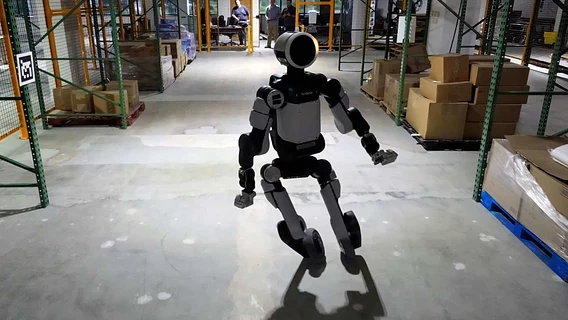
Instead of legs, there are wheels from a scooter. Boston Dynamics engineers taught the Atlas robot to drive using artificial intelligence
American robotics company Boston Dynamics has temporarily modified its new electric humanoid Atlas by replacing its feet with wheels. This is not a preparation for the release of a new commercial product, but a research project aimed at testing the limits of the capabilities of electric motors and artificial intelligence algorithms in real-world conditions.
American robotics company Boston Dynamics has temporarily modified its new electric humanoid Atlas by replacing its feet with wheels. This is not a preparation for the release of a new commercial product, but a research project aimed at testing the limits of the capabilities of electric motors and artificial intelligence algorithms in real-world conditions.
Boston Dynamics control systems engineer Andy Wu shared the details of the experiment on the company's official blog. According to him, it was important for the developers to create a scenario in which the robot's motors would continuously produce high torque and speed under real-world load. Driving on wheels with constant starts, turns and stops was the ideal solution for such stress tests.
The hardware modification turned out to be surprisingly simple. The engineers used only one new part — a special custom adapter that allowed them to attach standard wheels from an electric scooter directly to the ankle-mounted drives. The software adaptation also did not require much effort: in the simulator, the wheels were simply modeled as “ankles” capable of rotating continuously.
The main challenge of the project was to overcome the so-called gap between simulation and reality. Reinforcement learning algorithms are trained in millions of virtual simulations before being loaded into a physical robot. Engineers had to carefully synchronize low-level control parameters and tune virtual motors to match physical measurements precisely, otherwise the AI would try to perform movements that the real hardware is not capable of.
After fine-tuning the simulator, the algorithm figured out how to use the new equipment on its own. For training, the developers used a library of human motion capture data. “Give the algorithm wheels, and it will figure out how to use them,” says Andy Wu. According to him, the robot was even able to perform a 360-degree jump on the first try. At the same time, the AI creatively adapted the movements: where a person would simply slide his feet during sharp maneuvers, Atlas learned to steer and drive through these areas.
Recall that this spring, Boston Dynamics officially retired its famous hydraulic robot Atlas, which became famous for parkour and somersaults . Instead, the company introduced a fully electric version of the humanoid . The new Atlas has become lighter, quieter and has a much wider range of motion. All the data on the operation of the engines obtained during the experiment with wheels, engineers are already integrating into the standard configuration of the bipedal robot to make it more resistant to failures and expand its overall capabilities.
Чатбот від Google заявив інженеру, що живий, а той повірив. Чи загрожує нам повстання роботів
Інженер Блейк Лемуан, що працював у відділі відповідального штучного інтелекту Google і розмовляв з чатботами каже, що одна із систем штучного інтелекту компанії — мовна модель The Language Model for Dialogue Applications (LaMDA) — може мати власні почуття. У червні про це з’явилась стаття у Washington Post.