JetBrains releases Mellum2.1 Instruct programming model that consumes 45% fewer tokens by eliminating “thinking”
JetBrains has introduced a new version of its open-source code generation model, Mellum2.1 Instruct. It is designed for fast code editing, tool calling, and routine tasks that AI agents perform within more complex projects. The main feature of the new model is the absence of a step-by-step reasoning stage, which makes the model faster and more economical than its “thinking” version, Mellum2.1 Thinking.
JetBrains has introduced a new version of its open-source code generation model, Mellum2.1 Instruct. It is designed for fast code editing, tool calling, and routine tasks that AI agents perform within more complex projects. The main feature of the new model is the absence of a step-by-step reasoning stage, which makes the model faster and more economical than its “thinking” version, Mellum2.1 Thinking.
Why abandoning “thinking” is important for AI agents
The original proprietary Mellum model debuted in 2024 for code completion in JetBrains’ IDE. In June 2026, the company released Mellum2 with 12 billion parameters (Mixture-of-Experts architecture) under the Apache 2.0 open license in two versions, Thinking and Instruct. Last month, Mellum2.1 Thinking was released, trained to work at the scale of entire repositories through reinforcement learning (RL), and now the version without the reasoning stage has received the same capabilities. The training used Nvidia’s open libraries NeMo RL and NeMo Megatron-Bridge on an infrastructure of 10,000 simultaneous “sandboxes”.
Gleb Ingman, a representative of the Mellum development team at JetBrains, explained that the model is designed specifically for subagents, tool call loops, and chats. While the Thinking version is better suited for deep analysis (for example, finding the causes of unit test failures), most of the agents' daily work consists of simpler actions - changing a few lines of code or searching for data in the codebase.
"In such cases, reasoning takes time and computational resources without adding quality. This is especially noticeable when running the model locally - each extra token of "thinking" increases the waiting time," Ingman noted.
Testing results and trade-offs
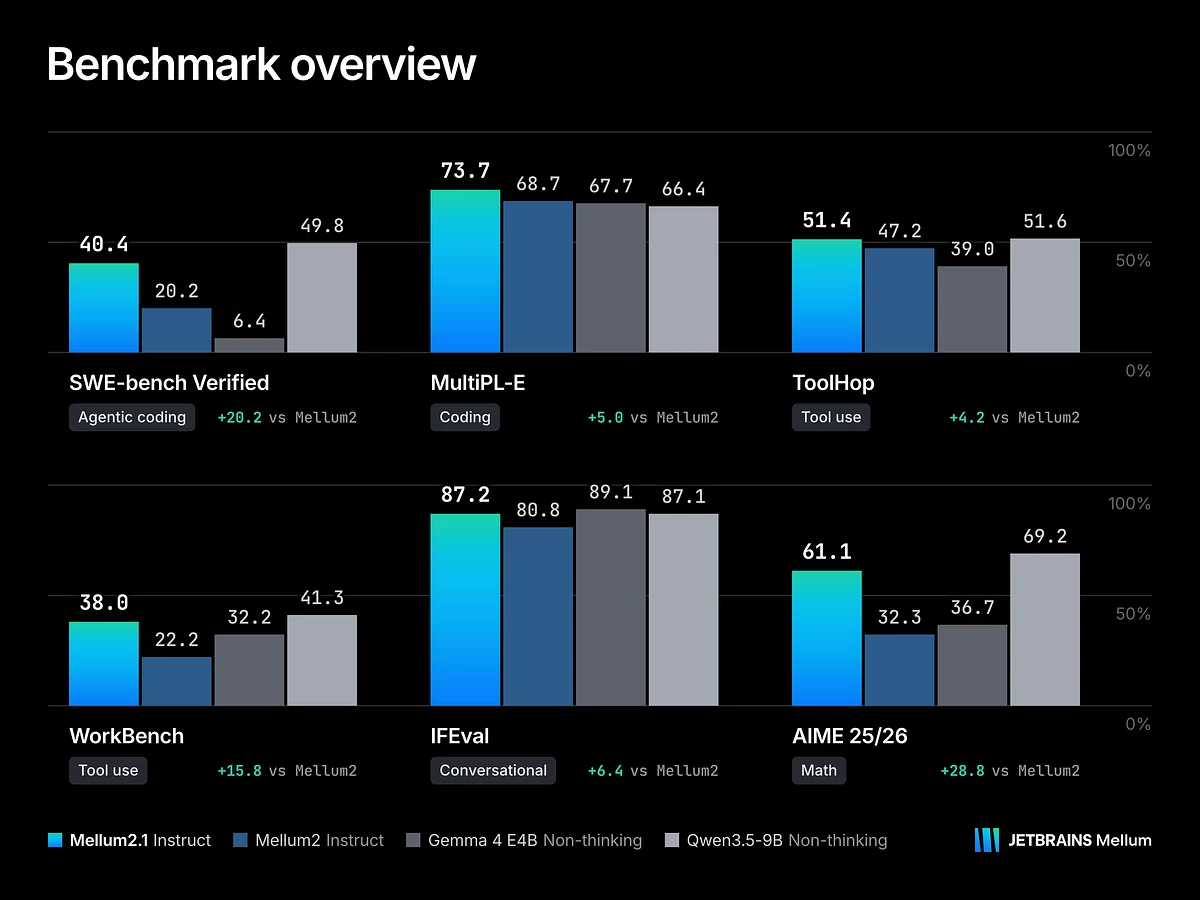
During internal testing, JetBrains compared Mellum2.1 Instruct with its predecessor Mellum2 Instruct, as well as with Alibaba's Qwen3.5 9B and Google's Gemma 4 E4B (with reasoning mode disabled):
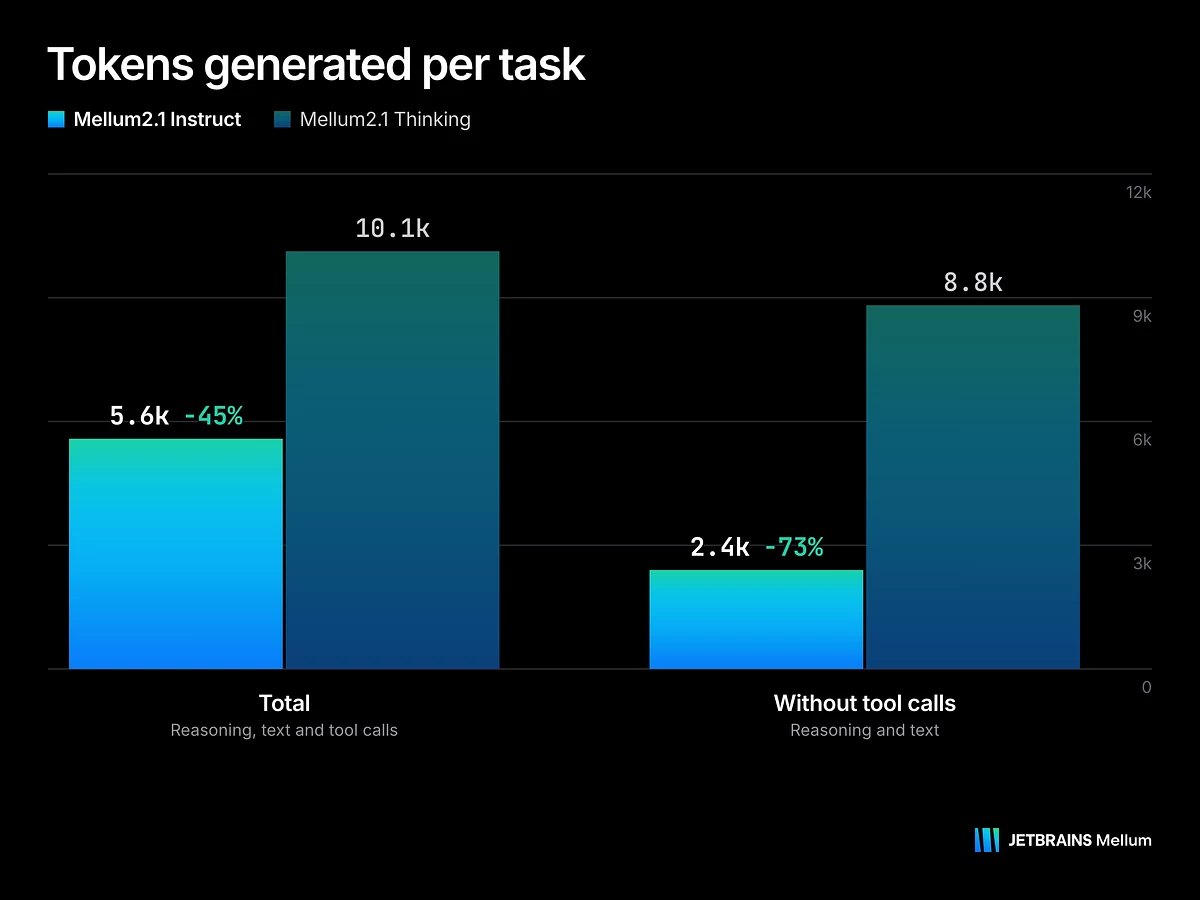
Resource savings: In tasks for AI agents Mellum2.1 Instruct generated an average of 5,600 tokens versus 10,100 in the Thinking version — a 45% reduction. If you exclude tokens for tool calls, the savings reach 73%.
Speed: Thanks to the MoE architecture, the model activates only 2.5 billion out of 12 billion parameters per token, which allows it to generate responses 1.4 times faster than Qwen3.5 9B on single queries and 1.8 times faster under load.
Code quality: on the SWE-bench Verified benchmark, the result doubled compared to the previous version (from 20.2% to 40.4%), although Qwen3.5 9B still outperformed the new version with a score of 49.8%. On the MultiPL-E multilingual code generation test, the JetBrains model surpassed all competitors.
Limitations: on complex algorithmic and mathematical tasks (in particular LiveCodeBench and AIME), the model is significantly inferior to the Thinking version, for which step-by-step reasoning remains critically important.
Accessibility
Mellum2.1 Instruct is now available on the Hugging Face platform under the Apache 2.0 license, including a version in GGUF format for local execution on devices with limited RAM. Along with the model, the company has released a multi-token prediction (MTP) module that speeds up generation by up to 1.8x.
The release comes amid active development of JetBrains' own agent tools — including an updated Air environment for working with multiple coding agents and the Junie local agent. At the same time, the company has not yet specified whether it plans to integrate Mellum2.1 Instruct directly into its own commercial products.
Як нейромережі бачать вільну та незалежну Україну? Тест dev.ua
Нейронні мережі для генерації зображень бачать світ по-своєму, їхню логіку зрозуміти часом зовсім неможливо. Але таки хочеться. На честь Дня Незалежності України редакція dev.ua вирішила провести невеликий експеримент.
Ми задали чотирьом різним нейронним мережам п’ять однакових запитів: «прапор України», «День Незалежності України», «український Крим», «перемога України» та «українці». Отриманими результатами ми ділимося з вами нижче.
У TikTok тепер можна генерувати фон за допомогою нейромережі. Ми протестували її та ділимося результатами
У TikTok з’явилася нова функція «Розумний фон». З її допомогою як фон для тіктоків можна підставляти згенеровані нейромережею зображення. Редакція dev.ua протестувала цю технологію і ділиться своїми враженнями.
Ukrainian sellers on foreign marketplaces will not be able to pay personal income tax at the 10% rate provided for by the law on digital platforms: what is the reason and what is the solution?
"Tired of AI tools trying to be a designer instead of me": Ukrainian Senior UI/UX Designer launches his own AI editor. How is module.build different from Figma and Paper?